


Why the race for AI, power and strategic materials is colliding with the global debt problem
The AI boom is not happening in the cloud. It is being built with debt, electricity, copper, chips and rare-earth magnets. That physical arms race is arriving just as governments need to refinance record debts—and China controls many of the industrial bottlenecks.
THE SIMPLE VERSION
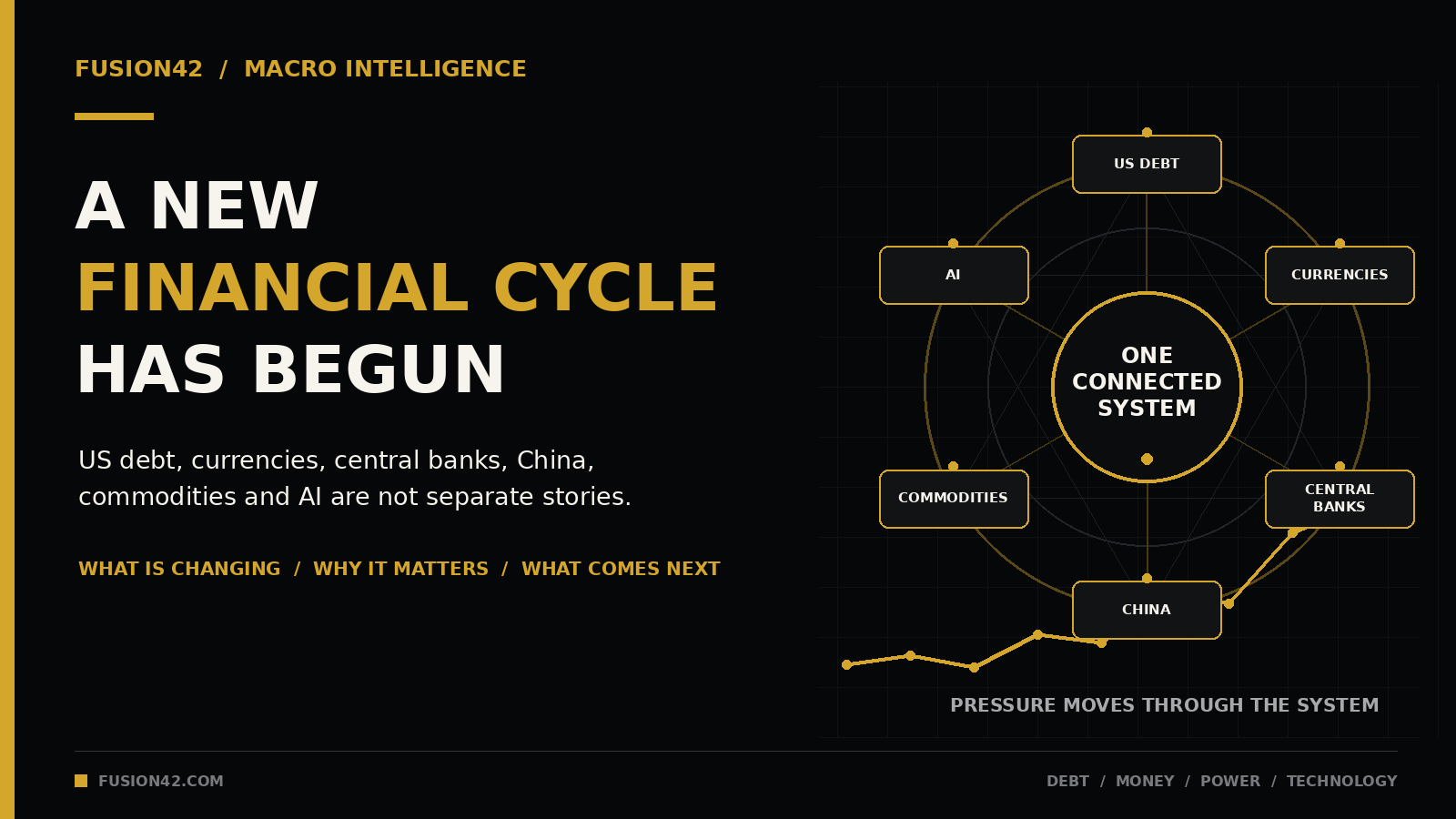
Governments across the developed world need to borrow more just as inflation is stopping central banks from making money cheap. AI is adding another vast demand for capital, electricity, copper and strategic minerals. Japan is being squeezed by its currency, Europe by issuance, and America by debt and refinancing. China has weak domestic demand but controls critical processing and magnet supply chains. Oil is the accelerant. Gold and Bitcoin are the market’s vote against the policy mix.
THE OVERLOOKED MACRO SHOCK
AI can eventually make goods and services cheaper. Building it is inflationary first. Technology companies are competing with governments for capital, with households for electricity and with industry for copper, transformers and strategic minerals. China’s control of refining and magnets turns that commodity squeeze into geopolitical leverage.
This week’s market message
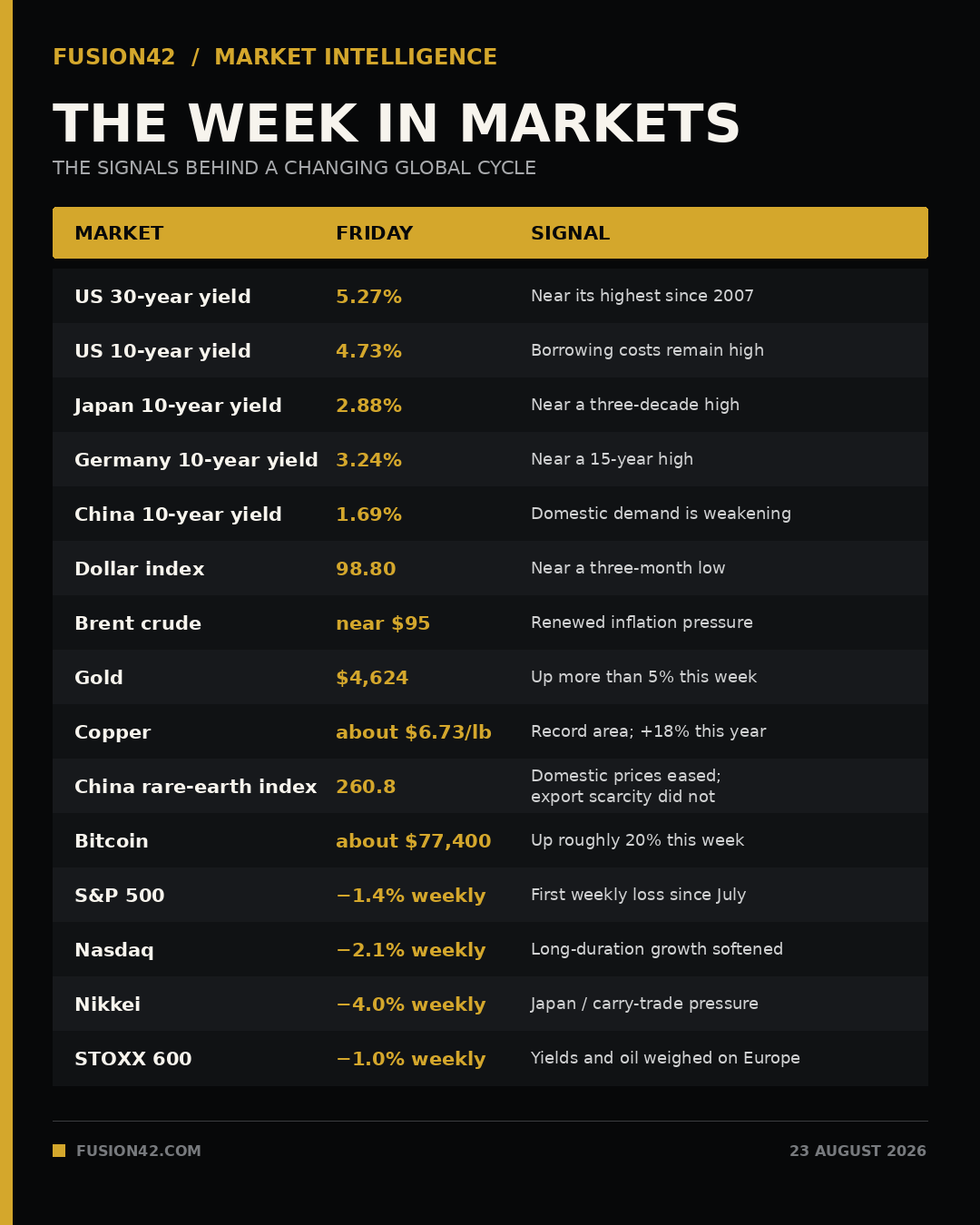
The clearest signal was not any single price. It was the combination: long-term government yields remained near multi-decade highs, the dollar fell, oil rose and monetary alternatives rallied. Normally, higher US yields support the dollar. When yields rise and the dollar falls together, investors are asking for more return because they see greater fiscal and inflation risk—not because American growth is suddenly stronger.
The AI–China–commodity chain
This is the layer that connects the technology boom to bonds, inflation and geopolitics. AI infrastructure creates a new buyer for capital and physical resources while China controls much of the processing needed to turn those resources into usable components.
THE STRATEGIC CONTRADICTION
America leads much of the AI stack, but China controls many of the physical inputs required to scale it. The competition is no longer just about models and chips. It is about capital, grids, copper, processing, magnets and power.
1. The bond market is repricing the developed world
For most of the past fifteen years, governments could borrow heavily because central banks held rates near zero and bought bonds. That regime has ended. Inflation is higher, central banks are no longer absorbing the same amount of debt, and governments are issuing more to fund deficits, defence, energy security, ageing populations and infrastructure. At the same time, technology companies are borrowing vast sums to finance AI infrastructure.
The result is simple supply and demand. More bonds are being sold, while the largest dependable buyer—the central bank—is stepping back. Private investors will still buy, but only at a price. That price is a higher yield.
WHY IT MATTERS
A higher government yield becomes the base rate for the rest of the economy. Mortgages, corporate debt, project finance and equity valuations all become more expensive.
2. America is the centre of the refinancing problem
US gross federal debt has passed $40 trillion. The more important point is not the headline number by itself; it is the speed at which old debt must be refinanced and new deficits funded. Treasury has deliberately issued heavily at the short end, using bills rather than locking in today’s long-term rates.
That swaps duration risk for refinancing risk. Short bills barely move in price when long yields jump, so the balance sheet looks less sensitive today. But those bills mature quickly. If rates stay high, the interest bill resets within weeks or months rather than years.
Using the estimate that roughly $6.45 trillion must be refinanced before year-end, every additional basis point paid across that amount adds about $645 million to annual interest expense. That is an approximation—the debt will mature at different points and different yields—but it shows the scale. A move of 50 basis points is roughly $32 billion a year.
Treasury showed its pain threshold
When the 30-year yield reached 5.34%, Treasury announced that selected long-end buybacks would double from $2 billion to at least $4 billion per operation between September and November. The 30-year yield initially fell to about 5.19%, then returned to roughly 5.27% by Friday.
The buyback is not QE. Treasury is exchanging one form of government debt for another, not creating money through the Fed. It can improve liquidity and reduce long-bond supply, but it does not reduce the deficit. If the purchase is financed with more bills, it shortens the debt profile and increases future refinancing exposure.
The operation is also small beside a $32.2 trillion Treasury market. Its importance was the signal: Washington revealed that a 30-year yield around 5.30% is politically and financially uncomfortable. Markets test visible pain thresholds.
3. Japan is the pressure point
Japan spent decades with near-zero rates. Its banks, insurers and investors therefore placed capital abroad, while global funds borrowed cheap yen to buy higher-yielding assets elsewhere. That is the yen carry trade.
Now Japanese inflation is rising, oil is expensive and the yen remains weak. The Bank of Japan is under pressure to raise rates. Its 10-year yield ended Friday around 2.88%, the 20-year near 3.76% and the 30-year around 4.06%. Those are enormous changes for a system built around almost-free money.
Higher Japanese yields make domestic bonds more attractive. They also make borrowing yen more expensive. Japanese capital has more reason to return home, while leveraged investors have more reason to close carry trades. Closing the trade means selling the foreign asset and buying back yen. That can hit US Treasuries, technology shares and other risk assets at the same time.
Why the Fed’s FIMA facility matters
If Japan needs dollars to defend the yen, it could sell part of its large Treasury portfolio. FIMA offers a bridge: Japan can temporarily pledge Treasuries to the Fed and receive dollars rather than dumping the bonds into the market. It can then sell those dollars and buy yen.
That protects the Treasury market from forced selling in the short term. It is a secured, reversible loan—not automatic QE. The concern starts if seven-day funding is repeatedly rolled, expanded or treated as permanent. At that point, temporary liquidity support becomes ongoing official balance-sheet support.
JAPAN’S DILEMMA
Raise rates and risk unwinding the carry trade. Hold rates down and risk further yen weakness, imported inflation and more intervention.
4. Europe has the same disease with different symptoms
Europe is not being singled out by the market; it is suffering from the same global repricing. Germany’s 30-year yield reached about 3.79%, its highest since 2011. French 10-year yields moved above 4.1%, while long French yields approached 5%. Italy and the UK face the same refinancing pressure.
Germany is loosening its old fiscal rules to fund defence and infrastructure. Euro-area governments are borrowing more for defence, healthcare and ageing populations. Record German issuance is expected, while the European Central Bank is allowing bonds on its balance sheet to mature rather than replacing them. More supply is therefore being pushed onto private investors.
The ECB faces an awkward split. It must control inflation across the whole bloc, but higher yields hurt highly indebted countries much more than Germany. If it supports the weakest sovereign markets too aggressively, it risks appearing to finance governments. If it does too little, spreads widen and the euro area fragments.
5. China is moving in the opposite direction
China is the major exception. Its five-year government yield is around 1.39% and its 10-year yield near 1.69%, a 13-month low. While developed-market yields are rising because governments need more money and investors fear inflation, Chinese yields are falling because households save heavily, private credit demand is weak and the economy is struggling to generate enough productive domestic borrowing.
That is useful for Beijing: it can finance stimulus and infrastructure more cheaply than the West. It also gives China room to use fiscal policy while other governments are being disciplined by bond markets. But crashing yields are not proof of effortless strength. They also signal weak consumption, poor loan demand, pressure on banks and lingering property problems.
China could buy higher-yielding US, European or Japanese debt, but the decision is not purely about return. It must also consider currency risk, sanctions and the danger of holding reserves inside a system Washington can weaponise. That is why China is likely to diversify selectively: some foreign bonds, more gold, more renminbi trade settlement and more financial infrastructure outside the dollar system.
6. How the AI–China commodity shock works
AI is usually discussed as software, productivity and company valuations. The immediate build-out is far more physical. Data centres require land, grid connections, transformers, cooling systems, gas turbines, advanced chips and large amounts of copper. High-performance motors, power systems, semiconductors, aerospace and defence also depend on rare earths and other strategic minerals.
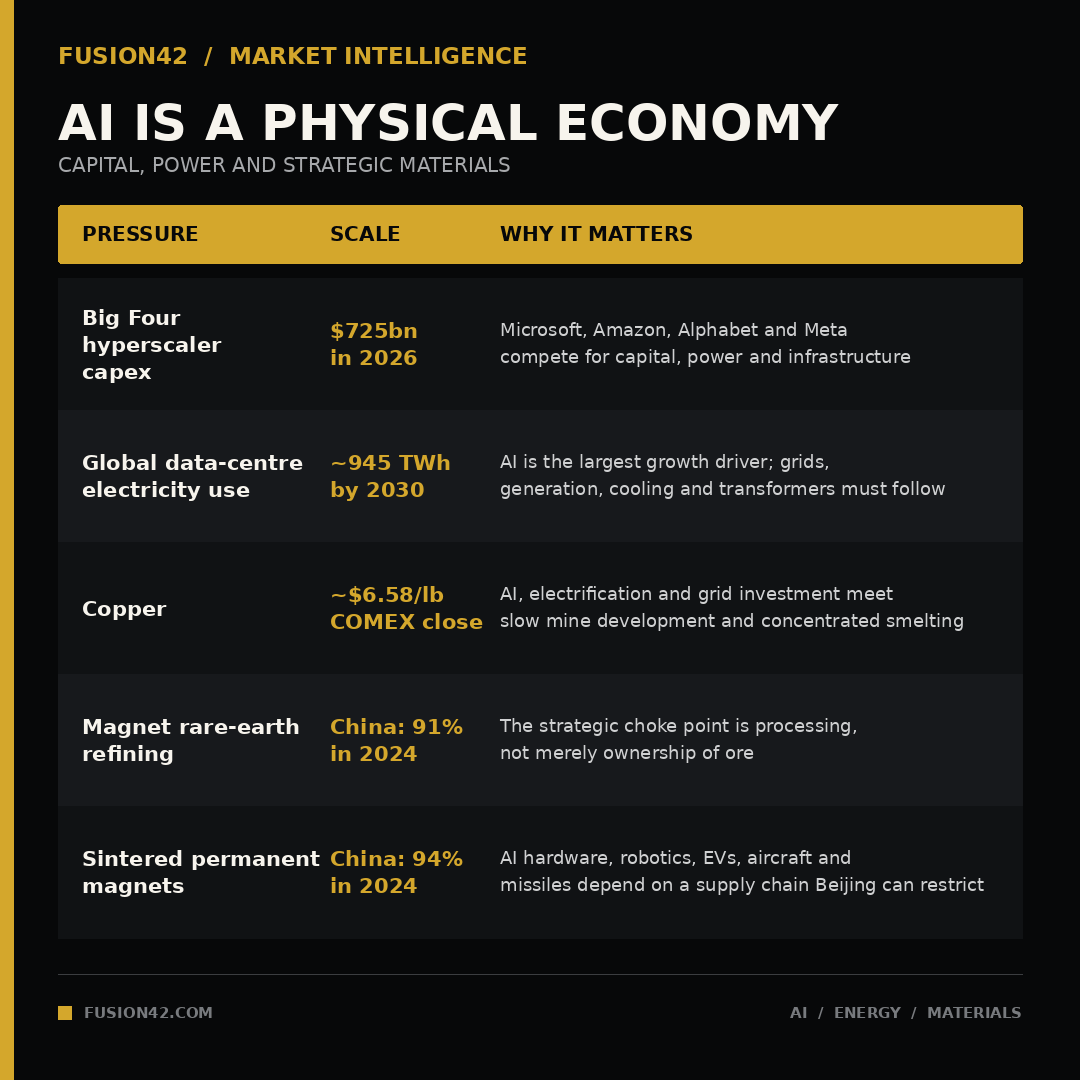
The largest US technology companies are expected to spend about $725 billion on AI-related capital expenditure in 2026. Alibaba has just proposed raising roughly $10.2 billion for chips, infrastructure and models. Nebius raised $5 billion through convertible bonds for data centres and AI capacity. This money does not come from nowhere. AI companies are competing with governments, utilities and industry for the same capital. That adds corporate issuance to an already crowded bond market.
Power is the first bottleneck
The International Energy Agency expects global data-centre electricity use to more than double to around 945 terawatt-hours by 2030—slightly more than Japan consumes today. Data centres are expected to account for nearly half of US electricity-demand growth this decade. That means more grids, generation, storage, gas and nuclear investment. It also means higher power prices where infrastructure cannot keep up.
AI can be highly deflationary once it raises productivity. Building the infrastructure is inflationary first. It absorbs capital, skilled labour, energy equipment and commodities years before the full productivity benefit arrives.
Copper is the clearest broad commodity signal
Copper traded around a record $6.73 per pound this week and is up more than 18% this year. AI data centres, grid reinforcement, renewable generation and electrification are all increasing demand while new mines take years to permit and build. The IEA still projects a copper supply gap of roughly 25% by 2035 based on announced projects. China also controls about half of global copper smelting capacity, so the vulnerability is not only in mining; it sits in processing.
Rare earths are a geopolitical price, not one market price
Rare earths do not trade on one transparent global exchange like copper. There are different oxides, metals, alloys and magnets, often sold through bilateral contracts. China accounted for about 60% of magnet rare-earth mining in 2024, 91% of refining and 94% of sintered permanent-magnet production. The real leverage sits in separation, refining and magnet manufacturing—not simply in owning ore.
That has created two markets. China’s domestic rare-earth price index fell to 260.8 in August from roughly 310 in March, and its NdPr oxide benchmark dropped about 12% from July. Yet controlled heavy rare earths remained dramatically dearer outside China. Indicative August transactions put terbium oxide near $990–$999 per kilogram inside China against roughly $3,625–$4,500 outside; dysprosium showed the same divide. These are opaque bilateral prices, but the message is clear: export licences and political access can matter more than the domestic commodity quote.
China increased some yttrium and permanent-magnet shipments to the US ahead of trade talks while continuing to restrict dysprosium and terbium exports to Japan. That links the AI and mineral story directly to the yen and carry trade. China can apply industrial pressure to Japan without selling a single Treasury.
THE STRATEGIC EDGE
America leads much of the AI stack. China controls many of the physical inputs needed to scale it. The next phase of the contest is therefore about grids, copper, processing, magnets and power—not just models and chips.
Western governments will respond with subsidies, price floors, strategic stockpiles and domestic processing. Those policies improve resilience, but facilities outside China can cost 20% to more than 150% more to build and roughly 50% more to operate. Supply-chain security therefore adds another layer of spending, deficits and inflation to the global debt problem.
The coercion trap
The proposed US MATCH Act shows how technology controls feed back into this system. If enacted, it would give allied supplier countries such as the Netherlands and Japan 150 days to align their semiconductor-equipment controls with Washington. If they did not, the United States could extend its jurisdiction over foreign machines containing American technology and restrict both sales and servicing in China. The bill is not yet law, but it advanced from the House Foreign Affairs Committee by 36 votes to eight.
The short-term security logic is clear. American export controls achieve little if Dutch or Japanese suppliers can provide the same essential equipment. But forcing an ally to restrict its own national champion carries a strategic cost. China represented 29.1% of ASML’s total net sales in 2025, and the Dutch government has formally objected to the proposed law’s extraterritorial reach.
Each restriction gives China another reason to accelerate domestic lithography, retaliate through rare earths and redesign supply chains around non-American technology. It also gives Europe and Japan an incentive to remove US components from their own products so that Washington can no longer control where they are sold. The policy can slow China today while weakening the network of dependence and trust on which American power rests tomorrow.
AMERICA IS SPENDING ITS POWER
America is using its dominance to slow China today. But every time it coerces an ally, it gives the world another reason to build a system that America cannot control tomorrow.
7. Oil is the accelerant
Brent ended the week close to $95 as the Iran conflict and uncertainty around the Strait of Hormuz kept supply risk elevated. About a fifth of the world’s oil and liquefied natural gas normally passes through the strait. Higher energy prices feed directly into transport, food, manufacturing and household bills.
This matters because governments need lower yields at the exact moment oil is pushing inflation higher. Central banks cannot cut aggressively into a fresh energy shock without risking their credibility and currencies. The US threat of tougher sanctions on Iran may increase economic pressure on Tehran, but it also raises the oil and inflation risk facing the US Treasury and the Fed. One arm of policy is working against the other.
8. Every major central bank is trapped differently
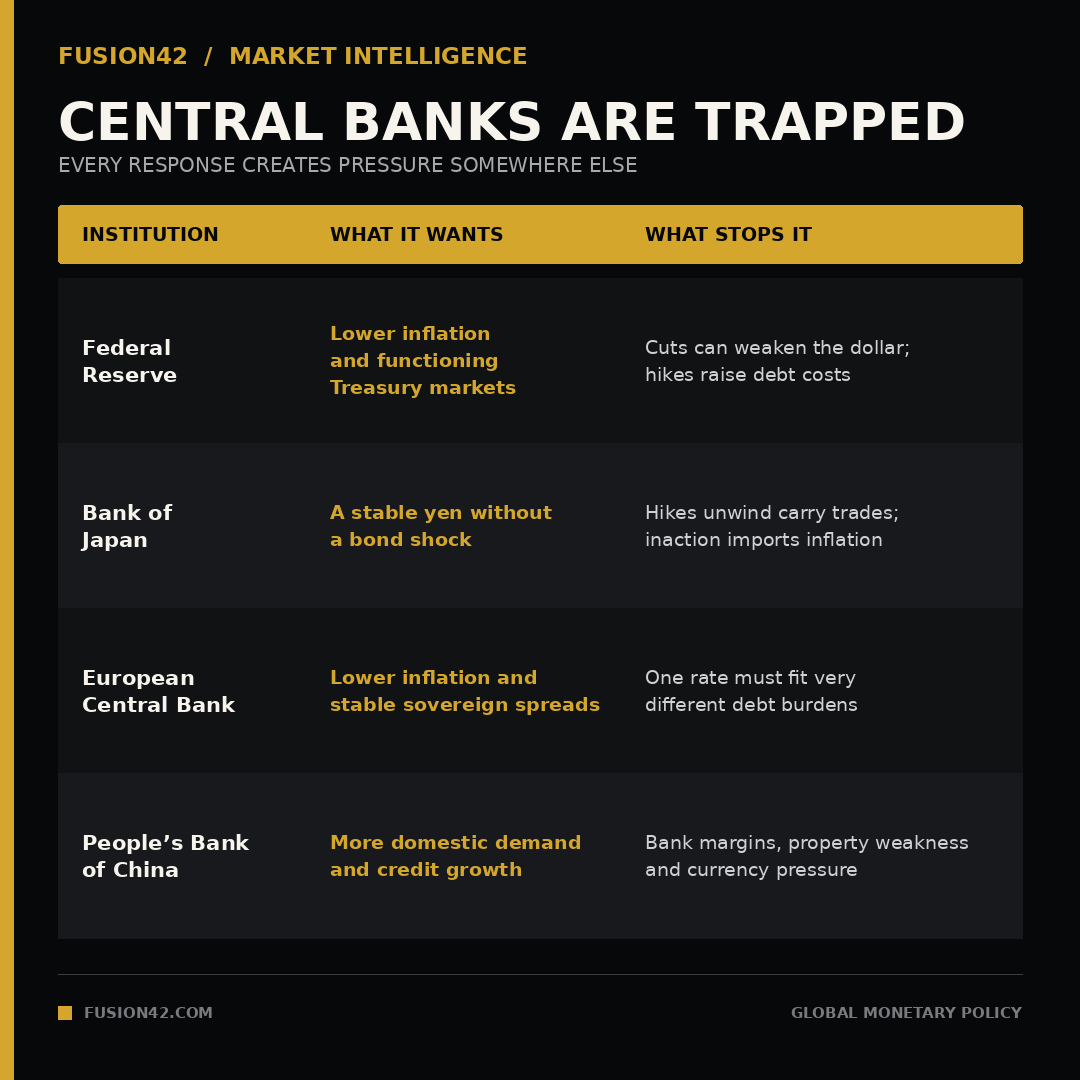
This is why the world feels unstable. There is no single interest-rate policy that solves the problem. Each central bank can remove pressure from one part of the system only by moving it somewhere else.
9. This is a dollar unwind—not yet ‘Sell America’
A true Sell America event would mean the dollar, Treasuries and US equities falling together in disorderly fashion, with poor auctions and damaged market liquidity. We are not there. US shares rose on Friday, buyers still appeared at auctions and Treasuries continue to trade normally.
But the trade is spreading. The dollar fell nearly 1% over the week while long yields remained high. Gold rose more than 5%, silver finished near $69.62 and Bitcoin had its strongest week in roughly two and a half years. Investors are not abandoning America. They are reducing the amount of unhedged confidence they place in the dollar and nominal government debt.
What reserve managers are actually doing
Central-bank balance sheets show a gradual diversification rather than a sudden flight from the dollar. The dollar’s share of disclosed global foreign-exchange reserves has fallen from about 71% in 1999 to 57.13% in the first quarter of 2026. But it rose from 56.42% in the previous quarter and has been broadly stable near current levels since 2022. The direction is clear; the pace is slow.
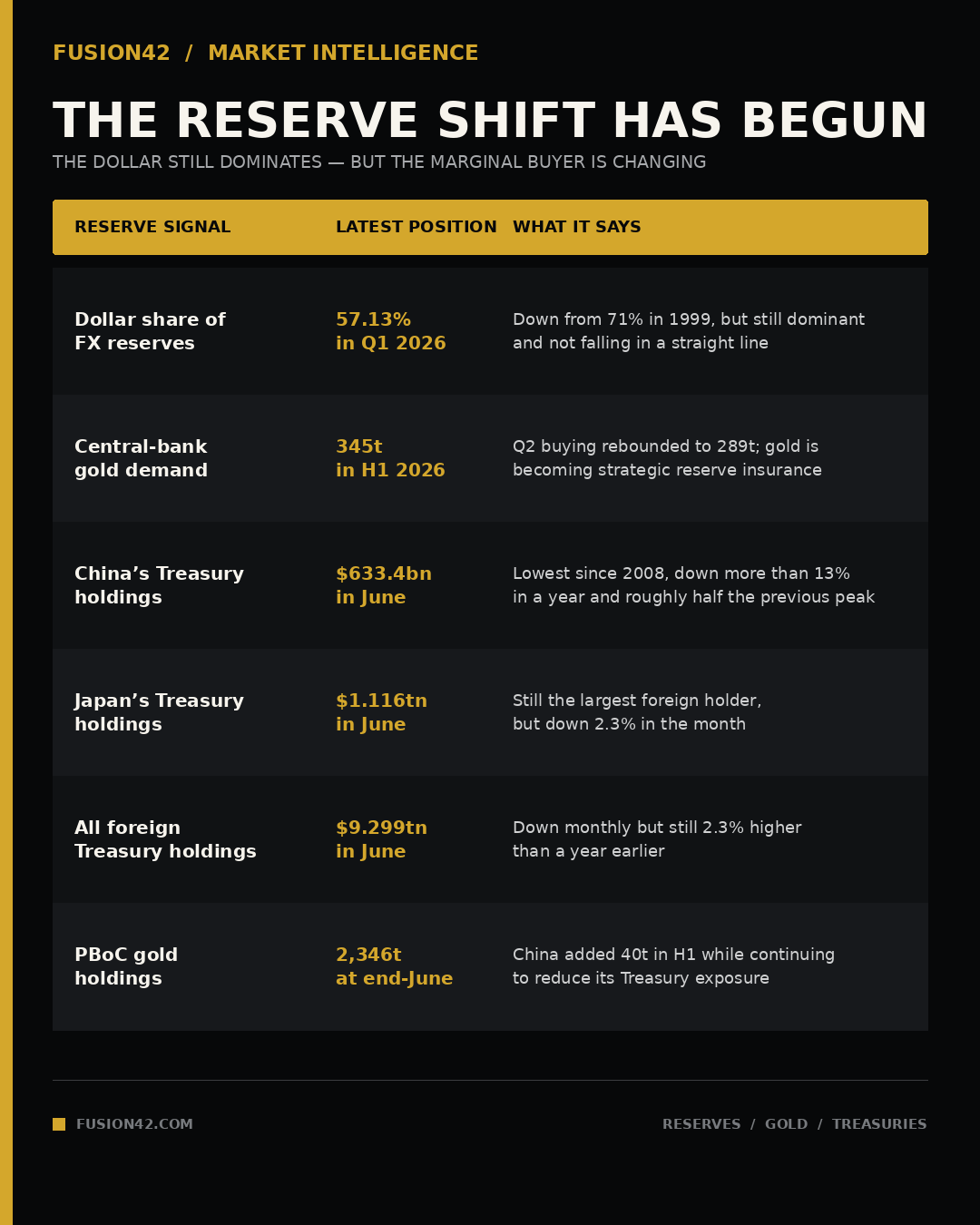
The ownership mix matters as much as the total. Foreign private investors still buy American assets, including record amounts of US equities, while foreign official institutions have become less reliable Treasury buyers. The United States is therefore becoming more dependent on domestic investors, private foreign capital and leveraged market structures rather than reserve managers whose demand was traditionally less price-sensitive.
DE-DOLLARISATION HAPPENS AT THE MARGIN
The dollar does not need to be replaced for US borrowing costs to rise. Reserve managers only need to direct less of each new dollar into Treasuries and more into gold, other currencies or domestic assets. With Treasury issuance expanding, a weaker marginal buyer matters long before the dollar loses reserve status.
Why gold is the cleanest signal
Gold has no issuer, no refinancing calendar and no promise from a government. It benefits when real confidence in currencies and sovereign debt falls. Bitcoin expresses a similar idea with much greater volatility and technology risk. Silver also carries industrial demand, so it is a less pure monetary signal.
Equities can still rise in nominal terms. Companies with pricing power and real cash flow can pass on inflation. The danger is that persistently high real yields eventually reduce valuations and make financing harder—especially for businesses dependent on cheap capital.
10. The feedback loop
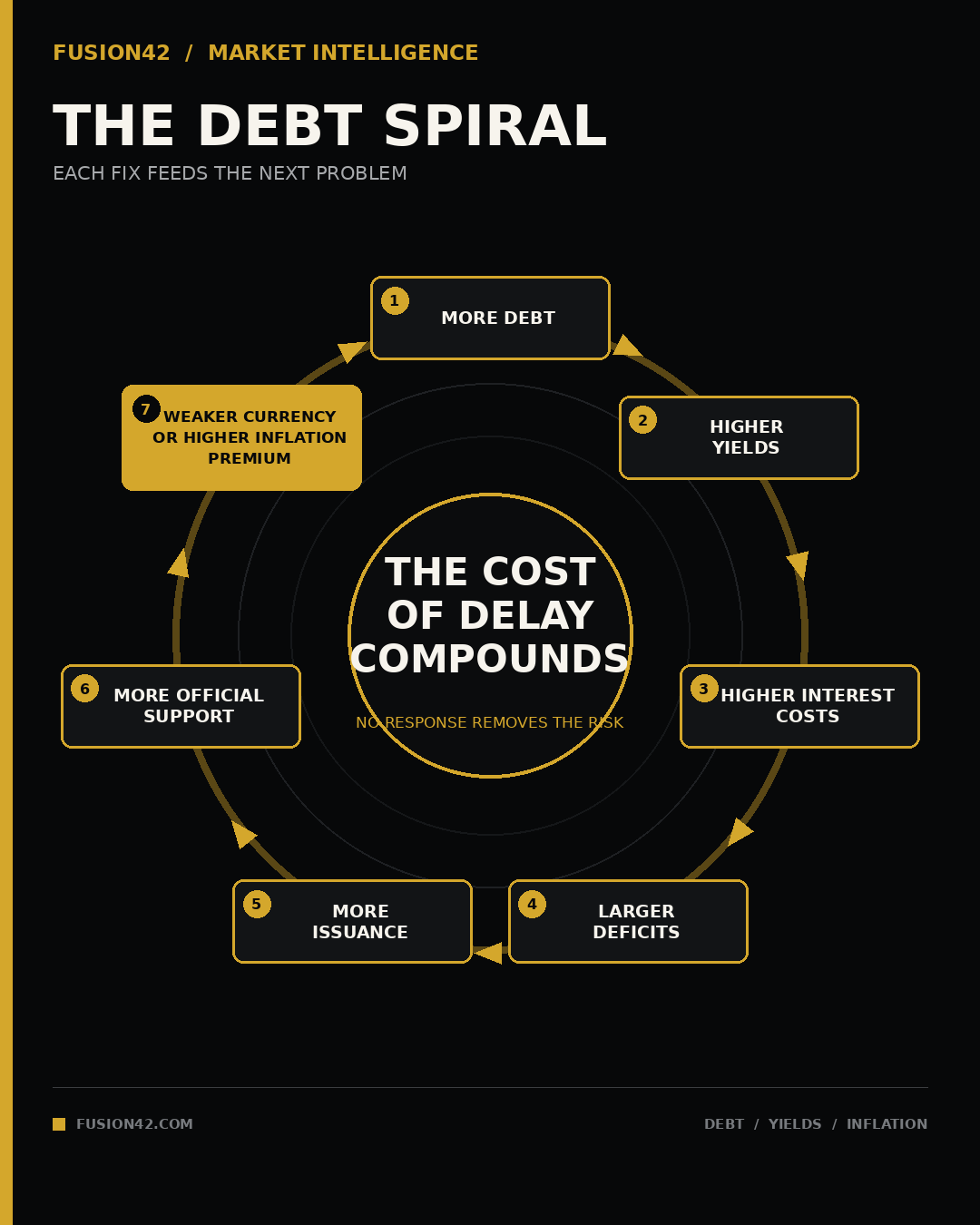
That is the debt spiral people are worried about. It does not mean default tomorrow. Countries that borrow in their own currency have powerful tools. They can tax, cut spending, extend maturities, change regulation, provide liquidity and allow inflation to reduce the real value of old fixed-rate debt.
The problem is that these tools have costs. Tax rises weaken growth. Spending cuts are politically difficult. Short funding increases refinancing risk. Currency weakness raises inflation. Central-bank purchases damage credibility if they become permanent. The spiral begins when the market sees every rescue adding to the next problem.
What this means for ordinary people
BORROWERS Mortgage and loan rates can stay high even if central banks begin cutting overnight rates.
SAVERS Cash earns more interest, but energy and food inflation can still reduce purchasing power.
PENSIONS Higher yields help new bond buyers but damage the price of long-dated bonds already held.
BUSINESSES Debt-heavy firms and companies without pricing power face the greatest squeeze.
INVESTORS Diversification matters more when bonds and equities can fall together. Hard assets help, but they are not guaranteed one-way trades.
What would make this worse
The dangerous combination is oil above $100, the US 30-year yield holding above 5.30%, dollar–yen breaking decisively through 160, weak Treasury auctions, wider French and Italian spreads, and official liquidity facilities being enlarged or repeatedly rolled. If the dollar falls while all of that happens, the market is adding a fiscal credibility premium.
What would calm it down
A durable fall in oil and inflation would give central banks room to cut. Credible fiscal restraint would reduce future bond supply. Strong auctions without official support would show private demand is intact. A stable yen after a measured Bank of Japan move would reduce carry-trade risk. Better Chinese domestic demand would make its low yields look like successful easing rather than a warning about weak growth.
The next tests
Next week brings 2-, 5- and 7-year US Treasury auctions, fresh US growth and inflation data, Nvidia’s results and the Federal Reserve’s Jackson Hole gathering. Japan’s September policy meeting is the next major pressure point for the yen and the carry trade. Europe’s auctions and sovereign spreads will show whether the stress remains global or begins concentrating in weaker countries.
Watch the relationships, not just the levels. Falling yields with a firmer dollar would be relief. Falling yields with a collapsing dollar would look like financial repression. Rising yields with a stronger dollar would be conventional tightening. Rising yields with a weaker dollar is the warning signal.
The bottom line
The world is leaving the cheap-money era with far more debt than it entered with. America is fighting refinancing risk. Japan is fighting the consequences of ending zero rates. Europe is fighting issuance and fragmentation. China is fighting weak domestic demand while controlling strategic processing and magnets. AI is creating a new call on capital, power and copper. Reserve managers are adding gold and reducing their marginal dependence on Treasuries. Oil is making every decision harder. The market has found the contradiction: governments need lower yields while inflation, debt supply and physical scarcity demand higher ones.
This is not yet a global debt crisis. It is the stage before one, when policy still works—but each intervention lasts for less time, costs more and moves the pressure somewhere else. It’s not looking pretty that’s for sure.
Sources and further reading
Global markets: yields and oil remain high
US Treasury doubles selected long-end buybacks
Why the bond-market relief may be brief
European debt issuance and rising yields
Japan’s bond yields and inflation pressure
China’s falling yields and weak credit demand
China holds benchmark lending rates
IEA: rare-earth concentration and economic exposure
IEA: 2026 critical-minerals outlook
Alibaba’s proposed $10.2bn AI capital raise
Nebius raises $5bn for AI data centres
China’s strategic rare-earth shipments to the US and Japan
August rare-earth pricing and regional premiums
Reuters: MATCH Act and allied semiconductor controls
ASML 2025 annual report and China exposure
IMF: currency composition of reserves, Q1 2026
Federal Reserve: the international role of the dollar
World Gold Council: central-bank buying in Q2 2026
Reuters: Japan and China reduce Treasury holdings
Federal Reserve explanation of FIMA repo
Gold and precious-metals close
This report is commentary for general information, not personal investment advice. Market levels are approximate closing figures for Friday, 21 August 2026, and can change rapidly.
Go take a and look
Scout - who just got funded
Newly funded startups, pre-seed to Series B, as the rounds happen.
Raise - who’s deploying
New funds with fresh capital and cheques to write.Wire - what changed, what matters
The intelligence feed that filters the noise, with the “so what” attached.
If you have not joined the Fusion42 Community on Telegram —
it is probably time to do so.
For the ❤️ of Startups
For the ❤️ of startups
✌🏼 & 💙
Derek
Thank you for reading. If you liked it, share it with your friends, colleagues and everyone interested in the startup Investor ecosystem.
If you've got suggestions, an article, research, your tech stack, or a job listing you want featured, just let me know! I'm keen to include it in the upcoming edition.
Please let me know what you think of it, love a feedback loop 🙏🏼
🛑 Get a different job.
Subscribe below and follow me on LinkedIn or Twitter to never miss an update.
The problem with AI development in the US is that it is really the creation of intellectual property (by enclosing the common intellectual development of the last couple of centuries). That is why there's a backlash against it. China, OTOH, is developing AI as a public utility, like their power and transportation systems.
The US is on track to have another financial crash. I expect it to happen in September (see 2008). That is also motivating the move away from the petrodollar.