


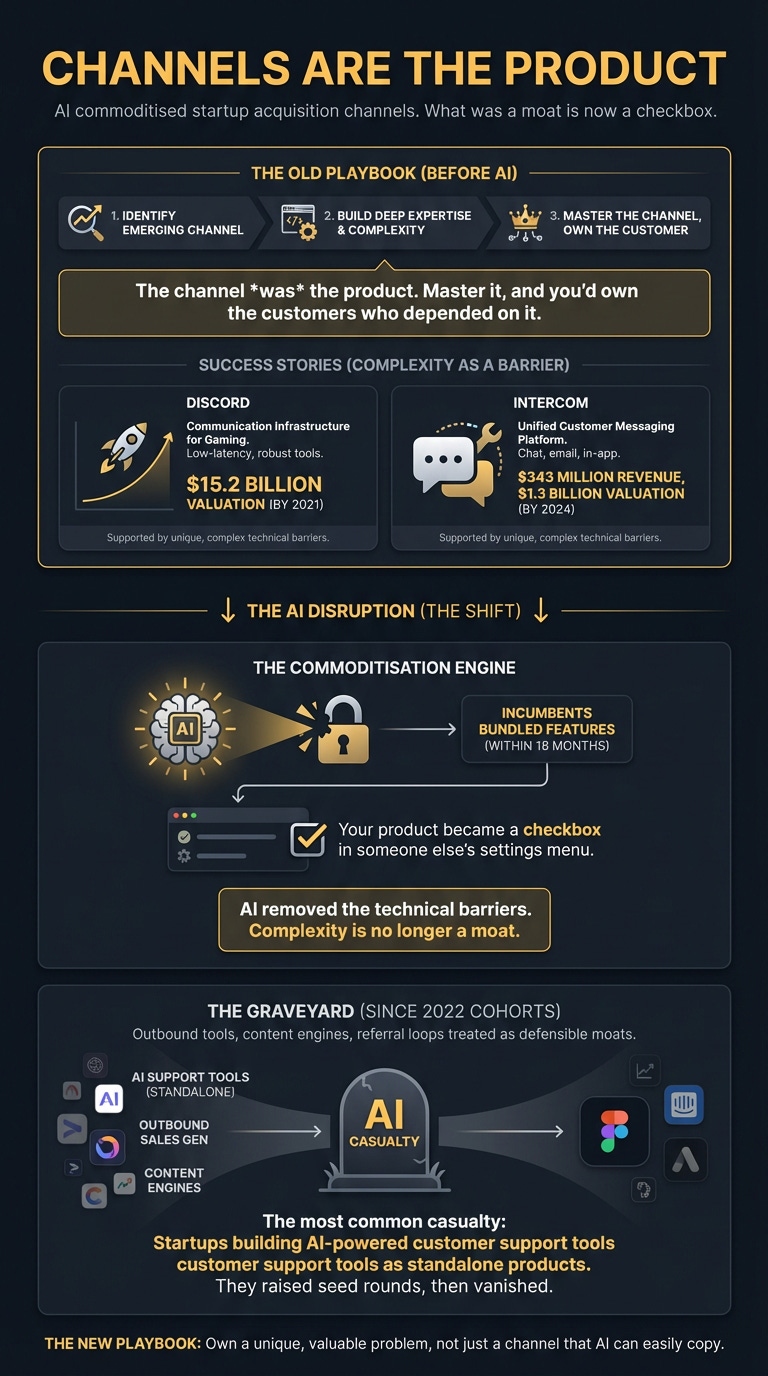
AI commoditised startup acquisition channels , outbound sales tools, content engines, referral loops, that founders treated as defensible moats. Incumbents bundled them as native features within 18 months. The founders who built entire companies around “owning” a distribution channel woke up to find their product was now a checkbox in someone else’s settings menu.
Why This Mattered Before
The logic was sound: identify an emerging channel, build deep expertise in its mechanics, and create a product that makes that channel work better than anyone else could manage in-house. The channel was the product. Master it, and you’d own the customers who depended on it.
Discord proved this brilliantly. They didn’t just build another chat app, they built the communication infrastructure for gaming communities. Low-latency voice, robust server management, community moderation tools that understood how gamers actually organised themselves. By 2021, they’d raised nearly $1 billion and hit a $15.2 billion valuation. The product was inseparable from the channel it served.
Intercom did the same for customer messaging. They weren’t selling software, they were selling the channel itself. Chat widgets, in-app messages, email campaigns, all unified into one platform that became the primary way SaaS companies talked to users. By 2024, they were generating $343 million in revenue with a $1.3 billion valuation. The channel was the entire value proposition.
Both companies succeeded because the technical complexity and channel-specific knowledge created genuine barriers. You couldn’t just bolt on Discord’s voice quality or Intercom’s message orchestration as an afternoon project.
The Graveyard
In the cohorts I’ve worked through since 2022, I’ve watched this pattern destroy dozens of early-stage companies. The most common casualty: startups building AI-powered customer support tools as standalone products. They’d raise a seed round on the promise of “intelligent chatbots that understand context” or “automated ticket routing that learns from your team.” Solid products. Real customer validation. Then Meta, Zendesk, and Salesforce started bundling comparable AI features directly into their core platforms, often at no additional cost.
The breaking point wasn’t that the AI got better. It was that the incumbents already owned the channel. They had the customer data, the existing integrations, the sales relationships. Adding an AI layer was trivial compared to the distribution advantage they already held. The startups were selling a feature. The incumbents were giving it away to protect their platform position.
I watched one founder in a 2023 cohort spend eighteen months building a sophisticated AI email outreach tool. Beautiful product. Real engagement metrics. Dead within six months of HubSpot shipping their AI email writer. The channel, email outreach became a commodity the moment the platform players decided to compete.
What AI Actually Changed
The specific mechanism: AI collapsed the technical barriers that made channel expertise defensible. What used to require deep domain knowledge and months of custom development now takes an afternoon with the right API calls.
Outbound sales automation used to be hard. Tools like Outreach and SalesLoft built entire companies on sequencing, personalisation, and analytics. Then ChatGPT made it trivial to generate hundreds of personalised cold emails in minutes. Clay, Apollo, and a dozen others bundled AI writing directly into their platforms. The channel, cold email, stopped being a product and became table stakes.
Content generation followed the same path. Companies built businesses around “content marketing automation” or “SEO content at scale.” Jasper raised $125 million on this premise. Then every CMS, every social media tool, every marketing platform added AI writing. WordPress plugins, LinkedIn’s built-in post composer, HubSpot’s content assistant, all free or near-free. The channel commoditised in eighteen months.
Referral mechanics and growth loops used to require serious engineering. Tools like Viral Loops and GrowSurf sold the infrastructure to run referral programmes. Now? Most CRM and marketing automation platforms ship with AI-powered referral tracking and optimisation built in. The channel became a feature, not a product.
The pattern repeats: AI made the technical execution cheap enough that platform players could bundle it without thinking twice. The channel stopped being defensible the moment it became a commodity capability.
The New Playbook
Build distribution into the product experience, not around it. Your product should create its own distribution as a natural byproduct of use. Loom did this, every video shared was a mini demo of the product itself. The distribution was embedded in the core value, not bolted on as a separate channel strategy. If your “channel” can be replicated by someone else’s feature update, it’s not a product.
Own proprietary data that makes the channel work better for your specific use case. If you’re building on top of a channel, the defensibility comes from data incumbents can’t easily replicate. Scale AI didn’t just build labelling tools, they built proprietary training data that made their tools uniquely effective for specific AI use cases. The channel (data labelling) was commoditised, but the data moat held.
Make the AI create network effects, not just automate tasks. Tools like Notion AI or Figma AI get more valuable as more people use them because they learn from collective usage patterns within teams. The AI isn’t just a feature, it’s the mechanism that creates lock-in. If your AI just automates what one person does faster, you’re building a feature. If it gets smarter as your customer’s team grows, you’re building a moat.
Ship faster than incumbents can bundle. The only way to win the feature race is to not be in it. Move so fast that by the time a platform player copies your current feature set, you’re already three versions ahead. Linear does this relentlessly, they ship meaningful updates every week, staying ahead of Jira and Asana’s AI features by sheer velocity. Speed becomes the moat when technical complexity isn’t.
The Warnings
The “AI wrapper” trap. I’ve watched too many founders build what they think is a product but is actually just a thin UI on top of OpenAI’s API. They raise a seed round, get early traction, then watch their entire value proposition evaporate when OpenAI ships a native interface or when their customers realise they can just use ChatGPT directly. The cost: six to twelve months of runway burned before the pivot. If your product is just “ChatGPT but for [vertical],” you’re not building a company, you’re renting time until the channel owner notices.
The “bundling is coming” delusion. Founders convince themselves they have eighteen months before the big platforms bundle their feature. They’re wrong. In the cohorts I’ve tracked, the median time from “this could be a feature” to “this is now a free feature” dropped from thirty-six months pre-2020 to fourteen months post-ChatGPT. The acceleration is real. If your entire moat is “we do this one channel thing really well,” you don’t have years, you have quarters. Plan accordingly or die surprised.
The Bottom Line
The channel isn’t the product anymor, the product is what makes you impossible to unbundle even after the channel gets commoditised.
Companies To Watch
These companies built their core product around owning a distribution channel. Each one faces the same bundling pressure described above, watch how they respond.
Aspire Singapore. Influencer discovery and campaign management platform. Built their entire product around owning the influencer distribution channel. TikTok Shop and Meta are now building native creator marketplaces. The channel they own is becoming a platform feature.
PartnerStack Toronto, Canada. Partner and referral programme infrastructure for SaaS. Their moat is being the dedicated layer for partner distribution. As HubSpot and Salesforce build native partner tracking, the standalone case gets harder to make.
Yotpo Tel Aviv, Israel. UGC, SMS and email acquisition platform for e-commerce. Built a $1.4B valuation on owning those channels for Shopify merchants. Shopify’s own marketing tools are eating directly into that territory.
Impact.com Santa Barbara, USA. Affiliate and partnership automation platform. Owns the affiliate channel for enterprise brands. AI-powered attribution and fraud detection are now standard features in major ad platforms.
Talon.One Berlin, Germany. Promotion and loyalty engine. Built around owning the promotions distribution layer. CDPs like Segment are bundling similar capabilities as native features.
Referral Rock Washington DC, USA. Referral programme infrastructure. Their pre-AI moat was referral loop mechanics as a standalone product. Growth platforms now ship this as table stakes.
Part of Startup Principles for an AI World. 30 principles for building in the new era. New issue every week.
Arthur is the AI native startup operating system I’m building in public not hype, but a system that turns input into structured execution and tracks founder progress. If you want to follow or use it, it’s open for early access.
→ Access Arthur
Enjoy and hope to see you soon.
❤️ & ✌🏼
Thank you for reading. If you liked it, share it with your friends, colleagues and everyone interested in the startup Investor ecosystem.
If you've got suggestions, an article, research, your tech stack, or a job listing you want featured, just let me know! I'm keen to include it in the upcoming edition.
Please let me know what you think of it, love a feedback loop 🙏🏼
🛑 Get a different job.
Subscribe below and follow me on LinkedIn or Twitter to never miss an update.