


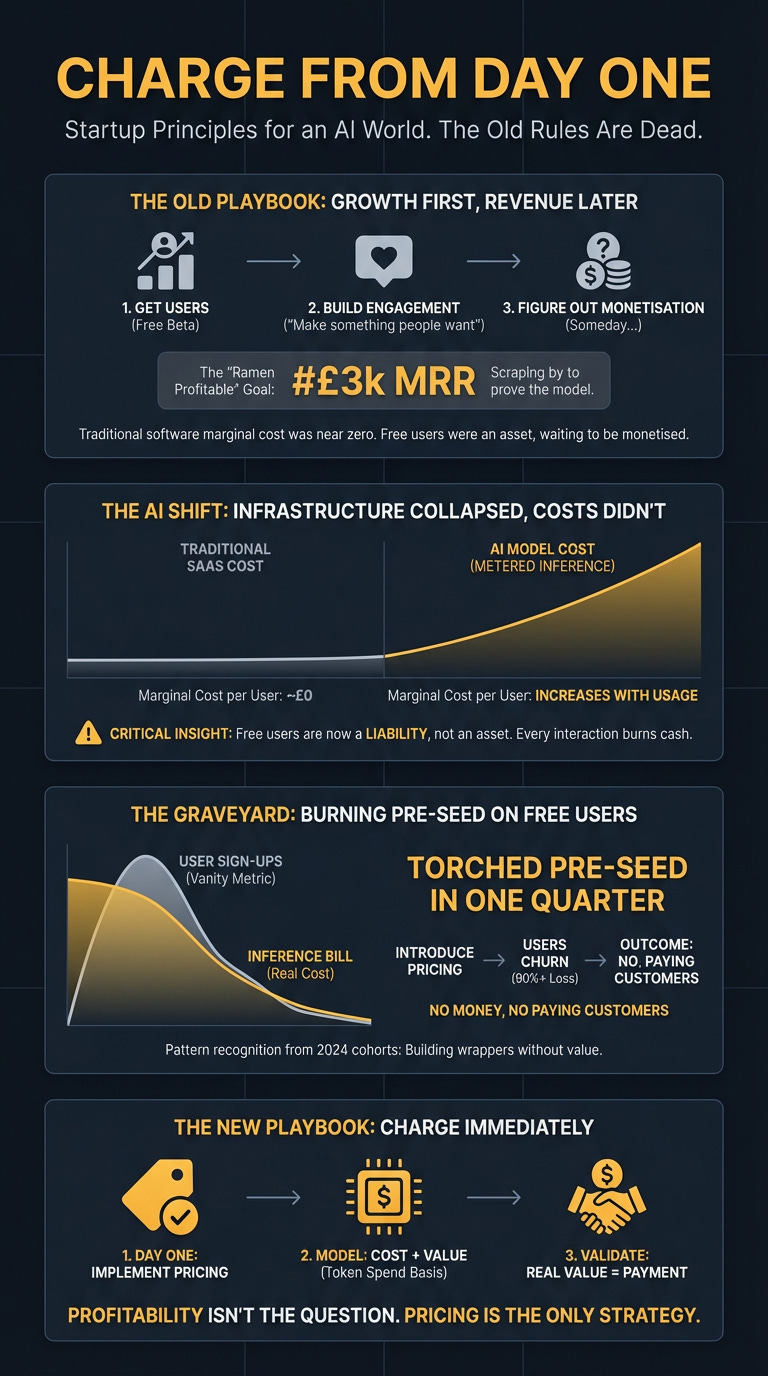
You were told to get ramen profitable scrape by on £3k MRR while you proved the model. Turns out AI collapsed infrastructure costs so completely that profitability happens almost by accident. But here’s the thing: metered inference costs mean free users are now a liability, not an asset. The interesting question isn’t whether you can be profitable. It’s what pricing looks like when your only real cost is token spend.

Why This Mattered Before
You were told to focus on growth first. Get users, build something they love, and figure out how to make money later. The mantra was “make something people want.” Revenue was a secondary concern to engagement.
I used to hear this in every single office hours session. Founders would say “we’ll figure out monetisation once we have traction.” And for years, that actually worked. For traditional software, the marginal cost of serving another user was near zero. Once the code was written, adding the ten-thousandth user cost little more than the tenth. You could afford to give it away because it cost you almost nothing.
The Graveyard
The public post-mortems for AI startups that burned to death subsidising free users haven’t been written yet. The market is moving too fast. But I can tell you what I’ve seen.
In the cohorts I’ve worked with since 2024, the pattern is painfully consistent. A founder builds a clever wrapper around a powerful model. They launch a free beta and get a rush of sign-ups. They see user numbers climb and think it’s traction. But their OpenAI bill climbs faster. I’ve watched teams torch a meaningful chunk of pre-seed in a single quarter on inference, then lose the vast majority of ‘users’ the moment they introduced pricing. They’re left with no money, no paying customers, and a product no one actually valued enough to pay for.
What AI Actually Changed
Here’s the thing. AI turned whole product categories into near-zero marginal-cost businesses overnight. Shipping, support, onboarding, even chunks of delivery are now automated. So charging £20/month doesn’t prove you’ve got a business—it might just prove you’ve got cheap compute and a Stripe account.
Every time a user interacts with your product, it triggers an API call to OpenAI, Anthropic, or your own self-hosted model. That is a real, metered, non-zero cost. It shows up as a line item on your monthly bill. Your Cost of Goods Sold (COGS) is no longer just server hosting; it’s a direct function of user engagement. An active free user is not an asset, it’s a liability.
Giving away an AI product for free is not like giving away software. It’s like giving away coffee. The first cup isn’t free to you, and the thousandth cup certainly isn’t. You’re paying your supplier for every single one. If you don’t charge the customer, you’re just running a very expensive charity
.
The New Playbook
Charge from Day One. This isn’t just about covering costs. It’s the fastest way to validate that you’ve built something of actual value. Free users will tell you they love it; paying users prove it. Price on the value you create. Just last week on Hacker News, I saw a tool that negotiated a hospital bill down by thousands; people will happily pay a percentage of that saving.
Know your Unit Economics. You must know your exact cost-per-user and cost-per-query from the start. Instrument everything. If it costs you £0.50 in tokens to serve an average user session, and you’re charging £10 a month, you know your ceiling for engagement. If you don’t track this, you’re flying blind into a cash-flow crisis.
Use Strategic Freemium, Not a Free-for-all. A free tier can still work, but it must be a marketing tool, not the core product. Offer a low-cost version that uses a cheaper, less powerful model (e.g. Haiku instead of Opus). Or, offer a severely rate-limited or feature-gated experience. The goal of the free tier is to demonstrate value so clearly that users upgrade. It’s a product tour, not an open bar.
Align Billing with Costs. Usage-based billing is your friend. By charging per-credit, per-report, or per-token-bundle, you ensure your revenue scales directly with your single biggest cost centre. This protects your margins and forces high-volume users to become your most valuable customers, not your biggest expense.
The Warnings
The Pivot Trap. I’ve watched founders realise too late that their free users and their paying customers want different things. The person playing with your AI toy at 2am is not the same person who’ll expense a £200/month SaaS tool. If you build for free users first, you’re building the wrong product. The Timing Trap. You think you’ll introduce pricing ‘once we have more features.’ But your free users are training you to build features that don’t drive revenue. Every month you delay is another month you’re learning the wrong lessons.
The Bottom Line
Charge early. Cover your costs. Prove your value. Don’t fund hobbies with venture capital.
Part of Startup Principles for an AI World — 30 principles for building in the new era. New issue every week.
Arthur is the AI native startup operating system I’m building in public — not hype, but a system that turns input into structured execution and tracks founder progress. If you want to follow or use it, it’s open for early access.
→ Access Arthur
Enjoy and hope to see you soon.
❤️ & ✌🏼
Thank you for reading. If you liked it, share it with your friends, colleagues and everyone interested in the startup Investor ecosystem.
If you've got suggestions, an article, research, your tech stack, or a job listing you want featured, just let me know! I'm keen to include it in the upcoming edition.
Please let me know what you think of it, love a feedback loop 🙏🏼
🛑 Get a different job.
Subscribe below and follow me on LinkedIn or Twitter to never miss an update.