


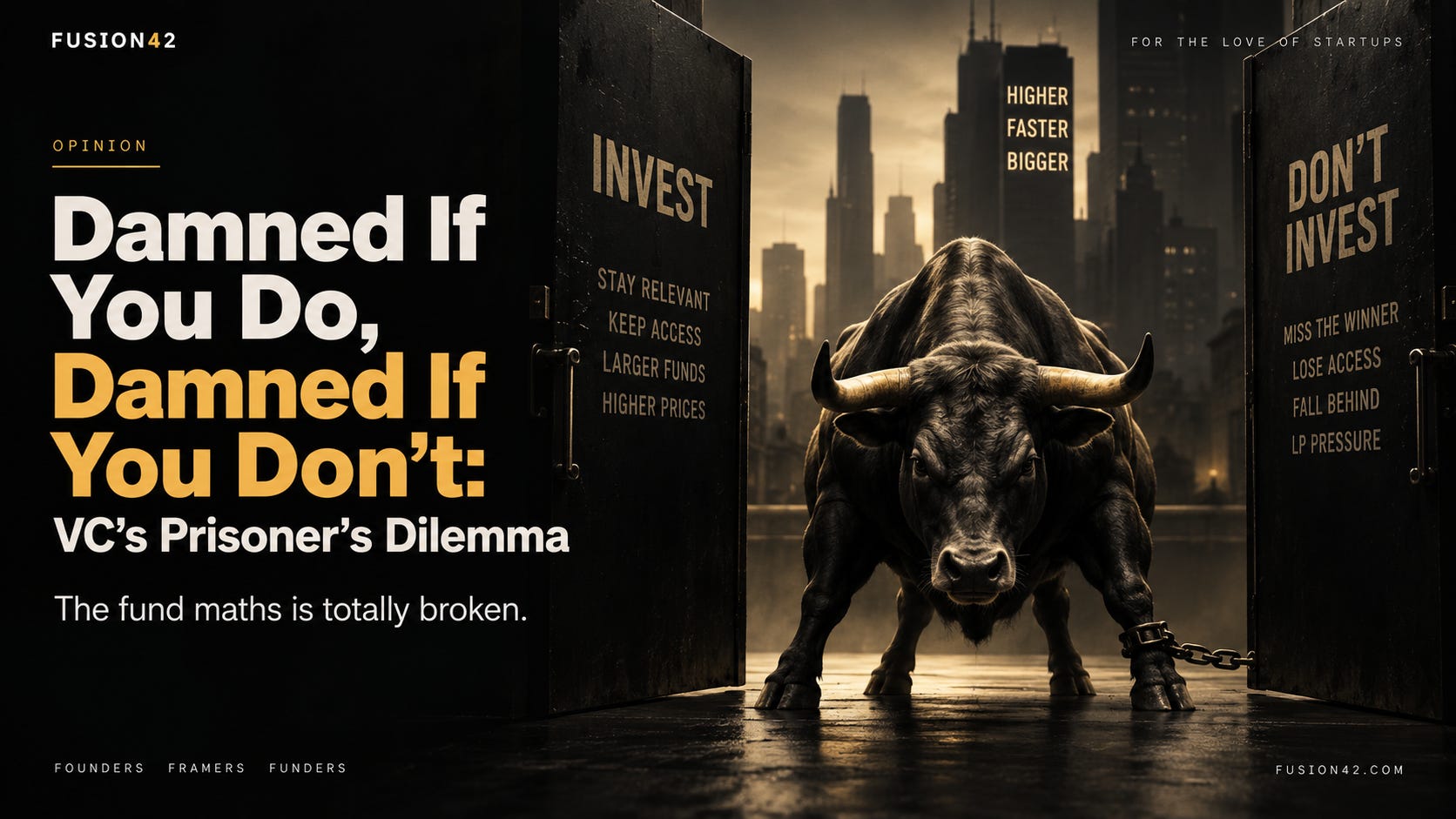
Harry Stebbings called bullshit on what is happening in venture recently. One company he met had raised at a $150 million valuation. A week later it raised at $500 million. A week after that it raised at $1.5 billion. According to Stebbings, it was still three people with an idea. Another company started its first round at $3.5 billion, but there was so much demand that the price went up to $5.5 billion. He also said his team was struggling to find companies raising rounds of less than $100 million.
Stebbings calls it froth and I agree. What interests me more is that plenty of the people paying these prices know it’s frothy as well. They aren’t sitting there thinking these are perfectly normal seed valuations. They can see what’s happening and they’re playing anyway.
HE IS TOTALLY ON POINT HERE.
I had an exchange with a VC recently who described the problem facing funds as two Prisoner’s Dilemmas. They have to raise mega-funds because otherwise they can’t compete with the firms that have already have. Then they have to invest in billion-dollar seed companies because otherwise it looks as though they’re missing the startups everyone is talking about.
My first reaction was that this isn’t a prisoner’s dilemma because there is a third choice: don’t play. If the maths doesn’t work, don’t invest. That’s supposed to be the job. If your investment thesis has become making sure you’re in all the startups everyone is talking about, you’re basically consensus trading with a ten-year lock-up.
He made a fair point though. Sitting it out has a cost. If every major fund is in the company that becomes the next OpenAI and you’re not, your LPs know. The best founders know. Other VCs know. Do it often enough and it starts affecting whether you even get the call on the next one. It’s a bit fucked if you do, fucked if you don’t, but staying relevant and staying disciplined shouldn’t be mutually exclusive.
I think the problem gets worse when being in the right deals becomes part of the VC’s own status. You’re looking at the return available from the investment, of course, but somewhere in the background there’s another calculation going on: what happens to us if we walk away and this becomes a $100 billion company? Nobody wants to be explaining to LPs for the next decade that they could have invested in the winner at $5 billion but thought it was a bit expensive.
That makes walking away at $3 billion harder when you know another top fund will pay $4 billion. At $4 billion somebody else will pay $5 billion, the round gets oversubscribed and suddenly the fact that everyone wants in becomes part of the reason you want in yourself. The company gets validation from having the famous VC on its cap table while the VC gets validation from being allowed onto the cap table. It’s wonderfully circular.
The Stebbings examples show how stupid this can get. A company goes from $150 million to $1.5 billion in two weeks. Unless the business changed beyond recognition during those fourteen days, it didn’t suddenly create $1.35 billion of value. Investors simply became prepared to pay a lot more for the (punt) shares.
The other example is even more fucking nuts. The company raised a round at a $3.5 billion valuation. There was so much demand from investors who couldn’t get enough of the round that it then went out and raised another round at $5.5 billion. Two separate rounds. Nothing in Stebbings’ account suggests the company created another $2 billion of underlying value between them. What changed was that a load more investors wanted in, and apparently that was enough.
The return maths is where I really struggle with what is happening. A venture fund doesn’t get paid for correctly identifying a brilliant company. It gets paid on the return from the price at which it invested.
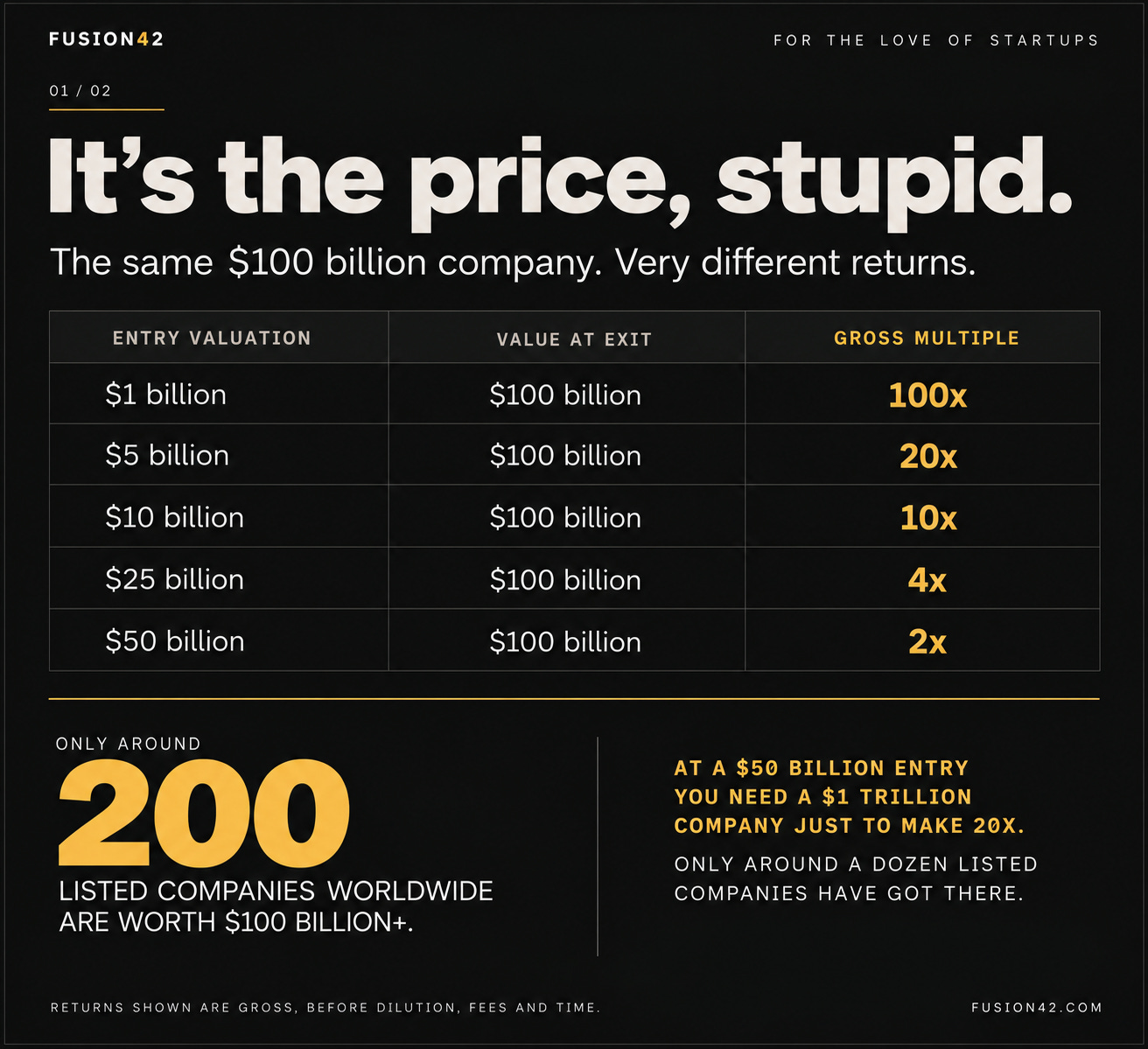
Take an exceptional company that eventually becomes worth $100 billion. An investor who gets in at $1 billion makes 100 times before dilution. At $5 billion, 20 times. At $10 billion, 10 times. At $25 billion, 4 times. At $50 billion, 2 times.
Put those numbers into context. There are only around 200 listed companies in the world worth more than $100 billion. So investing at $5 billion and looking for a 20x means underwriting a startup to become one of roughly the 200 largest listed companies on the planet.
At a $50 billion entry price, you need a trillion-dollar company to make 20x. There are only around a dozen listed companies in the world worth that much. That’s before dilution, before the years your money is locked up and before dealing with all the other investments in the fund that inevitably go nowhere.
The company can be an extraordinary success and still produce a pretty ordinary venture return because you paid too much going in
There is another problem with those multiples. Time.
Two times your money sounds fine until it takes ten years. That’s roughly 7% a year. Four times over ten years is about 15%. Ten times is roughly 26%. That’s before getting into what eventually reaches the LP after the economics of the fund.
Now compare what you’re taking to earn it. Your money is locked up for years. You have very little control over when you get it back. You have far less information than you would in a listed company. You can be diluted repeatedly and, in plenty of cases, the investment goes to zero.
That’s why venture returns are supposed to be fucking enormous when you get one right.
Mega-funds make this worse. A $500 million exit can change a founder’s life and produce a fantastic return for an early investor, but it does bugger all for a $10 billion fund unless the fund owns a massive chunk of the company. Even a billion-dollar exit doesn’t move the needle much. If you’ve raised $10 billion, you need outcomes capable of returning meaningful chunks of that $10 billion and ideally the whole bloody fund several times over.
Which means a lot of perfectly good venture investments become almost pointless to you.
So the big funds end up fishing in the same small pond. They need companies capable of becoming worth tens or hundreds of billions and there simply aren’t many companies that can do that. Even fewer where everyone agrees early on that they might.
Then all that capital turns up at the same door.
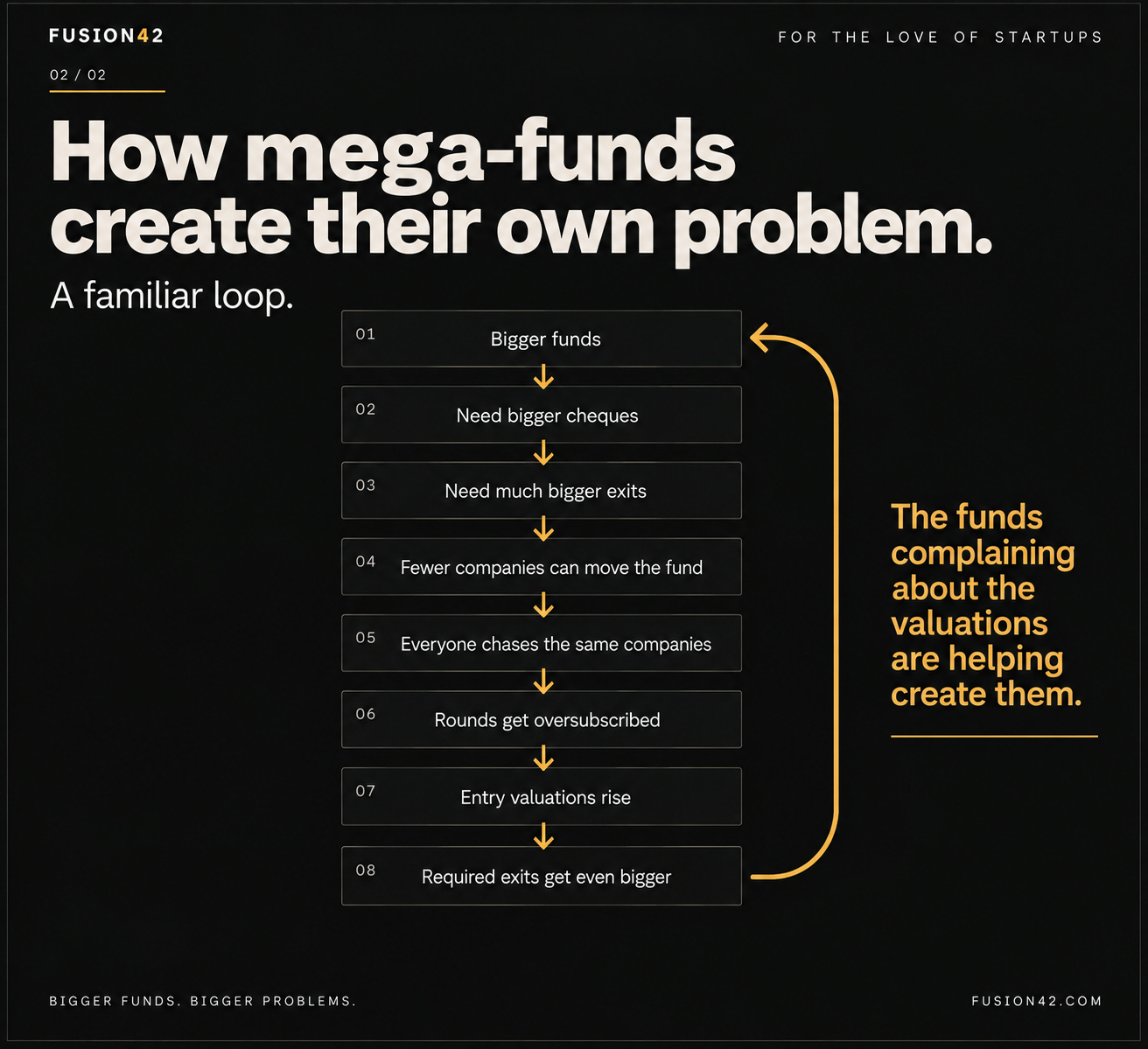
And here’s the slightly fucked bit. The mega-funds complain about ridiculous valuations while the size of the funds themselves is helping create them. Raise $10 billion and you can’t spend your time writing $10 million cheques into companies that might sell for $500 million. The returns could be fantastic and it still wouldn’t matter enough. You need to put serious money into potential mega-companies, and so does the other bloke who just raised $10 billion.
The founder sitting across the table knows this perfectly well. If five funds with billions to deploy all decide they need to own your company, you’re hardly going to tell them to calm down and offer you less money at a lower valuation. You make them pay. I would.
You can see how the wheel starts spinning. One fund gets bigger. The next fund needs to get bigger to compete. Bigger funds need to write bigger cheques. Bigger cheques need bigger outcomes. That drives everyone towards the same small group of companies, which drives the prices of those companies higher, which means they now need even bigger outcomes to generate the same return.
At some point the structure of the venture industry starts creating the very valuations everyone inside the industry is complaining about.
There’s another part of this which I don’t think gets enough attention. In private markets you can keep this going for quite a long time without anybody actually proving the valuation.
A company raises at $5 billion. Six months later another sophisticated investor puts some money in at $10 billion. The earlier investors can now mark their holdings up. On paper they’ve doubled their money.
Then somebody comes in at $20 billion.
Another mark-up.
Everyone’s portfolio looks fantastic.
But the company hasn’t been sold for $20 billion. A relatively small amount of new capital has established a price which can then be applied to a much larger amount of existing equity. That’s how private markets work and there’s nothing inherently wrong with it, but when rounds start happening three weeks apart and valuations start going $150 million, $500 million, $1.5 billion, it’s probably worth remembering what those marks actually represent.
Eventually LPs need cash back, they can’t spend TVPI.
Secondaries help. Tender offers help. Founders, employees and early investors can now get liquidity without forcing the company onto the public markets, which in many cases is a good thing. But it also means companies can stay private for far longer while still giving insiders liquidity.
That removes one of the pressures that used to force a successful company into public markets, where its valuation gets tested every day by people who aren’t necessarily members of the same club.
Twenty years ago a hugely successful technology company eventually went public. At that point the private valuation met a liquid market with thousands of buyers and sellers and constant price discovery. Today a company can raise billions privately, sell secondary shares, run tender offers and keep going.
Again, that’s not evidence the valuation is wrong. It does mean the same relatively small pool of capital can keep setting the marginal price for much longer.
And that brings me back to Silicon Valley.
There is another part of this which Shaun Maguire, Partner @sequoia, put rather well recently. He left Silicon Valley six years ago because he thought it had become a monoculture, with some of the most extreme groupthink he’d experienced. His example was simple. Turn up at a dinner and everyone is in tech, so people start stack-ranking each other. Founder of the $100 billion company beats founder of the $50 billion company, managing partner of the tier-one VC beats the hired CEO, founder of the $10 billion company comes somewhere below that. Everyone knows where everyone sits.
His point was that this kind of hierarchy kills independent thinking. People become more reluctant to speak truth to power because everyone knows their place. I think he’s right, and it matters here because these are the same people competing to get into the same companies at the same time.
Then, almost perfectly timed, along comes Cosign.
Cosign is a new curated professional network for the startup community, co-founded by a16z GP Erik Torenberg. People cosign other people, build lists of founders and companies they rate and vote on questions such as who is defining the future of technology. The stated aim is to “find the signal in the crowd”.
I can see why that’s useful to A16Z, lots of data. I can also see how it could make exactly the problem Maguire is talking about worse.
You already have a relatively small group of powerful people watching each other, ranking each other and trying to work out who and what matters. Now give that group a platform explicitly designed to record who the respected people cosign, who they would invest in and which companies they rate. You have effectively formalised the hierarchy Maguire is complaining about.
And this matters for the fund maths because attention isn’t separate from price in venture. The right people cosign a founder, more investors look at the company, the round gets hotter and being absent starts to carry exactly the reputational cost we’ve been talking about. The social hierarchy and the capital allocation process start feeding each other.
@Cosign may turn out to be very good at finding genuine signal. But in a market already struggling with consensus, status and everyone chasing the same handful of companies, I’d be careful about confusing who the network rates with what the investment is worth.
It reminds me of RBS buying ABN AMRO in 2007. The circumstances were completely different, but the behaviour is familiar. Barclays wanted ABN AMRO. RBS wanted to compete, Fred Goodwin wanted scale, and walking away meant watching somebody else get the prize. RBS ended up leading a €71 billion acquisition at almost exactly the wrong moment.
Nobody at RBS woke up one morning and thought, let’s make one of the worst fucking deals in banking history. They got there through a series of decisions that made sense to them at the time, while the pressure to win the deal kept building and the willingness to walk away kept disappearing.
That’s why “we have to do the deal” bothers me. Nobody has to do the deal. Once missing it feels worse than overpaying for it, the seller has you exactly where they want you.
And I come back to the VC who called it a prisoner’s dilemma because I understand his point better now than I did when I first replied. A top venture firm probably can’t miss every important AI company and pretend there is no cost. Access matters. Brand matters. LPs quite reasonably ask why they’re paying you venture fees if every defining company of the cycle is sitting in somebody else’s portfolio.
But if maintaining your position requires investing at prices where the return maths doesn’t work, then perhaps the problem started before the investment committee meeting. Maybe the fund is too big. Maybe there is too much capital chasing too few genuinely exceptional companies. Maybe AUM has become too important to the VC business itself.
Maybe fear of missing the next great company has simply become stronger than fear of paying a stupid price for it.
Harry Stebbings is right to call the froth out. I just don’t think three rounds in three weeks is the problem. It’s what the problem looks like once it reaches the term sheet.
Founders aren’t causing this. If investors want to compete to take my company from $3.5 billion to $5.5 billion because too many of them want into the round, I’m not going to sit them down and explain that they’re fucking up their fund economics. I’m taking the money.
The investors are supposed to know better.
Maybe these companies deliver. Some almost certainly will. But the investment maths doesn’t care how exciting the company is, how famous the founder is, who else is on the cap table or how embarrassing it might be to miss the deal.
Every time the entry price rises, more of the future return belongs to the person who was there before you.
At some price even a brilliant company becomes a shit investment.
And if you crossed that price because everyone else was desperate to get in, that’s not independent investment thinking.
It’s FOMO with an investment committee.
Go take a look, For the ❤️ of startups
Scout - who just got funded
Newly funded startups, pre-seed to Series B, as the rounds happen.
Raise - who’s deploying
New funds with fresh capital and cheques to write.Wire - what changed, what matters
The intelligence feed that filters the noise, with the “so what” attached.
If you have not joined the Fusion42 Community on Telegram —
it is probably time to do so.
For the ❤️ of Startups
✌🏼 & 💙
Derek
Thank you for reading. If you liked it, share it with your friends, colleagues and everyone interested in the startup Investor ecosystem.
If you've got suggestions, an article, research, your tech stack, or a job listing you want featured, just let me know! I'm keen to include it in the upcoming edition.
Please let me know what you think of it, love a feedback loop 🙏🏼
🛑 Get a different job.
Subscribe below and follow me on LinkedIn or Twitter to never miss an update.