


The rules changed. Here’s the new playbook. 30 principles for building startups in an AI world — what worked before, what broke, and what founders need to do now. Not theory. Tactics that ship.
New principle every Monday
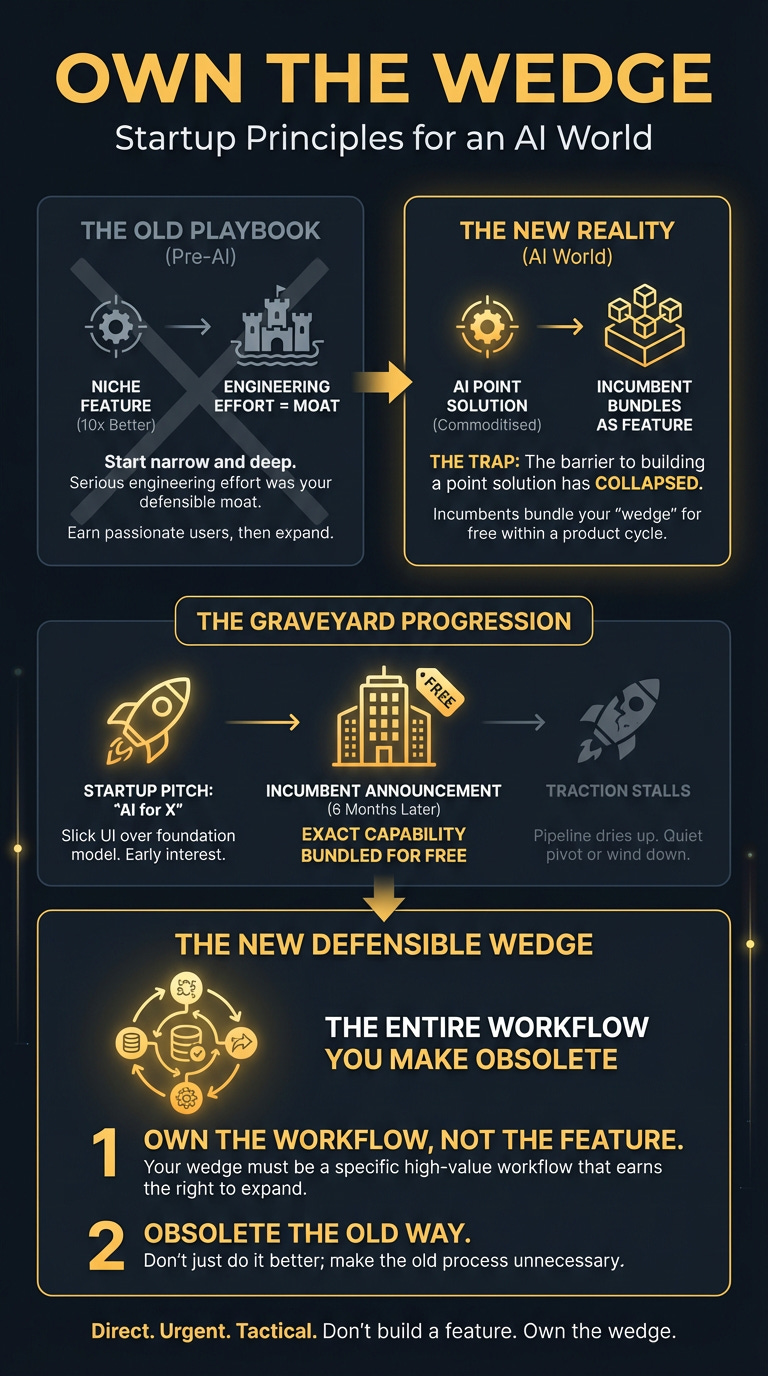
AI commoditised point solutions — founders need a specific high-value wedge that earns the right to expand, rather than building horizontal AI tools that incumbents bundle as features within a product cycle. You were told to start with a tiny niche, a single feature done ten times better. Turns out, that advice is now a trap. The defensible wedge isn’t a feature anymore; it’s the entire workflow you make obsolete.
Why This Mattered Before
The conventional wisdom was to start narrow and deep. Paul Graham’s essays hammered this home: own a tiny piece of the market completely before you even think about expanding. And it was right. Building anything, even a single, focused tool, required serious engineering effort. That effort was your moat.
A startup could build a defensible business by solving one problem exceptionally well because incumbents were too slow or unfocused to bother competing on such a small feature. You could earn passionate users, build from a position of strength, and expand from there. This playbook worked for years. Until it didn’t.
The Graveyard
I haven’t seen a single, high-profile company vaporised overnight because its wedge became an AI feature. It’s not that dramatic. It’s a slower, more painful death.
In the cohorts I’ve worked with since 2023, I’ve watched dozens of founders pitch some variation of ‘AI for X’—AI for summarising legal documents, AI for writing marketing copy, AI for generating social media posts. They build a slick UI over a foundation model. They get some early interest. Then, within six months, Google, Microsoft, or the dominant SaaS player in their market announces the exact same capability, bundled for free into a platform with a million existing users. The startup’s traction stalls, the pipeline dries up, and they quietly pivot or wind down.
What AI Actually Changed
Here’s the thing. The barrier to building a point solution has collapsed. What used to take a small engineering team a quarter to build can now be replicated by a single developer using an API in a weekend. Incumbents are not asleep at the wheel; they are weaponising this.
The wedge is no longer about doing one thing better—it’s about automating an entire workflow that incumbents serve with multiple products or clunky integrations. Large platforms are in a feature-bundling arms race. Look at the low-code space. Appian saw its stock jump after announcing strong results driven by its new AI-powered solutions in late 2025. Their AI-inclusive tier revenue more than doubled quarter-over-quarter. They didn’t launch a new product; they wove AI directly into their existing platform, instantly upgrading their value proposition and boxing out any startup trying to sell a standalone “AI for process automation” tool.
The New Playbook
Your goal is no longer to build a better tool. It’s to build a better, more automated workflow that creates high switching costs.
Map the entire workflow, not the task. Don’t build an AI to summarise meeting notes. Build the system that schedules the meeting, records it, generates the summary, creates action items in the user’s project management tool, and drafts the follow-up email. The value isn’t in one step; it’s in the seamless automation of all of them.
Go vertical, not horizontal. A horizontal tool like “AI for copywriting” competes with everyone. A vertical tool like “AI for generating Phase I Environmental Site Assessment reports” for commercial real estate has a built-in moat. It requires specific domain knowledge, proprietary data structures, and a deep understanding of a workflow that big tech will never bother to learn.
Build for deep integration. Your product should become the central nervous system for a specific business process. Use tools like Retool or Airtable not just as a database, but as a platform to build custom, AI-powered internal applications that are deeply embedded in your customer’s operations. The harder you are to rip out, the more defensible your business is.
Own the messy ‘last mile’. Fully automated AI is a commodity. A workflow that is 95% automated but requires expert human-in-the-loop validation for the final 5% is a powerful moat. You aren’t just selling software; you’re selling a guaranteed outcome. This is something incumbents with a purely self-serve model struggle to replicate.
Companies To Watch
Harvey — San Francisco, USA — AI platform that automates full legal workflows from contract review to case research and litigation strategy. Perfect example of the article’s thesis - avoided the point solution trap by automating entire legal workflows instead of building narrow AI tools that incumbents like Westlaw could easily bundle. Shows how to build a defensible wedge that makes existing workflows obsolete.
Sierra — San Francisco, USA — Conversational AI platform that powers full customer service workflows, from query resolution to retention plays. Exemplifies the new playbook by automating complete customer service workflows instead of building narrow chatbot features that platforms like Zendesk bundle for free. Demonstrates how to own the entire workflow rather than a single touchpoint.
Adept — San Francisco, USA — AI agents that automate complex enterprise workflows like sales outreach and data entry via natural language actions. Shows the evolution from point solutions to workflow automation - instead of building narrow AI tools that get commoditised, they’re creating AI agents that handle entire business processes. Perfectly illustrates the shift from better tools to obsolete workflows.
Ema — Mountain View, USA — Universal AI employee platform that handles multi-app workflows across HR, finance, and IT. Demonstrates the article’s core thesis by avoiding the commoditisation trap of single-purpose AI tools. Instead of building narrow automation features, they’re replacing entire cross-functional workflows that incumbents can’t easily replicate with simple bundling.
UiPath — New York, USA — End-to-end robotic process automation platform that orchestrates AI agents to replace entire back-office workflows from invoice processing to compliance auditing. Pre-AI example of the thesis in action - avoided the point solution trap by automating complete workflows before incumbents could bundle individual features. Shows the enduring value of workflow-level thinking that’s now even more critical in the AI era.
Zapier — Sunnyvale, USA — No-code automation platform that chains AI-powered apps into custom workflows, obsoleting manual integrations across sales, marketing, and ops. Illustrates how workflow-level thinking beats point solutions - while individual integrations get bundled by platforms like Salesforce, Zapier’s cross-tool workflow automation remains defensible. Shows the power of owning the entire process rather than individual connections.
Glean — Palo Alto, USA — Enterprise search and knowledge AI that replaces fragmented internal search workflows with instant, contextual answers. Avoids the commoditisation of individual search features by owning the entire knowledge discovery workflow. While point search tools get bundled into platforms like Slack, Glean’s comprehensive approach to enterprise knowledge creates higher switching costs.
Casetext — San Francisco, USA — AI legal research platform (CoCounsel) that automates full case prep workflows. Success story that validates the thesis - avoided building narrow legal research features and instead automated complete case preparation workflows. The $650M acquisition by Thomson Reuters shows the value of workflow-level thinking over point solutions.
The Warnings
The Thin Wrapper Trap. If your entire product is a slightly nicer UI on top of a third-party LLM model, you don’t have a business. You have a feature that’s waiting to be copied. I’ve watched founders raise money on this premise, only to see their churn skyrocket the moment their customers’ existing tools get the same AI capability for free.
Mistaking a Feature for a Workflow. Founders fall in love with a clever AI-powered feature. They build a company around it. But customers don’t buy features; they buy solutions to whole problems. If your “wedge” only solves one small part of their painful, multi-step process, you’ll be Sherlocked by the platform that owns the rest of that workflow.
The Bottom Line
Stop selling a smarter hammer. Start selling the automated workshop, with you as the foreman who guarantees the job gets done.
Part of Startup Principles for an AI World — 30 principles for building in the new era. New issue every week.
Sources:
Part of Startup Principles for an AI World — 30 principles for building in the new era. New issue every week.
Arthur is the AI native startup operating system I’m building in public — not hype, but a system that turns input into structured execution and tracks founder progress. If you want to follow or use it, it’s open for early access.
→ Access Arthur
Enjoy and hope to see you soon.
❤️ & ✌🏼
Thank you for reading. If you liked it, share it with your friends, colleagues and everyone interested in the startup Investor ecosystem.
If you've got suggestions, an article, research, your tech stack, or a job listing you want featured, just let me know! I'm keen to include it in the upcoming edition.
Please let me know what you think of it, love a feedback loop 🙏🏼
🛑 Get a different job.
Subscribe below and follow me on LinkedIn or Twitter to never miss an update.