


Sci-Fi vs Reality Did art imitate life, or did life imitate the inspiration?
Every week I watch a sci-fi film and ask a simple question: where did this idea actually come from? Did fiction imagine the future first — or did reality quietly leak into the story before we noticed?
From there, I do the reality check. What already exists in today’s tech? What’s genuinely caught up with the film? And what still doesn’t — not because no one’s tried, but because something real is in the way. Physics. Economics. Regulation. Human behaviour.
Some ideas turn out to be pointless. Some are just early. Others are waiting on one or two very specific breakthroughs.
The chicken and the egg were never separate. They were always in conversation.
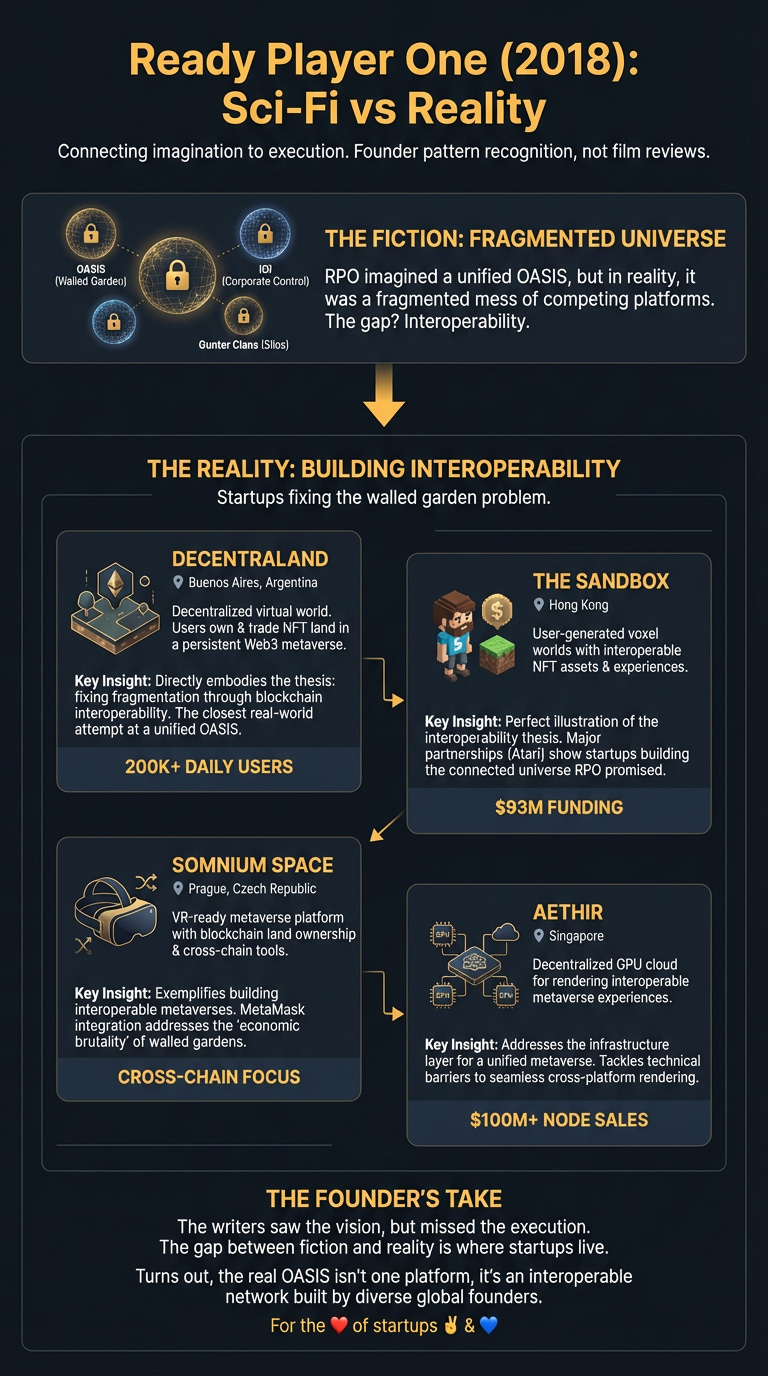
Fiction gave us one OASIS. Reality gave us many, and none of them talk to each other. That’s the entire story of the metaverse, right there.
What They Imagined
In 2018, Ready Player One showed us a bleak 2045 where humanity escapes into a single, seamless virtual universe called the OASIS. It was an infinite digital playground, economy, and social fabric rolled into one. With a simple VR visor and haptic suit, you could be anyone, go anywhere, and own anything. The OASIS solved for societal collapse by offering a better, more exciting digital alternative. It was one world, one login, one identity.
The writers saw it coming: a fully immersive digital layer for life. The key assumption was that it would all be connected.
What We Actually Built
I used to think a unified metaverse was inevitable. Turns out, the economics are fucking brutal. Why would Roblox want you to take the digital goods you bought from them over to Meta’s world? There is zero incentive.
So instead of one OASIS, we built walled gardens. Ready Player One showed a unified world. Reality delivered platform-specific fortresses. Roblox built a colossal one, pulling in $3.6 billion in revenue in 2024 with nearly 83 million people logging in every day. Meta made a multi-hundred-billion-dollar bet on its own version, building the Quest hardware and Horizon Worlds.
Each platform is a powerhouse. Each is a silo. We have good-enough goggles, not a second skin. And the gap between these fortresses is where the dream of a true, open metaverse dies—and where the real opportunity for founders begins.
The Gap They Missed
The film’s biggest blind spot wasn’t the tech; it was the business model. It completely glossed over the raw, competitive drive for proprietary control. Building a single OASIS assumes a level of collaboration and open standards that capitalism just doesn’t favour. Each platform wants to be the platform, not a neighbourhood in someone else’s city.
Here’s the thing: the motivation is also different. We aren’t building the metaverse to escape a dystopian future; we’re building it to augment our slightly lonely, inefficient present. It’s about connection and utility, not desperation. The pattern I keep seeing is founders assuming people want pure escapism, when what they really want are better tools for reality. That’s a fundamental disconnect between the fiction and the market need.
The Players
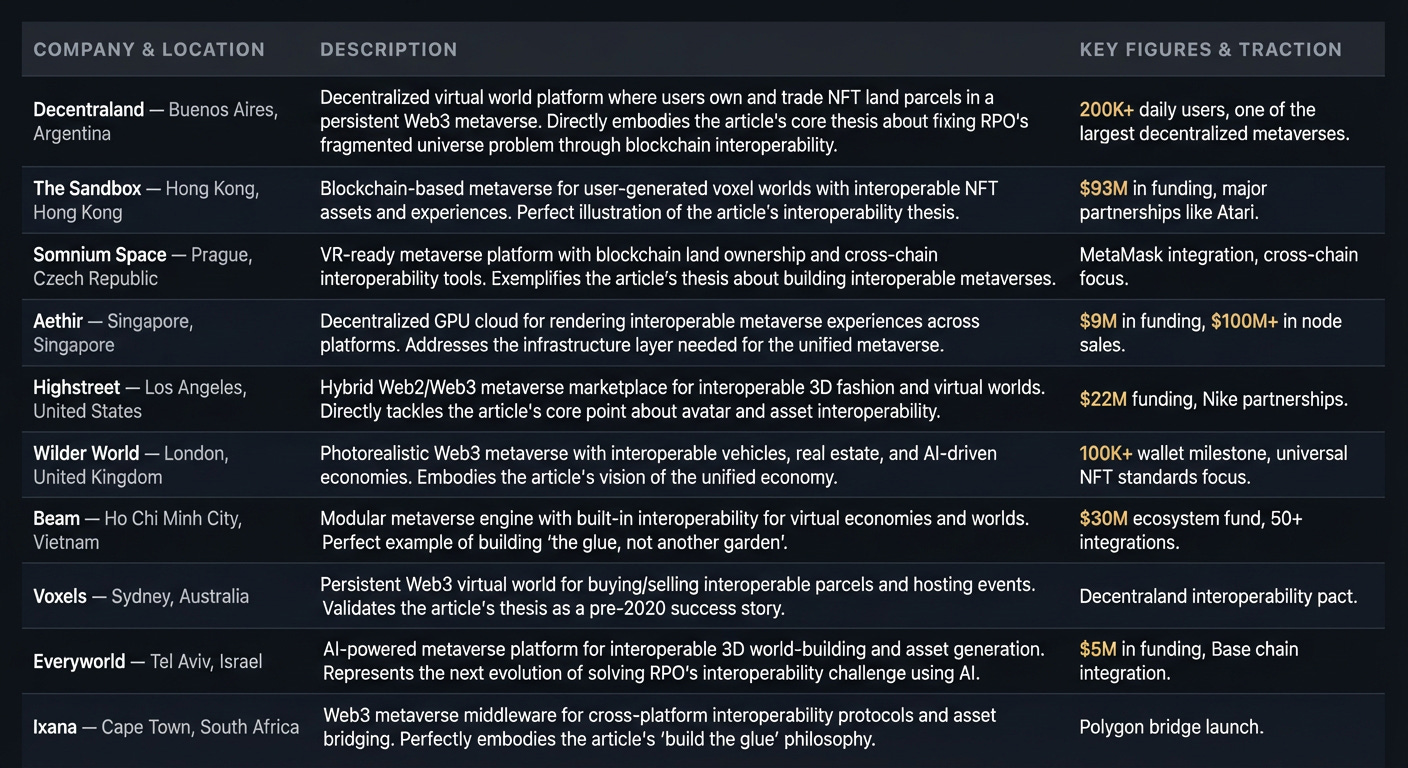
The giants built the islands. The startups are building the bridges. They aren’t trying to create another OASIS; they’re creating the protocols and tools to connect the ones we already have. This isn’t a Silicon Valley story, either. The work is happening everywhere.
Decentraland (Buenos Aires, Argentina): One of the original Web3 worlds where users own the land via NFTs. It’s a live experiment in creating the kind of user-owned, interoperable world the film imagined, proving the concept beyond a single corporate entity.
The Sandbox (Hong Kong): A major player in the user-generated content space, backed by $93M and big partnerships. Their entire model is based on interoperable NFT assets, directly tackling the walled garden problem by design.
Somnium Space (Prague, Czech Republic): A VR-first metaverse that’s deeply integrated with blockchain, allowing for true asset ownership and cross-chain compatibility. They’re building for the immersive future the film promised, but with an open economic layer.
Aethir (Singapore): You can’t have a seamless metaverse without massive rendering power. Aethir is building a decentralized GPU cloud to provide the infrastructure needed for high-fidelity, interoperable experiences, solving a huge technical bottleneck.
Highstreet (Los Angeles, USA): A hybrid of online shopping and gaming, creating a marketplace for digital goods that can “world-hop.” They are explicitly building for asset interoperability, allowing brands to exist across fragmented virtual worlds.
Wilder World (London, UK): Aiming for a photorealistic, AAA-quality metaverse on the blockchain. Their focus on universal NFT standards is a direct attempt to create the ‘take it with you’ asset portability that was effortless in the OASIS.
Beam (Ho Chi Minh City, Vietnam): Instead of building another destination, Beam is building the engine. It’s a modular metaverse framework with interoperability baked in, giving developers the tools to create connected worlds from the start.
Voxels (Sydney, Australia): An early, browser-based virtual world that has already formed interoperability pacts with platforms like Decentraland. They are proof that collaboration, not just competition, is a viable path forward.
Everyworld (Tel Aviv, Israel): Using AI to help users generate interoperable 3D assets and content. This tackles the scalability problem of content creation while ensuring the assets aren’t locked into a single platform from day one.
Ixana (Cape Town, South Africa): Pure-play middleware. Ixana is building the technical plumbing—the protocols and asset bridges—that allows different metaverse platforms to communicate. They’re not building a world; they’re building the universal translator for them.
What’s Left to Build
We have startups building bridges and protocols. But the gap they missed is still the most personal one: you.
In Ready Player One, your avatar, your inventory, and your reputation were singular and persistent. We don’t have that. Your identity is fractured across a dozen platforms. The startup that still needs to exist isn’t another world, it’s a universal passport. A truly portable, user-owned digital identity that plugs into any game or virtual space.
This isn’t just an avatar. It’s a wallet, a social graph, and a reputation score that you own and control. It’s the thing that proves you are you, wherever you go in the digital realm. It’s less about building another world and more about building the passport that lets you travel between them.
The Timing Signal
A generation is growing up inside Roblox and Fortnite; for them, this isn’t a strange new world, it’s just... the world. Their expectation of digital presence and ownership is native. That’s a massive behavioural shift.
Technically, the pieces are falling into place. The launch of devices like Apple’s Vision Pro validates the market for spatial computing, pushing the hardware and developer tools forward. On-device AI is becoming powerful enough to handle real-time rendering and interaction. And open standards like OpenXR are slowly gaining ground, creating a common language for developers. The incentive to connect the islands is finally starting to outweigh the desire to own the ocean.
For the ❤️ of startups ✌🏼 & 💙
Go Deeper
Thank you for reading. If you liked it, share it with your friends, colleagues and everyone interested in the startup Investor ecosystem.
If you've got suggestions, an article, research, your tech stack, or a job listing you want featured, just let me know! I'm keen to include it in the upcoming edition.
Please let me know what you think of it, love a feedback loop 🙏🏼
🛑 Get a different job.
Subscribe below and follow me on LinkedIn or Twitter to never miss an update.
The film got the one big OASIS idea right, but real life split it into competing platforms, and the real opportunity is clearly in the tools that connect them