


December 7, 2025
1. The Historical Anchor: From Gold to Fiat
To understand the current global economic predicament, it is essential to trace its origins to the mid-20th century and the architectural shift in the international monetary system. The post-World War II order, established at the Bretton Woods conference in 1944, was designed to prevent the competitive devaluations and trade wars that had characterized the 1930s. The system anchored global currencies to the U.S. dollar, which was in turn convertible to gold at a fixed rate of $35 per ounce. This created a quasi-gold standard that provided a degree of stability and discipline to international finance.
However, by the 1960s, the Bretton Woods system came under increasing strain. A surge in U.S. foreign aid, military spending (particularly for the Vietnam War), and overseas investment led to a surplus of dollars in global circulation. The United States no longer held sufficient gold reserves to back all the dollars in circulation at the pegged rate, rendering the dollar overvalued. This created a fundamental tension: the world needed U.S. deficits to supply liquidity for global trade, but these very deficits undermined the credibility of the dollar’s gold peg.
1.1 The Nixon Shock and the Dawn of the Fiat Era
The breaking point arrived on August 15, 1971, when President Richard M. Nixon, facing a run on the dollar and a deteriorating trade balance, unilaterally suspended the convertibility of the dollar into gold. This act, known as the “Nixon Shock,” effectively severed the last link between the global monetary system and a physical asset. The move was part of a broader “New Economic Policy” that also included a 90-day wage and price freeze and a 10% import surcharge, all aimed at forcing America’s trading partners to revalue their currencies against the dollar.
While the Smithsonian Agreement in December 1971 attempted to create a new system of fixed exchange rates with a devalued dollar, it proved short-lived. By March 1973, the major currencies were floating freely against each other, marking the definitive end of the Bretton Woods system. The world had entered the era of fiat money, where the value of a currency is based on faith in the issuing government rather than on a commodity peg. This shift had profound consequences, removing the external constraint on U.S. borrowing and enabling the financing of persistent deficits through the printing of money.
1.2 A Marxian Echo: Surplus Value in the 21st Century
The current economic landscape, characterized by a disconnect between production and compensation, echoes some of the critiques of capitalism articulated by Karl Marx. Marx’s theory of surplus value posits that the profit of the capitalist class is derived from the value created by workers above and beyond their own labor-cost. In essence, workers are paid just enough to reproduce their labor, while the excess value they generate is appropriated by the owners of capital.
In the 21st century, this concept finds a new expression. While real wages for the majority of workers in the West have stagnated for decades, the productivity gains from technology and globalization have flowed disproportionately to the owners of capital. The rise of the “gig economy,” the decline of unionization, and the financialization of the economy have all contributed to a shrinking labor share of income. As this report will explore, the advent of AI and robotics threatens to accelerate this trend to its logical conclusion: a scenario where labor’s share of income approaches zero, creating a terminal demand problem that challenges the very foundations of consumer capitalism.
2. The Current Global Landscape: A Tale of Six Economies
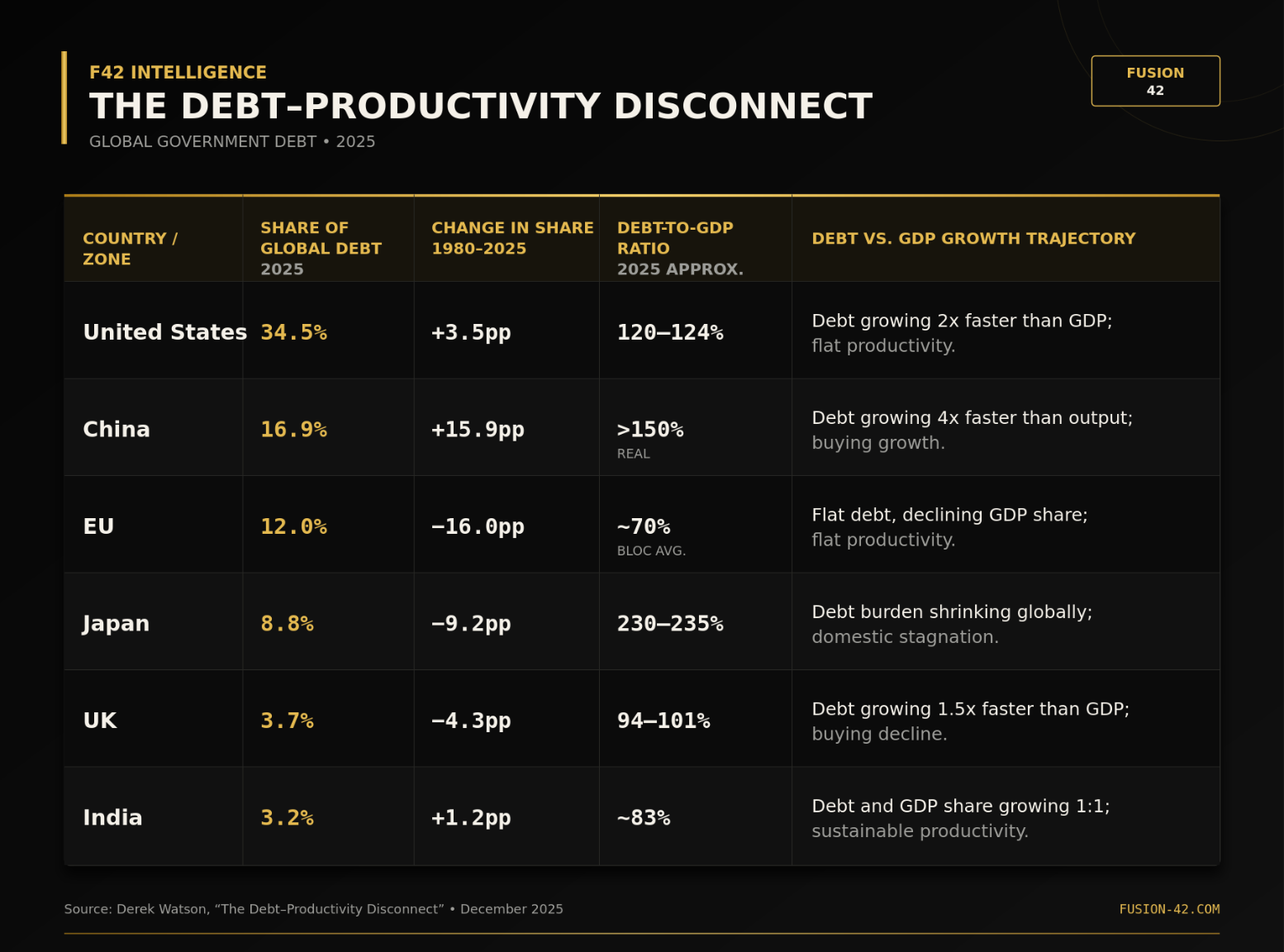
The post-Bretton Woods era of fiat currency has led to a world saturated with debt. As of 2025, six economies—the United States, China, the European Union, Japan, the United Kingdom, and India—account for a staggering 88.2% of global government debt. However, the nature and sustainability of this debt vary dramatically, revealing divergent economic models and future trajectories. This section analyzes the current state of each major economic bloc, drawing on the data presented in the initial user-provided analysis and subsequent research.
2.1 United States: The Illusion of Productivity
The United States remains the world’s largest economy in nominal terms, but this status is built on a foundation of rapidly accumulating debt. With a debt-to-GDP ratio exceeding 120% and a federal deficit of $1.8 trillion in fiscal year 2025, the U.S. is on an unsustainable path. The core of the issue is a stark productivity disconnect: for every dollar of new debt acquired, the economy generates only 55 cents of new GDP. This indicates that borrowing is being used to finance current consumption rather than productive investment, leading to a net destruction of value.
This precarious situation is sustained by the U.S. dollar’s status as the world’s primary reserve currency. This “exorbitant privilege” allows the U.S. to finance its deficits by issuing debt that the rest of the world must hold. However, this privilege is being eroded by geopolitical shifts and the growing desire of other nations to de-dollarize. The structural problems are profound: stagnating labor productivity, a hollowed-out middle class with flat real wages since the 1970s, and extreme wealth concentration, with the top 10% of the population owning 93% of equities.
2.2 China: From Investment to Bailout
China’s economic story is one of two distinct phases. From 2008 to 2018, the country engaged in a massive, debt-fueled investment campaign that built real assets—high-speed rail, modern ports, and vast manufacturing capacity—lifting hundreds of millions from poverty. While the debt grew 9.5 times, the GDP share also grew 2.5 times, a ratio of nearly 4:1. Since 2019, however, China has entered a “bailout phase.” Growth is now being propped up by throwing money at failing property developers and rolling over the immense debts of Local Government Financing Vehicles (LGFVs). The official debt figures are widely considered fiction; realistic estimates place China’s true debt-to-GDP ratio well over 150%.
China’s strategic goal is to achieve manufacturing dominance in key sectors like electric vehicles, batteries, and solar panels through a “race to zero” strategy of state subsidies and market flooding. This has been remarkably effective at destroying Western competition but creates a dependency on global demand. As Western economies face their own debt crises and potential austerity, the sustainability of China’s export-led model is in question, especially as it confronts a severe domestic property crisis and a looming demographic cliff.
2.3 Japan and the European Union: The Stagnation Alliance
Japan and the European Union represent models of managed stagnation, both grappling with severe demographic headwinds and low growth. Japan presents a unique paradox: with a debt-to-GDP ratio exceeding 230%, it should have collapsed decades ago. Yet, because over 90% of its debt is held domestically (with the Bank of Japan owning roughly half), it has avoided a sovereign debt crisis. Japan’s debt is a closed-loop, domestic accounting problem. The consequence is not collapse but a permanent state of stagnation, with a shrinking population and an economy that is declining in global GDP terms.
The European Union’s primary challenge is not debt but a lack of growth. Sclerotic labor markets, a heavy regulatory burden, an energy crisis, and an aging population have conspired to keep growth rates anemic. The ECB’s backstop prevents a sovereign debt crisis in high-debt member states like Italy and France, but it does not address the underlying lack of productivity and innovation. The bloc is borrowing not to invest, but to maintain the consumption levels of an aging populace, effectively treading water while its share of the global economy slowly shrinks.
2.4 United Kingdom: A Nation Adrift
The United Kingdom finds itself in a particularly unenviable position, facing all the structural problems of the United States—stagnant productivity and debt growing faster than output—but without the benefit of the world’s reserve currency. The 2022 mini-budget crisis, which saw gilt yields spike and the government of Liz Truss collapse in 45 days, was a stark reminder that the UK is subject to market discipline in a way the U.S. is not. Post-Brexit promises of a deregulated, dynamic economy have failed to materialize. Instead, the UK has experienced reduced trade, lower investment, and a GDP per capita that has grown up to 10% less than that of its peers.
2.5 India: The Lone Engine of Sustainable Growth
Amidst this landscape of debt and decline, India stands out as the only major economy where the math appears to work. Its debt-to-GDP ratio is a manageable 83%, and for every dollar of debt taken on, the economy generates a dollar of GDP growth—a sustainable 1:1 ratio. This is classical capitalism: debt is funding genuine productivity expansion. The key drivers are a powerful demographic tailwind (median age of 28), a rising middle class fueling domestic consumption, and a focus on real investment in manufacturing and infrastructure. While India faces its own challenges with bureaucracy and inequality, its trajectory is fundamentally sound, offering a counter-model to the debt-fueled consumption of the West and the state-driven overcapacity of China.
3. The Next 15 Years: Three Global Scenarios
The interplay between technological disruption, geopolitical competition, and unsustainable debt dynamics will shape the global economy over the next 10 to 15 years. The massive investments in artificial intelligence and robotics represent a wild card, with the potential to either unlock a new era of productivity or exacerbate existing trends of wealth concentration and labor displacement. This section outlines three potential scenarios for the global economy, flowing from the country-specific trajectories analyzed previously.
3.1 Scenario 1: The Productivity Boom (Optimistic, 20% Probability)
In this scenario, the trillions of dollars being invested in AI and automation finally translate into a broad-based productivity boom. The optimistic projections of a 1.5% or higher annual boost to productivity growth materialize, leading to a significant increase in global GDP. This growth is strong enough to allow major economies to stabilize their debt-to-GDP ratios, even without major fiscal austerity. The United States, leading the AI revolution, experiences a manufacturing renaissance and maintains the dollar’s reserve currency status. Real wages begin to rise as the demand for skilled human-robot collaboration outstrips the supply of qualified workers.
China, facing the limits of its export-led model, successfully pivots to a domestic consumption-driven economy, using its technological prowess to enhance efficiency rather than just subsidize production. India continues its strong growth trajectory, becoming a third pillar of the global economy. The EU and Japan, while still facing demographic challenges, benefit from the global technology spillover and manage to maintain stable, albeit slow, growth. In this world, the “capitalism death spiral” is averted as the gains from productivity are more widely shared through a combination of market forces and policy interventions like a reformed tax system and investments in education.
3.2 Scenario 2: The Great Stagnation (Base Case, 55% Probability)
This scenario represents a continuation of the current trend, where the promises of AI productivity fail to materialize in the aggregate economic data. Productivity growth remains sluggish, at 0.3-0.5% annually, not nearly enough to outpace the compounding of sovereign debt. The United States enters a period of stagflation, with low growth, persistent inflation, and rising interest payments crowding out essential public investment. The dollar’s status as a reserve currency erodes slowly, but no single alternative emerges, leading to a more fragmented and volatile international monetary system.
China’s economy becomes a “zombie,” with the state keeping failing companies and local governments afloat through endless debt rollovers. Its manufacturing overcapacity leads to trade conflicts and deflationary pressures globally. The EU and Japan continue their managed decline, while the UK faces a series of sterling crises and is forced into painful austerity. India’s growth moderates as it gets pulled down by the weak global environment. This is the “muddle through” scenario on a global scale, characterized by declining living standards in the West, heightened geopolitical tensions, and a growing sense of social and political malaise.
3.3 Scenario 3: The Debt Spiral and the Rise of the Machines (Pessimistic, 25% Probability)
In the most pessimistic scenario, the global debt burden becomes unmanageable. A crisis of confidence in the U.S. Treasury market triggers a spike in interest rates, forcing the U.S. into a severe fiscal crisis. The dollar loses its reserve currency status abruptly, leading to a sharp devaluation and a spike in inflation. This event cascades through the global financial system, triggering a wave of sovereign defaults and a deep global recession.
Simultaneously, the deployment of AI and robotics accelerates, not as a driver of shared prosperity, but as a tool for cost-cutting and labor replacement in a desperate bid for corporate survival. This leads to mass unemployment and a collapse in consumer demand, which can only be managed through the widespread implementation of Universal Basic Income (UBI). The world bifurcates into two competing models of techno-authoritarianism: the “corporate communism” of the West, where a handful of tech oligarchs own the means of production and the masses subsist on state-provided income; and the “state capitalism” of China, where the CCP controls the productive assets. In this dystopian future, the middle class is eliminated, democracy is hollowed out, and the global economy is centrally planned by algorithms, with human agency and economic freedom becoming relics of a bygone era.
4. The Wake-Up Call: The Good, the Bad, and the Ugly
The current trajectory is not sustainable. Each major economic bloc faces a distinct set of challenges and a narrow window of opportunity to alter its course. The failure to do so will result in the loss of prosperity, stability, and global standing. The following table summarizes what each economy has, what it stands to lose, and the grim reality it faces if it fails to adapt.
Country / Zone
The Good (What They Have)
The Bad (What They Will Lose)
The Ugly (If They Don’t Wake Up)
United States
Innovation engine of the world (AI leadership), deep capital markets, and the global reserve currency.
Its reserve currency status, global leadership role, and the financial security of its middle class.
A sovereign debt crisis, hyperinflation, and a dramatic collapse in living standards, leading to severe social and political unrest.
China
Unmatched manufacturing scale, state capacity for rapid infrastructure development, and a vast domestic market.
Its path to high-income status, social stability, and its ambition to become the world’s leading economic power.
A “lost decade” of Japan-style stagnation, but with a greater risk of social upheaval due to a less developed social safety net.
European Union
A large, integrated single market, high living standards, strong social safety nets, and significant regulatory power.
Its global relevance, technological competitiveness, and the social contract that has underpinned its post-war prosperity.
A slow slide into economic irrelevance, becoming a “museum of world history” unable to compete with more dynamic regions.
Japan
Extreme social stability, a closed and controlled domestic financial system, and world-class technological expertise.
Its status as a major economy and its ability to maintain first-world living standards for its aging population.
A managed but accelerating decline, where the fiscal burden of an aging population becomes unbearable, forcing a painful societal reset.
United Kingdom
A global financial hub (London), prestigious universities, and significant soft power.
Its position as a leading developed economy and its ability to maintain influence outside the shadows of the US and EU.
Becoming a permanently marginalized, low-growth economy caught between larger blocs, facing recurring currency and fiscal crises.
India
A powerful demographic tailwind, a sustainable debt-to-growth ratio, and immense potential for manufacturing and services growth.
The once-in-a-generation opportunity to achieve developed-nation status and lift hundreds of millions more out of poverty.
Succumbing to the same debt-fueled consumption model as the West, squandering its demographic dividend and getting stuck in the middle-income trap.
Conclusion: The End of Capitalism as We Know It
The world is at the precipice of a paradigm shift. The post-1971 experiment with fiat currency, which untethered money from the discipline of gold, has reached its logical conclusion: a global economy drowning in debt that has been mistaken for wealth. The core engine of classical capitalism—the virtuous cycle of labor, wages, and consumption—is breaking down. It is being replaced by two competing but convergent models that both point to the end of broad-based prosperity.
The Western model, exemplified by the U.S. and championed by figures like Elon Musk, is a form of corporate techno-feudalism. Here, productivity gains are captured entirely by the owners of AI and robots, while the displaced workforce is pacified with state-funded Universal Basic Income. It is a system that concentrates wealth and power in the hands of a tiny elite, turning the middle class into a dependent welfare class. The illusion of growth is maintained, but the reality is a hollowed-out society with no economic mobility.
The Eastern model, perfected by China, is one of state-driven mercantilism. Here, entire industries are captured through massive subsidies and predatory pricing, destroying global competition and creating supply chain dominance. This model exports deflation and unemployment to its trading partners, forcing them further into the debt-and-consumption trap. It concentrates productive power in the hands of the state, turning other nations into dependent consumer markets.
Both roads lead to the same destination: a world where the means of production are owned by a select few (be it tech billionaires or a party apparatus), where the majority of the population is economically disenfranchised, and where the state’s primary role is to manage the distribution of subsistence-level income to prevent revolution. This is not capitalism, and it is not socialism. It is a new and more pernicious system that combines the inequality of capitalism with the dependency of socialism, while offering the accountability of neither.
The debt is the tell. When the world’s leading economies are borrowing a dollar to generate mere cents of GDP, they are not investing in the future; they are mortgaging it to paper over their structural decline. The coming decade will force a reckoning. The choices made by policymakers, corporations, and citizens today will determine whether the world descends into a new dark age of techno-authoritarianism or finds a path back to sustainable, shared prosperity.
References
[1] “Nixon and the End of the Bretton Woods System, 1971–1973.” Office of the Historian, U.S. Department of State. https://history.state.gov/milestones/1969-1976/nixon-shock
[2] “Nixon Ends Convertibility of U.S. Dollars to Gold and Announces Wage/Price Controls.” Federal Reserve History. https://www.federalreservehistory.org/essays/gold-convertibility-ends
[3] “Surplus value.” Wikipedia. https://en.wikipedia.org/wiki/Surplus_value
[4] “U.S. Debt to GDP Ratio | Historical Chart & Data.” Macrotrends. https://www.macrotrends.net/global-metrics/countries/usa/united-states/debt-to-gdp-ratio
[5] “Treasury Confirms $1.8 Trillion Deficit in FY 2025.” Committee for a Responsible Federal Budget. https://www.crfb.org/press-releases/treasury-confirms-18-trillion-deficit-fy-2025
[6] “Years Into China’s Property Crisis, Even More Dark Clouds Gather.” Bloomberg. https://www.bloomberg.com/news/newsletters/2025-12-05/years-into-china-s-property-crisis-even-more-dark-clouds-gather
[7] “The ABCs of LGFVs: China’s Local Government Financing Vehicles.” Reserve Bank of Australia. https://www.rba.gov.au/publications/bulletin/2024/oct/the-abcs-of-lgfvs-chinas-local-government-financing-vehicles.html
[8] “How China won the world’s EV battery race.” BBC Future. https://www.bbc.com/future/article/20251110-how-china-won-the-worlds-battery-race
[9] “Global finances in peril? Debt levels hit insane highs as Japan, US, China, EMU lean on leverage.” The Economic Times. https://m.economictimes.com/news/international/us/global-finances-in-peril-debt-levels-hit-insane-highs-as-japan-us-china-emu-lean-on-leverage/articleshow/125742835.cms
[10] “Autumn 2025 Economic Forecast shows continued growth despite challenging environment.” European Commission. https://economy-finance.ec.europa.eu/economic-forecast-and-surveys/economic-forecasts/autumn-2025-economic-forecast-shows-continued-growth-despite-challenging-environment_en
[11] “A decade of Brexit: Britain falls behind peers in trade and growth.” Euronews. https://www.euronews.com/business/2025/12/03/a-decade-of-brexit-britain-falls-behind-peers-in-trade-and-growth
[12] “India Overview: Development news, research, data.” The World Bank. https://www.worldbank.org/en/country/india/overview
[13] “Gartner Says Worldwide AI Spending Will Total $1.5 Trillion in 2025.” Gartner. https://www.gartner.com/en/newsroom/press-releases/2025-09-17-gartner-says-worldwide-ai-spending-will-total-1-point-5-trillion-in-2025
[14] “Estimating AI productivity gains from Claude conversations.” Anthropic. https://www.anthropic.com/research/estimating-productivity-gains
[15] “Elon Musk Says Optimus Will ‘Eliminate Poverty’.” Business Insider. https://www.businessinsider.com/elon-musk-says-optimus-eliminate-poverty-2025-11