



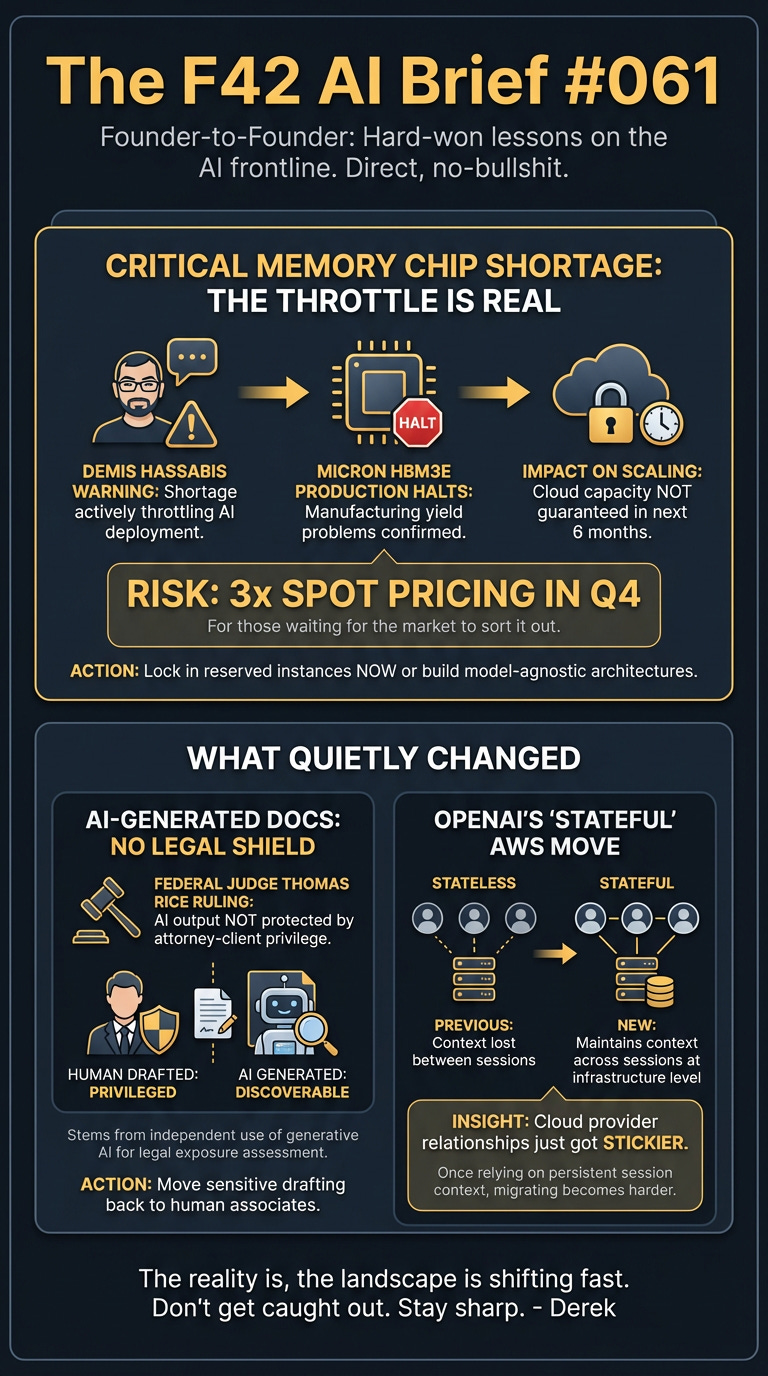
Demis Hassabis issued a stark warning this week: a critical memory chip shortage is actively throttling the deployment of AI models across the industry. Not theoretical scarcity — actual production halts.
Micron confirmed they’re halting manufacture of specific HBM3E chips due to manufacturing yield problems.
If you’re planning to scale inference in the next 6 months, your cloud provider’s capacity isn’t guaranteed. Lock in reserved instances now, or start building model-agnostic architectures that let you shift between providers when one hits a supply wall. The founders who wait for “the market to sort it out” will be the ones paying 3x spot pricing in Q4.

What Quietly Changed
AI-Generated Documents Lack Legal Privilege — Federal Judge Thomas Rice ruled this week in Heppner v. United States that documents generated by AI are not protected by attorney-client privilege or the work-product doctrine
This stems from a defendant’s independent use of generative AI to assess legal exposure
Most founders assume privilege covers anything your lawyer touches. It doesn’t if the analysis is generated by an AI tool. If your GC is using ChatGPT to draft risk memos for board meetings, those documents are now discoverable in litigation. Move that work back to human associates, or accept the exposure.
OpenAI’s “Stateful” AWS Architecture — Buried in the AWS partnership announcement this week, OpenAI’s infrastructure lead revealed they are shifting to a “stateful” architecture. This maintains context across sessions at the infrastructure level. If you’re a CTO making cloud decisions this quarter, the relationship with your cloud provider just got stickier. Once your application relies on persistent session context in AWS, migrating to Azure or Google Cloud Platform gets materially harder.
FDA De Novo for AI Medical Software — The US Food and Drug Administration (FDA) granted de novo classification this week to an AI-powered software from Ultrasound AI designed to predict delivery dates using standard ultrasound images
If you’re building medical AI, pull the de novo summary this week: list the clinical evidence endpoints and validation protocol, and map your product against them. This is the clearest regulatory blueprint we’ve seen for AI diagnostics.
Ginkgo Bioworks’ Strategic Pivot — Jason Kelly, CEO of Ginkgo Bioworks, confirmed this week a major strategic pivot for the synthetic biology company. After extensive losses, Ginkgo is now foregrounding the sale of AI lab robots and automation platforms to third parties, rather than solely focusing on their own bio-foundry services
It’s a recognition that the foundational tools for AI-driven discovery can be a more lucrative product than the discoveries themselves. For founders in deep tech, particularly those with significant CAPEX, it asks a blunt question: is your core IP the end product, or the machinery that makes it? Perhaps the real value is in selling the tools.
The Edge Case
Washington state’s Department of Licensing (which includes the DMV) rolled out an AI-powered voice system for customer service this week. The system, propped up by Amazon Web Services, immediately drew fire for its “heavily accented English.” This wasn’t some minor glitch. Bilingual customers found themselves stuck, then shunted to even longer wait times for a human.
The thing smart people are missing here: it’s not simply an issue of “accent.” The builder’s lesson is this: deploying AI in public-facing services isn’t just about functionality; it’s about inclusive design. An AI that can’t effectively serve a diverse user base is an outright failure. You must test your AI solutions on your actual user demographics, not just for technical performance but for comprehension and cultural fit. “Good enough” clearly wasn’t good enough for the Washington DMV. It’s basic product development. If your AI excludes a segment of your users, you’ve not built a product, you’ve built a barrier.
This Week’s Bet
BUILD: ServiceNow paid $60-80M for Traceloop this week.
Why? Because AI audit trails don’t exist yet, but the need for them is exploding. Compliance teams can’t answer ‘which AI agent accessed what customer data and why?’ Build the Datadog for AI agent activity — not for developers, but for CISOs who need to show auditors a complete chain of custody.
The wedge is enterprises already failing SOC 2 audits because their AI tools don’t log at the required granularity.
BAIL: Stop assuming your AI applications will be judged solely on their computational prowess; pull the plug on any deployment lacking robust, real-world user acceptance testing across diverse demographics. The Washington DMV case is a harsh reminder. Prioritize inclusive design and rigorous, representative user testing over raw performance metrics. Your customers don’t care how clever your algorithm is if it doesn’t work for them.
Go Deeper
Source 1 — Federal Judge Thomas Rice rules AI-generated documents are not privileged.
Source 2 — Venable LLP analysis of Heppner v. United States ruling.
Source 3 — OpenAI’s infrastructure lead discusses “stateful” AWS architecture.
Source 4 — FDA gives de novo classification to AI medical software.
Source 5 — Ginkgo Bioworks pivots to selling AI lab robots after significant losses.
For the ❤️ of startups ✌🏼 & 💙
We are building Arthur, your agentic Startup OS that gets **it done for you.

CLICK HERE TO GET EARLY ACCESS AND YOUR FREE FUEL UNITS
Thank you for reading. If you liked it, share it with your friends, colleagues and everyone interested in the startup Investor ecosystem.
If you've got suggestions, an article, research, your tech stack, or a job listing you want featured, just let me know! I'm keen to include it in the upcoming edition.
Please let me know what you think of it, love a feedback loop 🙏🏼
🛑 Get a different job.
Subscribe below and follow me on LinkedIn or Twitter to never miss an update.
For the ❤️ of startups
✌🏼 & 💙
Derek