



If you’re pouring budget into AI to replace your entire customer support team, you might want to pause. Booking.com just went on record saying its human support is the key thing that sets it apart, and they’re not wrong.

⚡ The Break
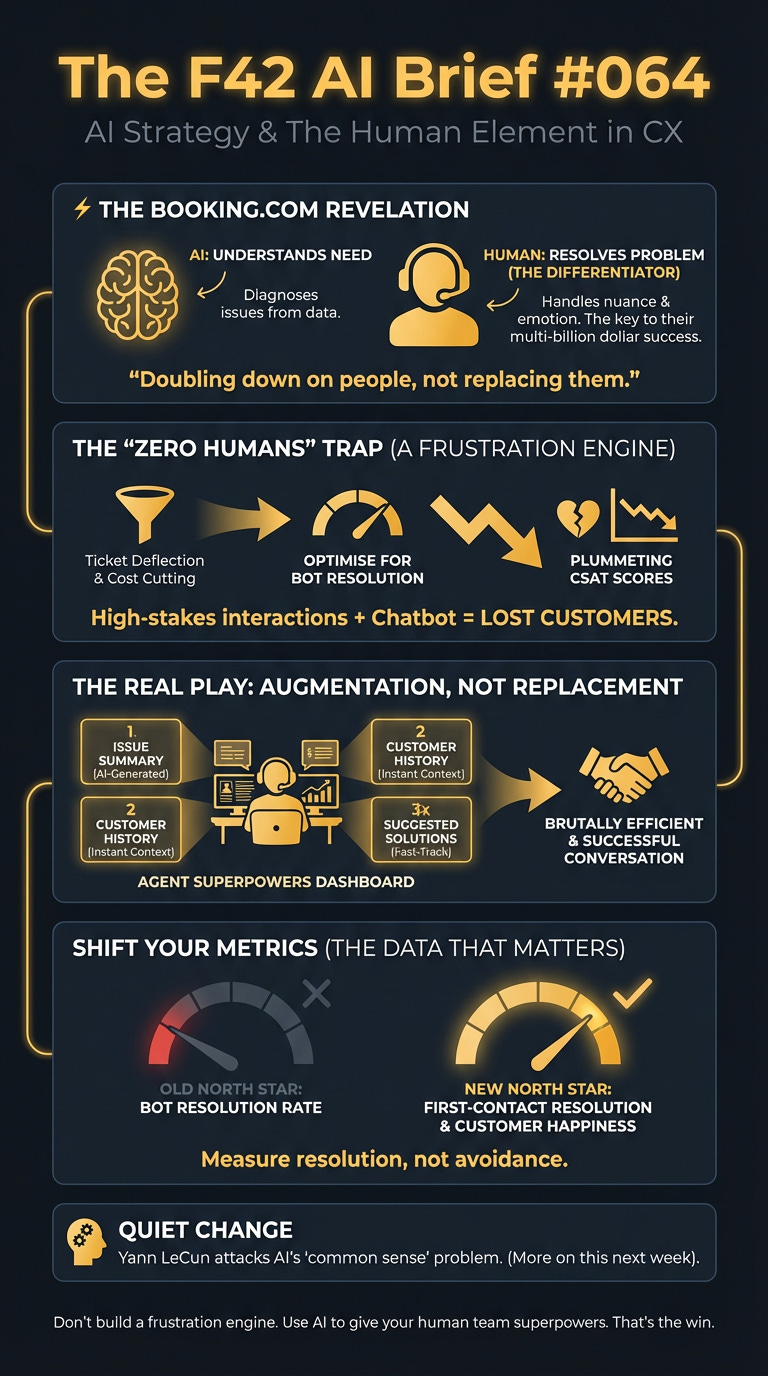
Booking.com made it clear this week: while they use AI to understand what a customer needs, their actual differentiator is having a human resolve the problem. They’re a multi-billion dollar tech company, and they’re doubling down on people.
Most founders assume the endgame for customer service is zero humans. It’s all about ticket deflection and cutting costs. The north star metric becomes how many customers you can prevent from ever speaking to a person.
Turns out, for high-stakes interactions, that’s a fast-track to losing customers. Here’s what this actually means: your customers don’t want to fight a chatbot when their flight is cancelled or their hotel room doesn’t exist. They want a solution. Fast. AI is brilliant at diagnosing the issue from a frantic email, but it’s often shit at handling the nuance and emotion required to fix it. People aren’t stupid; they know when they’re being managed by a script.
I’ve seen good projects hit the wall over this. They optimise for bot resolution rates, and watch their customer satisfaction scores plummet. The real play isn’t replacement, it’s augmentation. Use AI to give your human team superpowers. When an agent picks up a call, the AI should have already summarised the issue, pulled up the customer’s history, and suggested three possible solutions. The goal isn’t to avoid a conversation; it’s to make that conversation brutally efficient and successful.
So, look at your CX roadmap. If it’s a straight line to firing all your support agents, you’re building a frustration engine, not a service. Start measuring your team on first-contact resolution and customer happiness. That’s the data that matters.
🧠 What Quietly Changed
Yann LeCun’s attack on AI’s ‘common sense’ problem — While everyone is distracted by the latest video generator, Yann LeCun’s team dropped research on a thing called LeWorldModel. It’s a direct shot at one of AI’s biggest hurdles: learning how the world works just by watching, like a baby does. The research targets “JEPA collapse” in pixel-based models, which is a technical way of saying it’s trying to stop the AI from getting lazy and ignoring the details when predicting the future of a scene. This is the foundational work required for agents that can actually plan and reason in the real world, not just generate plausible-looking clips.
OpenAI’s $1B ‘goodwill’ fund — The OpenAI Foundation announced a $1 billion grant programme to ensure AI “benefits all of humanity.” This isn’t just a press release about ethics. For a founder, this is a giant flare telling you where the wind is blowing. Building with a clear, defensible social benefit is moving from a nice-to-have to a core requirement for survival. This kind of money doesn’t just fund non-profits; it shapes the entire narrative, pre-empts regulators, and sets the bar for what is considered an acceptable use of powerful technology. If your pitch deck doesn’t have a slide on this, you’re already behind.
The legal storm brewing for AI agents — We’re seeing more research into “agentic AI” and its geopolitical impact, but the quiet part is the immediate legal risk for builders. The moment your AI agent can act on a user’s behalf—making a purchase, sending an email, trading a stock—it can also break the law. When an autonomous agent executes a trade that violates international sanctions, who is liable? You? The user? The company that owns the platform? Most legal frameworks are completely unprepared for this. If you’re building agents, you need to be talking to lawyers now about liability, kill-switches, and how you log an agent’s ‘intent’.
🧪 The Edge Case
There’s a growing chorus of people confidently predicting an AI-driven dystopia. They speak with absolute certainty about how AI will upend society, destroy industries, and change the very nature of humanity.
The reality is, making investment decisions or building a company based on these arrogant predictions is a massive mistake. It presumes the future is a solved problem and that we are all just passengers. It ignores the simple fact that huge, complex systems—like global society—don’t just roll over for new technology. People adapt. They regulate. They find new ways to create value. The breathless predictions of flying cars in the 70s or the paperless office in the 90s should have taught us some humility.
Here’s the thing smart people are missing: they mistake a powerful tool for a deterministic force. They get so wrapped up in the technology’s potential that they forget about human behaviour, economics, and politics.
The builder’s lesson isn’t to ignore AI. It’s to stay grounded. Don’t build for a science fiction novel; build for a real customer with a real problem today. The most resilient startups will be those that use AI to solve a concrete need better than anyone else, while remaining agile enough to navigate the changes as they come. Betting the farm on a single, extreme vision of the future—whether a utopia or a dystopia—is just a dressed-up form of gambling. Solve today’s problems, and you’ll earn the right to solve tomorrow’s.
🎯 This Week’s Bet
BUILD: An AI-powered co-pilot for your customer support team. It should listen to calls and read chats in real-time to instantly surface the exact knowledge base article, previous ticket, or account detail the human agent needs to solve the problem. The goal is not to replace the human, but to make them impossibly fast and accurate.
BAIL: Chasing 100% automated customer support resolution. Set a rule: if a customer asks for a human twice in a row, the bot escalates immediately. The brand damage from trapping a frustrated customer in a chatbot loop is worth far more than the salary you think you’re saving.
For the ❤️ of startups ✌🏼 & 💙
We are building Arthur, your agentic Startup OS that gets **it done for you.

CLICK HERE TO GET EARLY ACCESS AND YOUR FREE FUEL UNITS
Thank you for reading. If you liked it, share it with your friends, colleagues and everyone interested in the startup Investor ecosystem.
If you've got suggestions, an article, research, your tech stack, or a job listing you want featured, just let me know! I'm keen to include it in the upcoming edition.
Please let me know what you think of it, love a feedback loop 🙏🏼
🛑 Get a different job.
Subscribe below and follow me on LinkedIn or Twitter to never miss an update.
For the ❤️ of startups
✌🏼 & 💙
Derek