


I’ve worked with thousands of founders and the thing that has become painfully obvious is that we’ve built an entire industry around telling founders what to do and why, while leaving them to carry nearly all of the cost, the risk and the actual doing.
The expectation is that a founder is a jack of all trades and hopefully an expert in one. You might be a brilliant engineer, a doctor, or someone who understands a particular corner of logistics better than anyone, and then you start a business and overnight you’re supposed to understand market dynamics, pricing, distribution, regulation, fundraising, hiring, sales and a dozen other things you’ve never done, with very little money, almost no room to get it wrong, and a growing collection of people explaining what you ought to be doing. It’s a ridiculous ask and the startup industry has spent decades making it sound normal.
I’ve started and run businesses of my own, some generating eight figures a year, invested in plenty more and spent years working with founders. I also built and ran a global accelerator with over 300 founders. We deliberately concentrated on the how and execution. What are you actually going to do this week, how are you going to do it, and did you do it? Founders don’t need another lecture about why customer validation matters. They need to know how to find the right customers, test their assumptions, work out what they’ve learned and turn that into something that makes money.
What’s changed in the last two years is that a huge amount of that work can now be done by a machine. Not answered, done. Market research that actually goes and reads the market, competitive analysis with the evidence attached, the economics worked out from real numbers, customers found and qualified, the software written, the sales material prepared. Work that took weeks, maybe months, and needed specialists who cost tens of thousands of dollars, can be done in hours, by agents that go away and do the job and come back with what they found. We’re still sending founders off to learn it all and do it themselves, or telling them to ask an LLM a question and take the answer, and that is the shittiest advice of the lot, because a plausible answer and a piece of real work are very different things.
Nobody measures the founder
When you hire someone there’s an invoice. When you do it yourself nobody measures anything.
Think about how much has to happen before you’ve built anything. Whether the problem is real and who actually has it. How the market is structured and where the money moves. Who the competitors are, what they charge, what they actually solve and where the gaps are. Market size, economics, regulation, how you reach customers, and whether the market you’re entering today will look anything like the same market in two years. All of it needs knowledge you probably don’t have, so you research. You watch videos, read reports, talk to advisers, sit through workshops and increasingly ask ChatGPT, hoping you know enough to spot when the answer is wrong. A few hundred hours go remarkably quickly, and that’s before the company itself, the accounts, the legals, the bank, the tooling, until you’ve got 20 SaaS subscriptions, a logo and a Notion workspace and it feels like a business.
At $100 an hour every hundred hours is $10,000 of your own time. Three hundred hours is $30,000. Illustrative, not money you’ve spent, but your time has a value whether or not it goes through the accounts, and because nothing left the bank it felt free.
I spent a long time allocating capital and the question was never what something cost, it was what it returned against the alternatives. Founders allocate their scarcest resource every day and almost none of them measure the return. Sometimes a few hundred hours of research saves you from a catastrophic mistake. Sometimes it produces a spreadsheet nobody opens again, and the hours are the same either way. And then there’s the cost that doesn’t show anywhere, the customers you didn’t call and the product you didn’t ship while you were learning to do something you weren’t qualified for.
An investor can spread capital across thirty companies. A founder can’t spread five years of their life across thirty startups. When it goes wrong the loss isn’t the money, it’s the earnings you gave up, the savings, the relationships that took the strain, and that’s a hell of a lot of risk to carry while learning on the job.
The assumptions you never called assumptions
Most founders can’t tell you which parts of their plan are facts, which are assumptions and which they simply don’t know. It’s all one document. The market size came from a report, the pricing from a competitor’s website, the churn number from a conversation at a conference, and all three sit in your head, a Google doc or a spreadsheet with the same font and the same confidence. Six months later the business is executing against a number that was a guess in February and is wrong by October, and nobody noticed because nobody wrote down that it was a guess.
You can’t ask a question you don’t know needs asking. The founder asks what they think is the right question, the AI answers it, the adviser makes a recommendation, everyone moves on, and nobody checks whether the question was wrong. That’s how capable people spend years on businesses that should have been challenged in month one. And we treat validation as something you do once. Find a problem, talk to customers, build an MVP, start selling. Sensible, but a problem people will pay to solve isn’t necessarily a good business, and a market that made sense at launch can be hostile eighteen months later. The assumptions need challenging continuously, and nobody is set up to do that.
The economics have moved and the playbook hasn’t
The fundamentals haven’t changed. Customers who pay, a way to reach them, economics that work, enough cash to keep going. Almost everything around those fundamentals has.
A small team can now build what used to need an engineering team and millions in capital. Wonderful, except your competitors have the same tools, so do your customers, and so do the incumbents with distribution and cash. In McKinsey’s 2026 State of AI survey, 32% of respondents said their organisation had decided not to buy at least one software product or feature because they could build it internally with agentic coding tools. You’re not only competing with the other startup any more. You’re competing with the possibility that your customer builds it themselves.
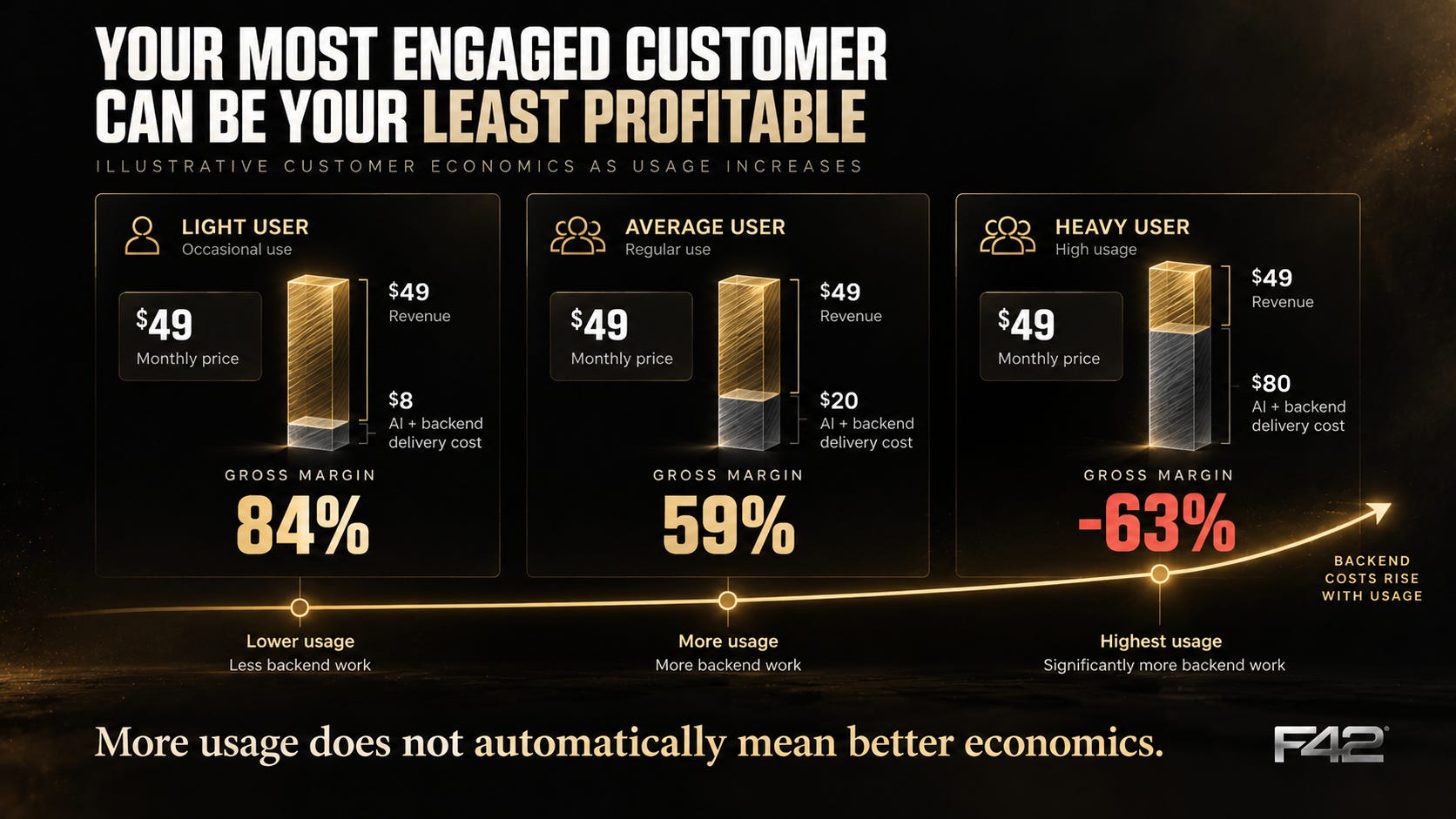
The cost structure has changed as well. SaaS ran on relatively low marginal cost. AI products carry usage costs that swing wildly from one customer to the next. Every call to the AI costs money and long conversations, big contexts, specialist agents and jobs running all day add up. Say you launch at $49 a month and your average customer costs $10 in usage. Fine. Then you land a few enthusiastic customers who run agents constantly, and one of them costs you $80 a month against a $49 subscription. Your most engaged customer is losing you $31 a month before you’ve paid for anything else, and growth makes it worse, not better.
And the $80 is only the part you can see. Behind every customer there’s a stack of AI doing work they never touch. I know because I’m building one. For every piece of work a customer sees there are a dozen jobs they don’t. The research that got checked, the output that got rejected and rerun, the enrichment that happened before the agent even started, the background jobs running overnight, the evals to make sure the thing is still working, and the list goes on. None of it shows up as a feature and all of it shows up on the invoice. For an AI product the opex line isn’t hosting any more, it’s compute, and it’s one of the biggest numbers in the business before you’ve paid a salary.
This isn’t theoretical. Earlier this year a one-person AI company in the US went from 500 to 5,000 paying customers in four months, and because every action in the product was an agent doing real work, the AI bill hit $1.2 million a month. The founder said it nearly bankrupted him. He got it down to about $100,000 by moving to rented GPUs and open-weight models, and when he said so publicly a well-known investor cheered it as heresy to the tokenmaxxers. Tokenmaxxing is the rhetoric founders are being dragged into. Spend the tokens, growth is the only number, don’t bother with the numbers because nobody knows what five years out looks like anyway. Nobody knows what five years looks like. You can still know what next month’s compute bill looks like, and whether the customer paying you $49 is costing you $80. The investor telling you not to do the numbers isn’t the one who gets the invoice.
Then you realise you’ve got to factor raw compute and inference pricing into your gross margins, and nobody at the accelerator mentioned it.
Here’s the bit that should worry people. A founder can do everything the playbook says, the accelerator, the plan, the early customers, and still end up with a business where the best customers cost more than they bring in, because the framework was right and the assumptions inside it were never tested against how AI products actually run. And when that information turns up, the usage data, the first big customer’s bill, the numbers should change, the pricing should change, the customer strategy should change, without the founder losing another week working out what it means. That’s not what happens. The founder finds out from the invoice.
All of this while the money concentrates. US startups raised $412.7 billion in the first half of 2026 according to the PitchBook-NVCA Venture Monitor, and 87.5% of it went into rounds of $100 million or more. The remaining 12.5%, about $51.4 billion, was spread across every round below that. Record funding in the headlines, most founders fighting over a small share of it. And you can see where that goes. SimpleClosure, which handles shutdowns, found that of the companies it closed in the first half of this year that gave a reason, 22.2% cited a change of priorities and another 5.4% founder conflict or burnout. Founders aren’t all waiting for the money to run out. Some are looking at what it’s going to take and deciding they’ve had enough. We should be helping them make that calculation a great deal earlier.
Two ways to start the same company
Take someone who’s spent twenty years inside a bank. They know one operational problem extremely well, they’ve watched the same process eat thousands of hours, they know the people, the regulations, the systems and where the money’s wasted.
The old way. They get into an accelerator and learn how to validate. They spend three weeks reading about competitors, pay someone for a financial model, go to a workshop on customer discovery and come out knowing they should interview twenty people. Finding those twenty, working out whether they’re the right twenty, getting them to talk, asking sensible questions and interpreting the answers is their problem. They find a developer, start raising, and eventually get in front of a customer six months in. Every piece of work done by them, in the evenings, or paid for with money they don’t have.
The other way. The founder puts in what they know about the problem. An agent investigates the market, which banks have the problem, how existing suppliers approach it, what they charge, where previous products struggled, which bit of the market a new company could actually reach. Another goes at the economics, what it costs to build and run, what it costs a bank to implement, how long the sales cycle is likely to be, what happens to cash if the first customer takes nine months to sign. The system digs into procurement, prepares the customer research plan, identifies the organisations, researches the contacts, drafts the outreach, and with the right permissions helps run the replies, book the interviews and analyse what customers actually said. Then it compares the lot with the original assumptions. Perhaps the buyer isn’t the head of operations, the budget sits with technology. Perhaps the problem is real but procurement makes the sales economics hopeless. Perhaps a smaller segment is easier to reach. Useful to know before six months of building.
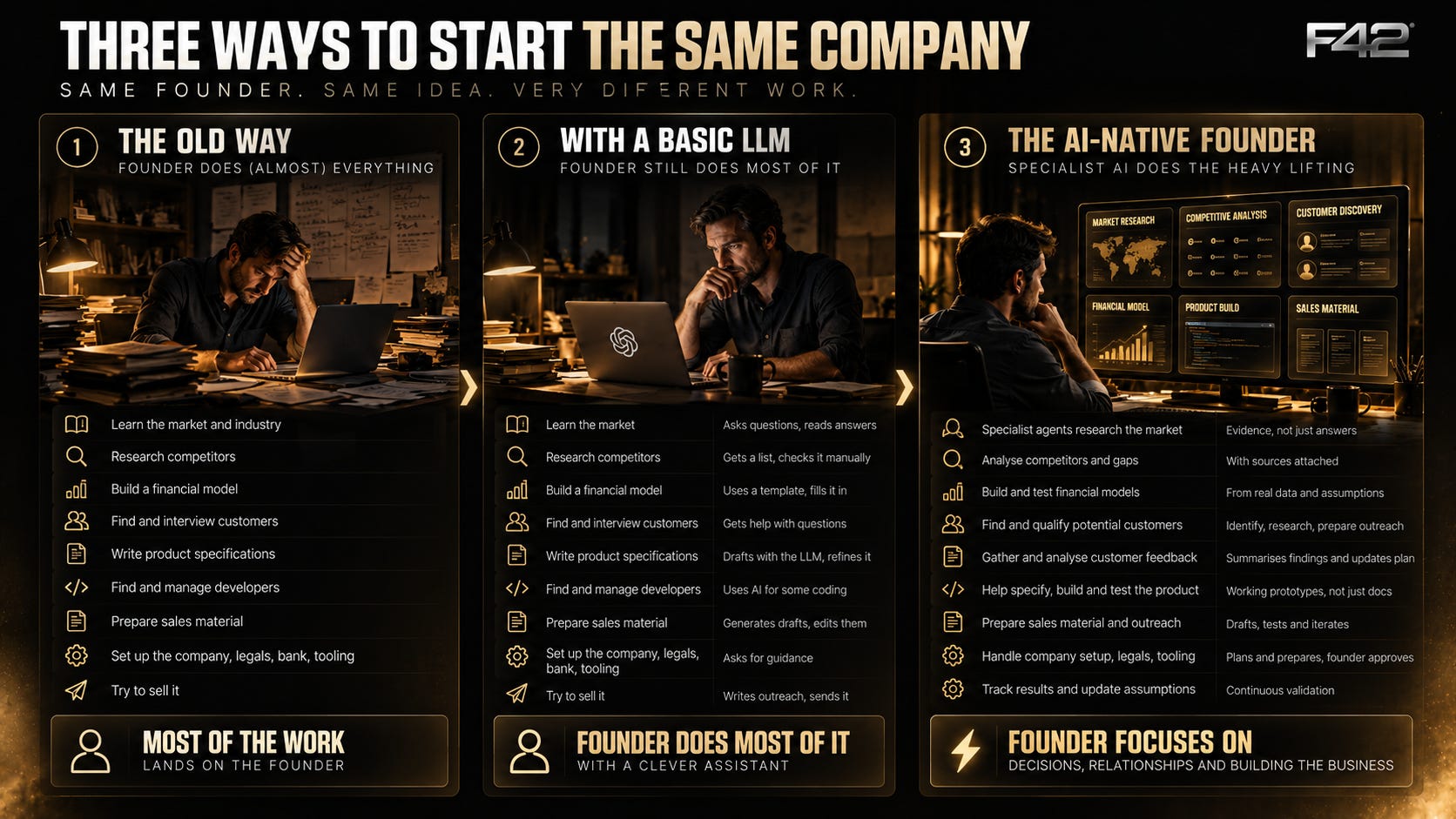
The founder reviews the evidence, makes the calls, builds the relationships, writes most of the product with AI doing the coding, and spends their time on the parts that actually need them. Same company, same founder. In the first version they spent six months as an unpaid junior researcher and an amateur financial modeller. In the second they did the founder’s job, looked at the evidence, tested the commercial assumptions, talked to customers, and the rest got done alongside them.
That second version is not what you get by opening ChatGPT. It needs a system built to work across the whole business, and that’s the gap.
What makes an AI a co-founder
Two years ago the best AI matched or beat an experienced professional on about one in seven real knowledge-work deliverables, on OpenAI’s own GDPval benchmark. By this spring the leading systems were at four in five, and the independent leaderboards now have half a dozen labs, closed and open-weight, within a few points of each other at the top. Which one is ahead changes monthly and doesn’t matter. The quality of work on tap does. I use these tools constantly and some of the output is better than what I’ve paid junior researchers for.
The AI is only part of the problem. Even when it does the work brilliantly it can be doing it on the wrong problem. The founder asks a question and the AI answers it, and if the question is wrong it will do an excellent job of answering it anyway. Point an agent at the wrong market or a business that doesn’t make economic sense and it produces an enormous amount of impressive work, research, comparisons, forecasts, a polished go-to-market, all supporting a business that never made sense. The failure used to be a thin answer. Now it’s a thick one, and the agent acts on it, so a bad assumption can set off hours of research, code, outreach and automated activity before anyone notices the start was wrong.
The AI alone doesn’t know your business. It doesn’t know what happened in your last customer interview, which assumptions you’ve tested, what the current numbers say or why you abandoned a market three months ago. It doesn’t notice when something it just found contradicts a decision you made last week. A co-founder does. A co-founder challenges you, remembers, knows which assumptions have been tested and knows when something needs a decision rather than another report.
So the system around the AI is the whole game. It needs a reliable picture of the company and its history. It needs to keep facts, assumptions and unknowns apart and hold on to the evidence behind each decision. It needs specialist knowledge across the different jobs of building a business and some way of checking the work was done properly. It needs to connect the work, so when five interviews kill the pricing assumption the numbers update, the sales plan changes and the next product decision changes with it. And it needs boundaries. Researching a prospect is low risk. Sending the message, spending the money, touching sensitive data or committing the company is not, and the founder stays in control of that line. If you’re copying the same information between six disconnected tools and explaining the business from scratch every time, you haven’t got a co-founder, you’ve got six more things to manage.
Parts of this exist and some tools do single pieces well. Bringing the knowledge, the evidence, the decisions and the execution together reliably is harder, and it’s the direction that matters.
What founders should expect now
Paying someone to tell you what to do and then going away to do the work yourself was defensible when there was no alternative.
There is one now, and it changes what a founder should expect. I want a system that understands what I’m building, knows what’s already established and challenges the assumptions that haven’t been tested. If the next job is a market, I want it researched, with evidence I can inspect and conclusions I can argue with. If it’s customers, I want to know who they are, why they fit, how to reach them and what it costs to find out if they’re interested. If we run an experiment, I want the result recorded and the next decision made with it. I want to know what was done, what it cost, how long it took, what evidence it relied on and what changed as a result, and I don’t want to start from scratch every time.
None of that removes the founder. It gives them back the time for the things that need their judgement, their relationships and their willingness to carry the responsibility. There’s no shortage of businesses that can be built and AI makes that easier every month. The harder question is whether they should be, whether the economics work, and whether someone can turn them into a company with paying customers.
We’re close to the point where a founder describes the business they’re trying to build and specialist AI goes and investigates the opportunity, tests the economics, finds the customers, prepares the work and helps get it done, and when something changes it knows what else needs looking at again. Most of the pieces exist. What’s missing is the bit that holds them together with the knowledge, the evidence, the checking and the permissions a real business needs. I think that’s going to change what founders are prepared to spend their time and money on.
If all AI does is make it easier to produce software, business plans and companies without improving the decisions behind them, we’ll produce more failed startups, faster, and the cost still lands on the founder.
I think founders are going to start asking the people and the systems they pay a much less polite question. What have you actually done for me, what did it cost and what was the result? Most of the advice industry hasn’t been good at measuring that. And if you’re a founder, it’s worth asking yourself the same thing about the last few hundred hours you spent on work you weren’t qualified to do.
Go take a look, For the ❤️ of startups
Scout - who just got funded
Newly funded startups, pre-seed to Series B, as the rounds happen.
Raise - who’s deploying
New funds with fresh capital and cheques to write.Wire - what changed, what matters
The intelligence feed that filters the noise, with the “so what” attached.
If you have not joined the Fusion42 Community on Telegram —
it is probably time to do so.
For the ❤️ of Startups
✌🏼 & 💙
Derek
Thank you for reading. If you liked it, share it with your friends, colleagues and everyone interested in the startup Investor ecosystem.
If you've got suggestions, an article, research, your tech stack, or a job listing you want featured, just let me know! I'm keen to include it in the upcoming edition.
Please let me know what you think of it, love a feedback loop 🙏🏼
🛑 Get a different job.
Subscribe below and follow me on LinkedIn or Twitter to never miss an update.