


The old rule was simple: don’t start without two co-founders — ideally three — to cover tech, product, and sales. AI made that rule outdated. One technical founder with the right tools can now do the work of a small early team, which changes what ‘balanced’ looks like.
Why This Mattered Before
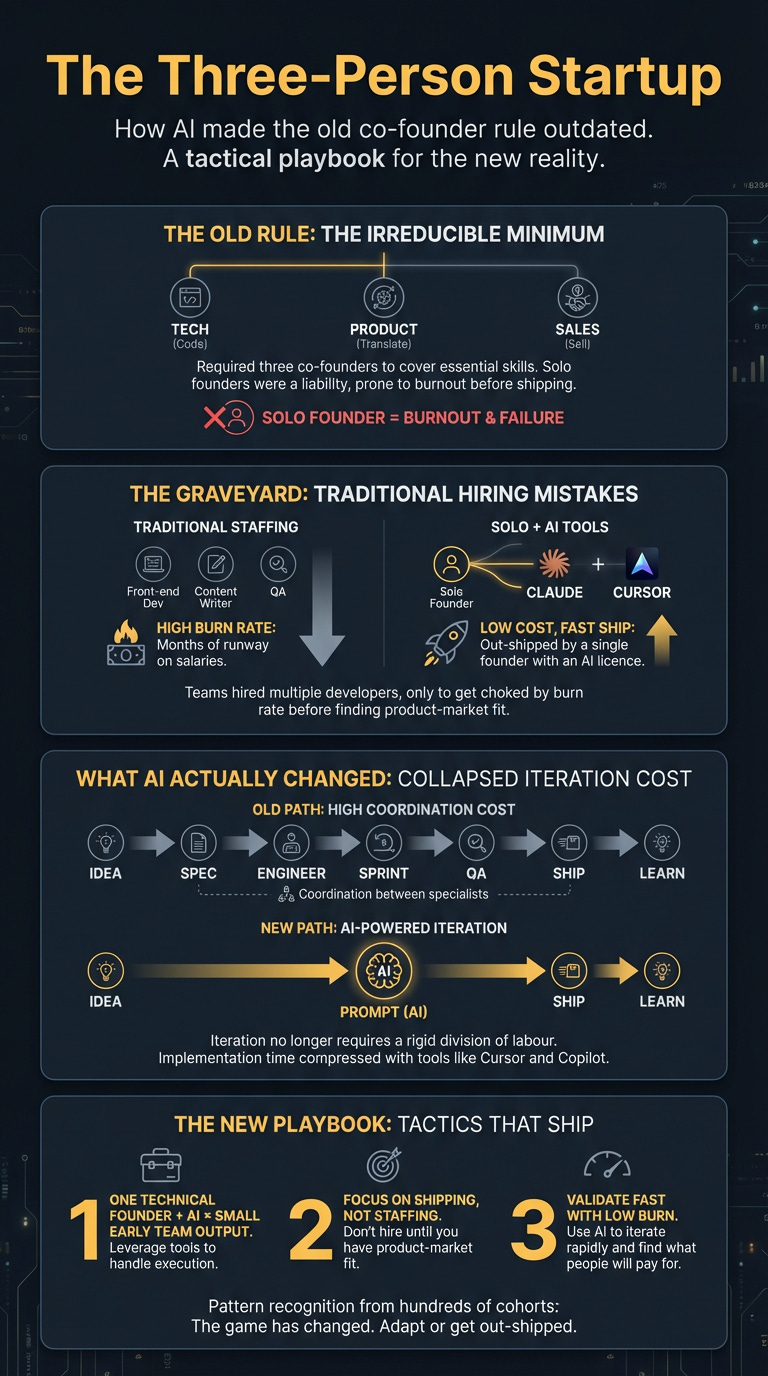
You need three co-founders. That’s what every accelerator told you: a technical founder who codes, a product founder who translates user needs, a business founder who sells. The solo founder was a liability—you’d burn out before you shipped.
I’ve watched this play out across hundreds of cohorts. The solo technical founder who couldn’t articulate the problem they were solving. The product visionary who couldn’t ship. The business founder with a deck but no demo. Each failed in predictable ways. The three-person team wasn’t about having bodies in seats — it was about covering the irreducible minimum of skills required to build something people would pay for.
The Graveyard
I’ve watched founders in my cohorts make this mistake. They’d staff up, hiring for traditional roles – a front-end developer, a content writer – whilst a solo founder with Claude and Cursor was already shipping. By the time they realised they were building a Rolls-Royce for a scooter market, they’d burned through months of runway on salaries that AI could’ve handled for a fraction of the cost. I’ve seen teams hire multiple developers, only to get out-shipped by a competitor with a single founder and an AI licence. Their burn rate choked them before they found product-market fit.
What AI Actually Changed
AI collapsed the cost of iteration. The old path—idea, spec, engineer, sprint, QA, ship, learn—demanded coordination between specialists. Now, it’s idea, prompt, ship, learn. This shift isn’t about AI being ‘powerful’; it’s that iteration no longer requires a rigid division of labour.
Implementation time compressed with tools like Cursor and Copilot. Specification writing, documentation, and even early marketing copy shrank from days to hours with Claude. Operational overhead, like customer support and rudimentary data analysis, is now largely automated. The bottleneck shifted from ‘can you code or write?’ to ‘can you decide what to build and ship it fast enough to learn?’ Early generalists with AI now out-iterate prematurely specialised teams.
The New Playbook
Start solo or duo. Add AI as your third. Don’t hire for output you can generate with AI. Hire for judgement, relationships, or domain expertise.
Run a 30-day loop:
Week 1: 15 customer calls. Write 10 problem statements. Pick one.
Week 2: Build the narrowest possible workflow in Cursor. Ship to 3 design partners.
Week 3: Instrument usage. Collect objections. Iterate daily.
Week 4: Charge. If nobody pays, kill it.
Hire when you’re turning down revenue. The undeniable signal that you’ve waited too long is when you are actively having to turn down revenue opportunities because your current setup cannot adequately deliver. Not when you’re busy. Not when you’re stressed. When you’re saying no to money because you physically cannot fulfil the work.
When you do hire, hire for what AI can’t do: complex sales, deep domain expertise, or strategic partnerships. Don’t hire a content writer. Don’t hire a junior developer. Hire the enterprise sales lead who can navigate six-month procurement cycles, or the domain expert whose knowledge isn’t in any training dataset.
The Warnings
Speed without a clear, validated direction is merely an expensive distraction. I’ve watched AI-enabled founders ship five products in six months and gain zero traction because they never validated the problem. AI removes the friction of building — it doesn’t remove the need to talk to customers first.
The second trap: staying lean becomes staying stuck. Some founders use “AI can do it” to avoid hiring when they’re already turning down revenue. That’s not discipline — that’s fear. If customers are waiting and you can’t deliver, hire.
The Bottom Line
The question isn’t ‘Can one person do this?’ It’s ‘Why would three?
Part of Startup Principles for an AI World — 30 principles for building in the new era. New issue every week.
Arthur is the AI native startup operating system I’m building in public — not hype, but a system that turns input into structured execution and tracks founder progress. If you want to follow or use it, it’s open for early access.
→ Access Arthur
Enjoy and hope to see you soon.
❤️ & ✌🏼
Thank you for reading. If you liked it, share it with your friends, colleagues and everyone interested in the startup Investor ecosystem.
If you've got suggestions, an article, research, your tech stack, or a job listing you want featured, just let me know! I'm keen to include it in the upcoming edition.
Please let me know what you think of it, love a feedback loop 🙏🏼
🛑 Get a different job.
Subscribe below and follow me on LinkedIn or Twitter to never miss an update.
Airopic is doing the same. Hopes he is not your competitor. Internet/news