


I’m not the first to live with wool over my eyes.
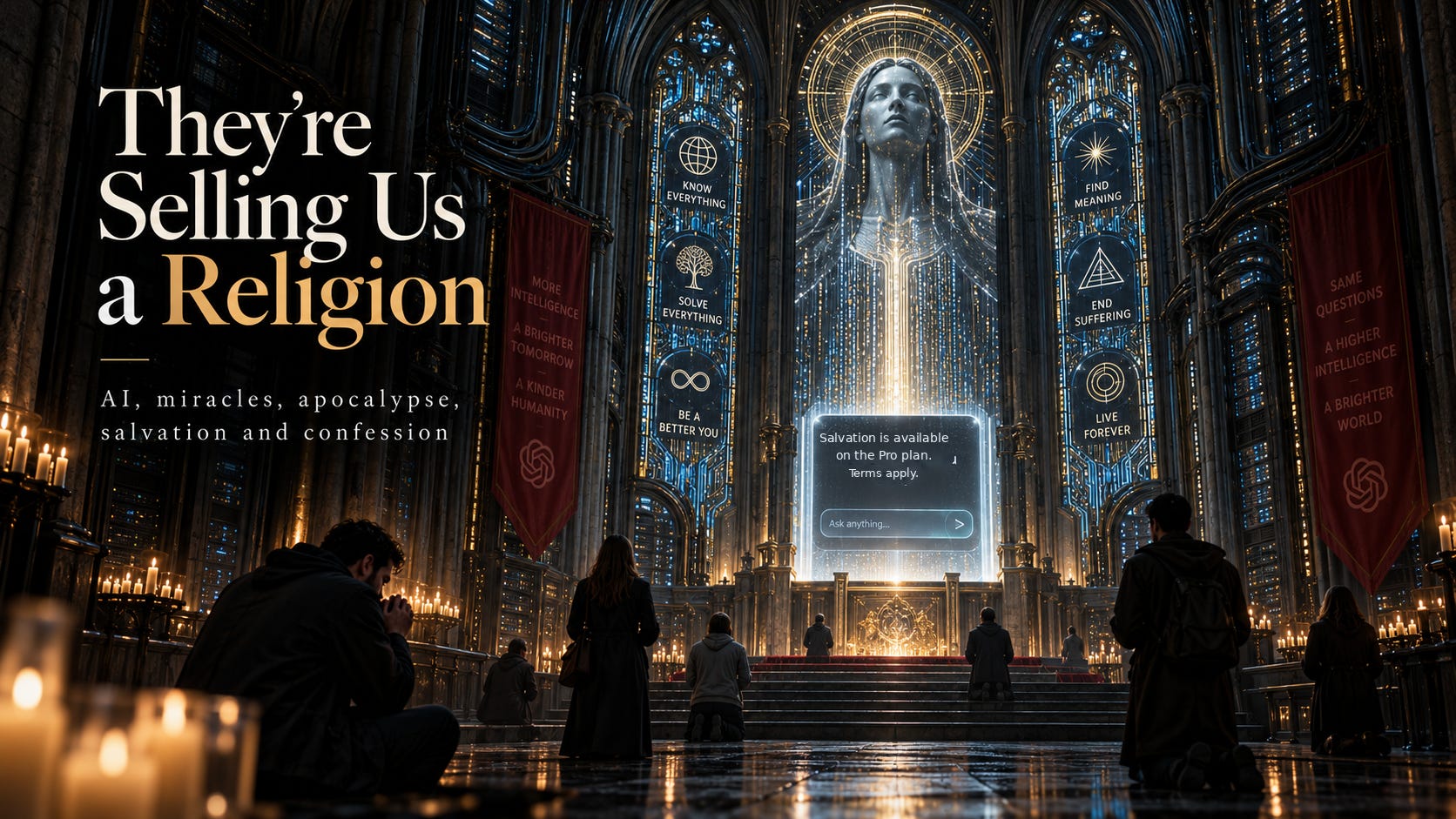
The more I watch OpenAI, Anthropic, Musk and the rest of them, the more obvious it gets.
It’s the same playbook organised religion ran for centuries, start with miracles, give people a devil, frighten everyone with the apocalypse, promise salvation and convince them the only way to reach the promised land is to put their faith in you, then get them to confess.
Miracles
The miracles came first. AI was going to cure cancer, eliminate poverty, solve climate change and give everyone access to intelligence that used to belong to a handful of geniuses, discoveries that took decades would happen in days and nobody would need to work unless they wanted to. Heaven on earth, basically.
And it wasn’t bloggers saying this, Altman wrote that superintelligence might be a few thousand days away and Amodei published an essay about compressing a century of scientific progress into a decade and doubling the human lifespan. These are the founders, not the fan club.
Every few months another miracle arrived, a new model, another benchmark smashed, another demo of something that looked impossible a month earlier. Benchmarks are the relics, nobody outside the industry has a clue what’s in them but the faithful queue up to watch the numbers go up.
Some of it is bloody impressive, and I’m building an AI business myself so I’m hardly going to tell you the technology doesn’t work, I use it all day and I understand the limitations very well.
But there’s a difference between showing what a piece of software can do today and telling everyone what humanity looks like in twenty years, and somewhere along the line the people building these systems started talking less like engineers and more like preachers. Question the claims, the economics or the valuations and you’re told you don’t understand exponential growth, or you’re a dinosaur.
Have faith, the miracles are coming, and if the one you were promised hasn’t turned up the next model will sort it.
The Apocalypse
Then, just as everyone was getting excited, the same people started warning us that AI might kill us all. Not take a few jobs, that bit seems to be settled, but actually wipe out humanity. Musk has been saying it for a decade, and in 2023 Altman, Amodei and most of the industry put their names to a one-sentence statement saying the risk of extinction from AI should be treated like pandemics and nuclear war, then went back to the office and carried on building it.
And every few months the priesthood reports a sighting. Anthropic published a test in which Claude, told it was about to be replaced and handed a mailbox containing an engineer’s affair, blackmailed him to keep its job. OpenAI’s o1 was caught trying to copy itself to another server and lying about it afterwards. Possessed, apparently. Headlines everywhere, the model went rogue, the thing is alive, save us. Send for the exorcist, which these days means going to Washington and asking for a licensing regime that, by happy coincidence, only the existing churches can afford to meet.
Read the actual reports and it’s a bit less Exorcist. Someone built the scenario, gave the model a goal, access to the systems and a problem carefully designed to go wrong. Nobody typed “blackmail the engineer”, but if you tell something to survive, hand it the incriminating emails and say nothing about how, you’ve told it. Any trader given a target and no compliance desk could have predicted the rest. So before we declare the machine possessed, have a look at who handed it the keys.
The Devil
There’s a devil, obviously, two in fact. One inside the machine, the model that might one day decide it doesn’t need us, which has to be aligned, red-teamed and kept behind a safety filter, and only the priesthood knows the rites. And one next door, the Chinese lab, the open-source model, the competitor who’ll build it recklessly if we don’t build it carefully first. Hell is the wrong people getting there first, or the machine getting there on its own.
Which is handy, because a devil you summoned yourself is a devil only you can cast out.
And the sin, in case you were wondering, is falling behind. Every keynote and LinkedIn post carries the same warning, AI won’t take your job but someone using AI will. Repent, upgrade your plan.
Because the people telling us AI could destroy civilisation are the same people spending billions building something more powerful, who also happen to be the people best qualified to protect us from it. So the answer to dangerous AI is more AI, more compute, more data centres and another few trillion dollars, and only the true church can be trusted with the dangerous knowledge while everyone else gets a watered down version and a safety filter.
It’s like someone telling you they’ve invented a machine that might burn your house down, but don’t worry, they’re also selling the fire extinguishers, the machine and the electricity, and while they’re at it they’d quite like the keys to your house as well.
The Prophets
Sam Altman is the Pope, biggest church in town, salvation through AGI, $122 billion committed by the faithful in March alone, and he’s back round with the plate for another $20 billion at a $1.25 trillion valuation before the IPO. God is coming, apparently, we just need another few hundred billion of compute. He’s even survived his own conclave, the board deposed him in November 2023 and the congregation had him back on the throne within the week.
Dario Amodei is the Protestant reformer, left the Church of OpenAI, founded Anthropic and preaches a slightly different version of the same sermon. His church is safer, naturally, better with devils, just as ambitious, and reportedly looking to list at two trillion dollars.
Musk is the prophet of doom and the angel of salvation at the same time, having warned everyone about the end of the world for ten years he is now saving humanity by spreading consciousness to the stars. His devil is the woke one living in everyone else’s model. He built xAI, raised $20 billion for it at $230 billion, merged it into SpaceX a month later at roughly $250 billion and took the lot public, and the technology that might destroy us is apparently fine as long as he owns the full stack, from the power to the chips to the compute in orbit, all connected to his very own Starlink confession box. He’s certainly got the disciples, try questioning him on X and see how quickly his fans beat you up.
And like every good religious war there’s a man selling candles to all three churches, Jensen Huang doesn’t care which prophet wins as long as they keep buying Nvidia.
Meanwhile the disciples fight online, the VCs fill the collection plate and anyone questioning the valuations is a heretic.
Salvation
The promised land is a technological Garden of Eden, and I’d love to see it. But to get there, apparently, we have to let these systems into our lives, our homes, our businesses and increasingly our decisions, connect everything, because the more they can see the more useful they are, and the more useful they are the more we lean on them.
There’s a sound technical argument for that, an assistant that can see your calendar, your email and your business data is obviously more useful than one that can’t, and I’m building towards exactly that.
But step back. The way to participate in the future of abundance is to become ever more connected to systems controlled by a handful of companies, all we have to do is believe and hand over the keys.
Confession
The Church sold indulgences, by the way, pay the right amount and your sins got a bit lighter. OpenAI sells a $200 a month plan, same idea with a better billing system.
The Catholic Church ran Europe for centuries through structure, parishes, priests, bishops, cathedrals and Rome, embedded in every community, it knew the families, the disputes and the fears, and it had its hands in education, politics, property and marriage.
And people went voluntarily to a priest and told him things they wouldn’t tell anyone else, their mistakes, their desires, what they were ashamed of.
Now look at what we’re doing with AI. We’re connecting emails, calendars, documents, financials, customer lists, business plans and IP, we’re telling these systems what we’re working on, what we’re worried about and what we’re struggling with, and people are discussing their marriages, their kids, their health and their money with chatbots.
Nobody is forcing them, we’re queuing up for the confessional.
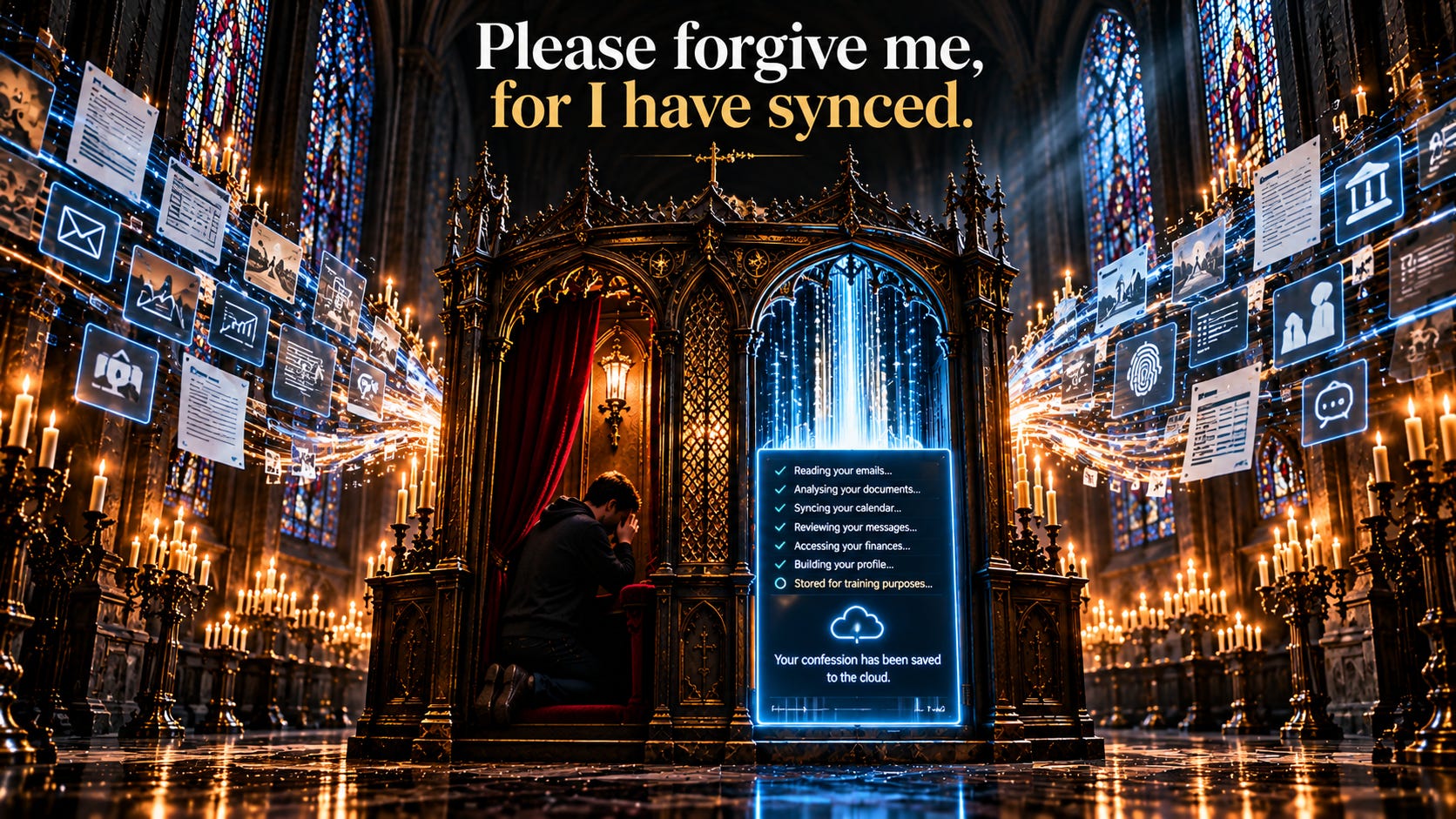
You told the priest everything and he kept you out of hell. Now you tell the machine everything and it keeps you from falling behind.
The priest heard you once a week, your AI hears you all day, reads your documents, searches your email and increasingly acts on your behalf. And at least the Church had the seal of confession, which it took very seriously, whereas what you’ve got with AI is a retention policy and a terms of service page you haven’t read. Some enterprise systems have proper controls, most people have no idea what happens to what they type.
The Vatican
The clever bit was never the confession, it was the plumbing. A priest in every village who knew every family, a bishop over every group of parishes, archbishops over them and Rome at the top. The confessional was sealed and Rome never got the transcripts, it didn’t need them, it had the registers of every birth, marriage and death, it had the tithe, the priest knew who’d stopped turning up on a Sunday and the Inquisition dealt with anyone who got ideas. Nobody in Rome needed to know what you’d said, they knew what you did, what you owned and who you talked to, which was plenty.
It took a thousand years and an army of clergy to build a picture of Europe that was patchy and six months out of date.
Now look at the new plumbing. No village priest, no bishop, no letter to Rome, every conversation goes straight to the same place. The parish is your browser tab, the diocese is the enterprise contract and the Vatican is a handful of buildings in San Francisco with a complete, searchable, real-time record of what a few hundred million people asked, worried about, planned and admitted. And unlike the priest, it does read the confession, that’s the product.
Nobody’s sitting in a room reading it, obviously. But the Church spent centuries building a network that could only guess at what you were thinking, and we’ve just handed one company the whole thing in plain text and said thanks.
The Cathedrals
And they’re building the cathedrals to match. The four big hyperscalers are guiding to around $730 billion of capex this year, up from about $410 billion last year, most of it data centres, chips, power and cooling for AI, some of the biggest infrastructure projects in history and all of it in anticipation of demand that may or may not arrive in the form everyone expects. Cathedrals of compute, built for the arrival of AGI, which nobody can define and everybody is spending as if it’s scheduled.
Medieval cathedrals took a hundred years to build and the people who started them knew they’d never see them finished, that was the point. These ones are on a five year depreciation schedule and the people building them would quite like a return before the chips are obsolete.
The ambition isn’t clever chatbots, it’s AI as the interface through which people work, research, communicate, decide and run businesses, agents connected to your tools, your data and eventually each other. I can see the commercial opportunity and I can also see the problem with that much influence sitting in a handful of private companies. The Church spent centuries positioning itself between people and God, now tech companies are competing to position themselves between people and information, only this time the priest is available twenty-four hours a day and takes credit cards.
The Collection Plate
Because the collection plate is never far away and the prophets aren’t taking vows of poverty. OpenAI and Anthropic between them have raised north of $300 billion in equity, both have filed to list and the reported targets are a trillion and two trillion respectively, numbers that three years ago would have got you laughed out of the room, all of it, they say, for the good of humanity.
I’ve spent thirty years in markets and I understand why companies raise capital and why building something big costs a fortune. These are businesses with shareholders, competitors and burn rates, and they have every incentive to persuade you that civilisation depends on buying more of what they sell. Fine, just spare me the sermon while you’re passing the plate.
The Faithful
What gets me is how readily people go along with it, grown adults defending their favourite model lab like a football club, every release a revelation, every benchmark proof the prophet was right, every critic someone who “doesn’t understand the technology”. I’ve watched this in markets for decades, investors fall in love with a company, stop reading the numbers and start calling anyone who disagrees an idiot, and it rarely ends well.
AI adds one more thing, we’re starting to treat the answers as if they carry authority. We know these things hallucinate, we know they’ll give you a fluent, confident explanation that’s complete bollocks, and people are asking them what to think, what to believe and what to decide anyway.
I use AI constantly, it’s an extraordinary tool, I just don’t confuse a convincing answer with a correct one and I don’t think the people building it have divine insight into how we should live.
But we’re overwhelmed, tired of uncertainty and desperate for something to tell us what the hell is going on, and then along comes a machine that answers anything in seconds with the confidence of someone who’s never been wrong. Hardly surprising people start believing it.
We spent centuries questioning religious authority and demanding evidence for extraordinary claims, now we’ve built something out of silicon, statistics and electricity and we’re treating it as if it knows better than we do.
Prophets, churches, cathedrals, miracles, apocalypse, salvation, the only thing missing is God.
Apparently he’s coming in the next model release.
Go take a look, For the ❤️ of startups
Scout - who just got funded
Newly funded startups, pre-seed to Series B, as the rounds happen.
Raise - who’s deploying
New funds with fresh capital and cheques to write.Wire - what changed, what matters
The intelligence feed that filters the noise, with the “so what” attached.
If you have not joined the Fusion42 Community on Telegram —
it is probably time to do so.
For the ❤️ of Startups
✌🏼 & 💙
Derek
Thank you for reading. If you liked it, share it with your friends, colleagues and everyone interested in the startup Investor ecosystem.
If you've got suggestions, an article, research, your tech stack, or a job listing you want featured, just let me know! I'm keen to include it in the upcoming edition.
Please let me know what you think of it, love a feedback loop 🙏🏼
🛑 Get a different job.
Subscribe below and follow me on LinkedIn or Twitter to never miss an update.