


I have recently been looking more closely at robotics, and something has started bothering me
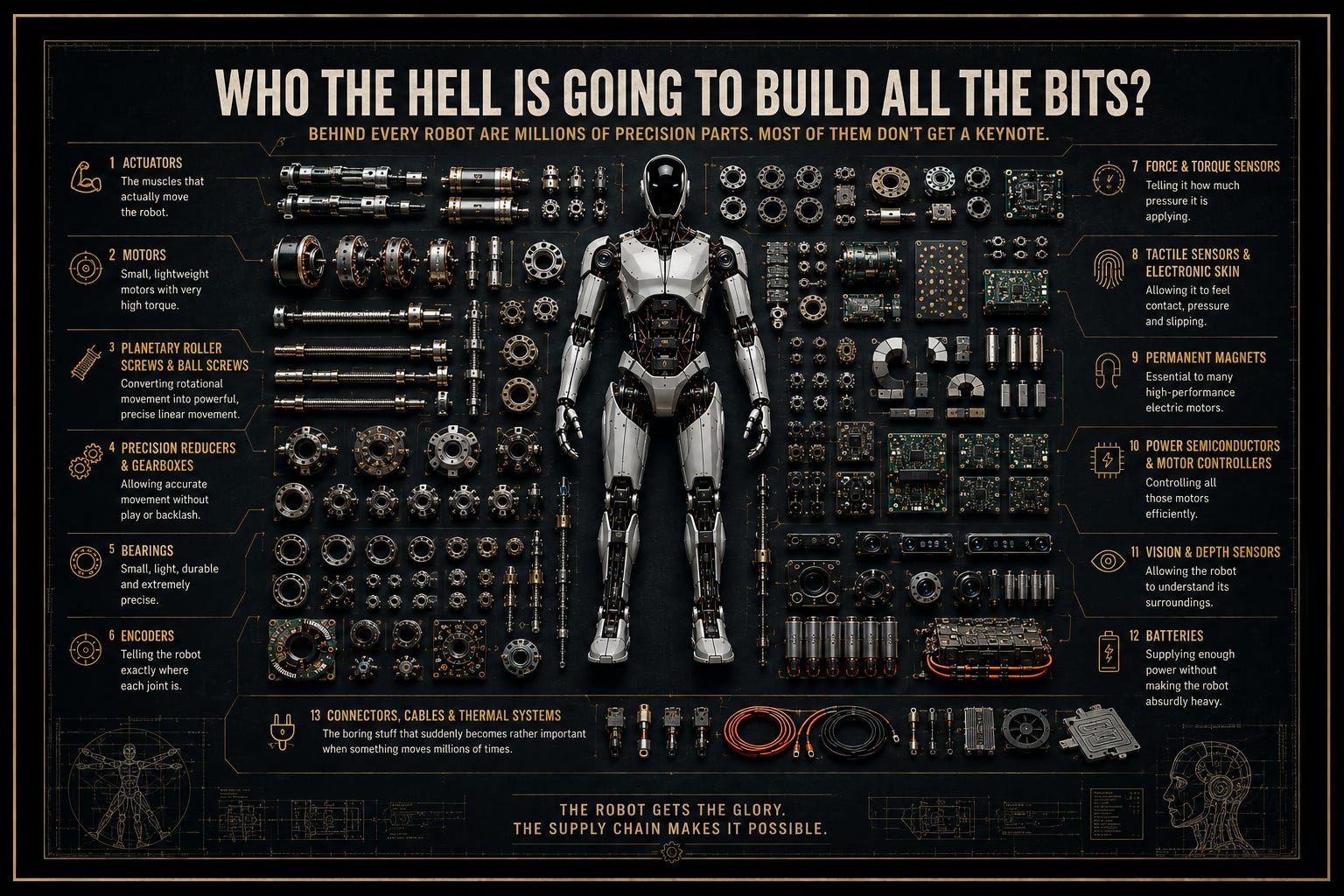
Everyone is talking about the robots themselves. Optimus, Figure, Unitree, Boston Dynamics, Apptronik, Agility, UBTech and an increasingly long list of companies now throwing serious money at Physical AI.
The forecasts are all over the place, but you don’t need to believe the most ridiculous ones for the numbers to get very big.
And that got me thinking about something much more basic.
But who the hell is going to make all the bits?
Because this isn’t software. You can’t spin up another million robots in AWS. They have to be built, and there is a surprising amount of difficult engineering packed inside each one.
A humanoid needs motors, bearings, gears, screws, encoders, sensors, magnets, controllers, batteries and actuators. It needs them everywhere. Shoulders, elbows, wrists, hips, knees and ankles all have to move accurately, carry weight and survive being used thousands of times a day.
The hands are another problem altogether. Ten fingers, each trying to reproduce movements and touch that we barely think about when we pick up a glass or turn a door handle.
Once you add cameras, power electronics, cooling, cables and compute, a humanoid starts to look like a small factory’s worth of precision engineering squeezed into one machine.
And the numbers get big very quickly. If the industry eventually builds ten million humanoids a year, it won’t need ten million motors, bearings or sensors. It could need hundreds of millions of them.
We spend a lot of time talking about whether the robots will be good enough.
I’m beginning to wonder whether we’ll be able to make enough of the bloody things.
The return of boring engineering
For the past few years, AI infrastructure has mostly meant GPUs, data centres, networking and memory. Then everyone realised the bloody things needed huge amounts of electricity. So we started worrying about grids, transformers, gas turbines, nuclear power and copper.
Robotics adds a different problem. You actually have to make things.
AI can design a better robot, write the software and teach it new tasks. But if Tesla, Figure and twenty Chinese manufacturers suddenly need another million precision bearings, motors or gearboxes, somebody has to physically make them.
And there are plenty of places where supply could get tight:
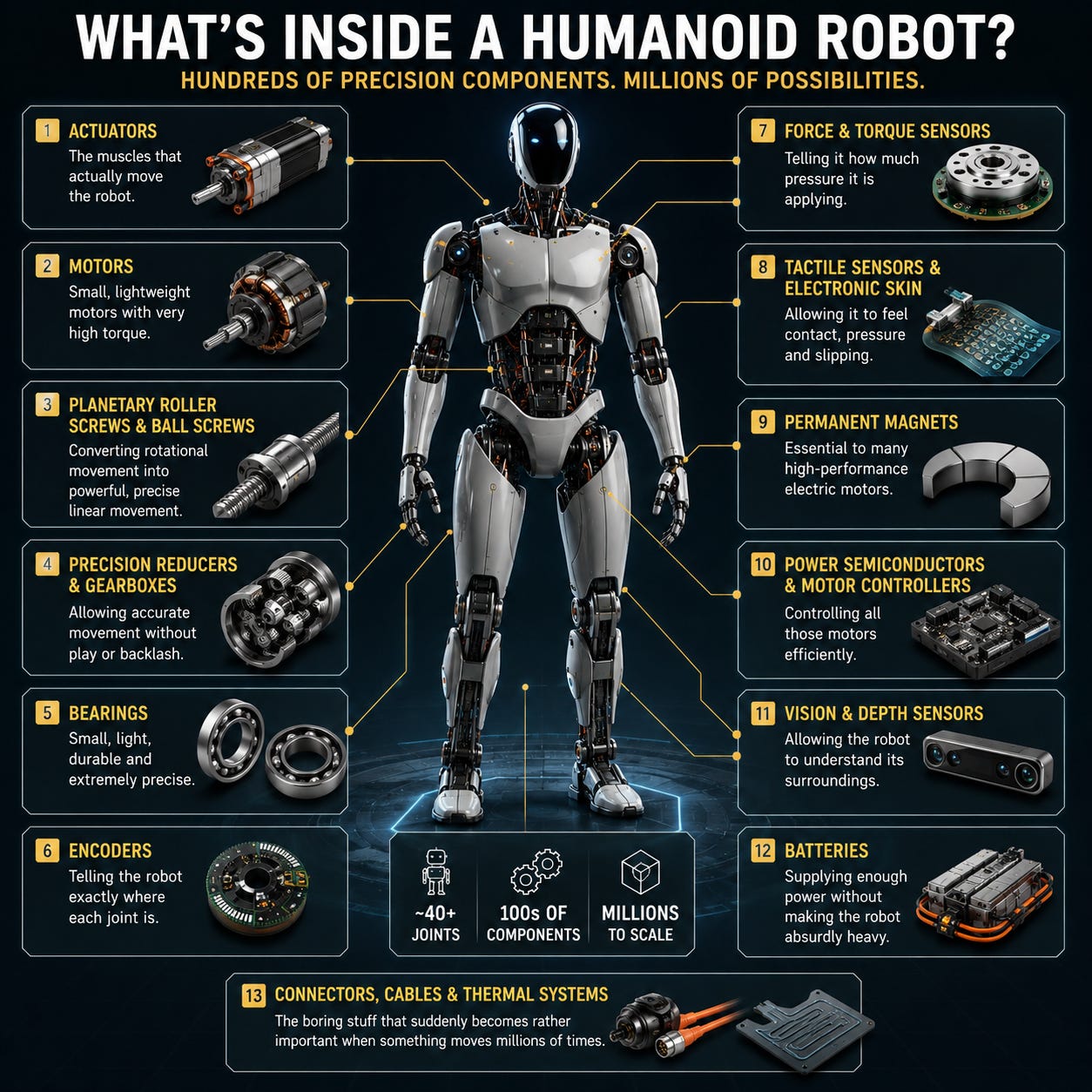
You don’t need shortages everywhere for this to become a problem. One component that can’t keep up can stop the whole production line.
The car industry found that out during the semiconductor shortage. Factories capable of producing thousands of cars sat idle because they couldn’t get enough relatively cheap chips.
Robotics will have the same weakness. A $20,000 robot is no use if you can’t get the $50 part needed to finish it.
Which led me to Japan 🇯🇵 and Germany 🇩🇪
This was the bit I hadn’t really thought about until I started looking at who actually makes this stuff.
Japan and Germany aren’t leading the AI hype cycle, but they’ve spent decades getting very good at the engineering robots need. Bearings, motors, gears, machine tools, linear guides, encoders, servo drives and precision screws.
None of it sounds particularly exciting. Most of these companies will never have a robot dancing on stage at a tech conference.
But without their parts, the robot doesn’t dance at all.
Japan has Harmonic Drive Systems and Nabtesco making precision reducers. THK makes linear-motion systems and screws. NSK makes bearings and screws. Nidec makes motors. Yaskawa and Fanuc have been building servo systems and industrial robots since long before anyone thought putting “Physical AI” in a PowerPoint would increase the valuation.
Germany has Schaeffler, Bosch Rexroth, Siemens and Infineon, alongside hundreds of specialist Mittelstand engineering companies most investors have probably never heard of.
But once you start looking properly, this is clearly not just a German and Japanese story.
Switzerland 🇨🇭has maxon and an extraordinary precision-engineering ecosystem.
Britain🇬🇧 has Renishaw, which makes precision measurement and encoder systems.
Taiwan 🇹🇼 has Hiwin, one of the world’s important manufacturers of linear guides and ball screws.
South Korea 🇰🇷 has enormous capability across batteries, electronics and motors.
America 🇺🇸 has companies such as Moog, Allegro MicroSystems and Monolithic Power Systems sitting in different parts of the motion and control stack.
Australia 🇦🇺has Lynas Rare Earths, which doesn’t make a single robot but suddenly becomes relevant because high-performance motors need permanent magnets.
And then, inevitably, there is China.
China 🇨🇳 could change the economics of the whole thing
China isn’t waiting to see how big humanoid robotics becomes. It’s building the robots and pretty much everything that goes inside them: motors, magnets, gearboxes, bearings, actuators, sensors, batteries and electronics.
It already dominates the rare-earth magnet supply chain and its precision component manufacturers are getting better quickly.
Take Harmonic Drive. It may make a better precision reducer today, but what happens if a Chinese competitor can make one that’s 95% as good for half the price, and make a million of them?
We’ve seen what China can do to the economics of an industry with solar panels, batteries and now electric vehicles. I wouldn’t bet on robotics being any different.
At low volumes, making the best component matters. At millions of robots a year, making it cheaply, reliably and in enormous numbers may matter more.
The part I keep coming back to is actuation.
Actuators are the robot’s muscles. A single joint can contain a motor, magnets, bearings, a gearbox or roller screw, an encoder, force sensors and the electronics controlling it. Now spread those across shoulders, elbows, wrists, hips, knees, ankles and fingers.
One component I hadn’t given much thought to before is the planetary roller screw. It turns the spinning movement of a motor into powerful, precise linear movement, which is useful when you need a lot of force from a small joint.
They’re also bloody difficult to make.
The threads have to be extremely accurate and survive repeated heavy loads. Materials, grinding and heat treatment all matter. You can’t suddenly double production because the orders have arrived.
Chinese manufacturers are already moving from small pilot lines towards much larger production capacity.
That’s the sort of thing I’m looking for: an obscure component that suddenly has to be made in completely different volumes.
Precision gears have much the same problem. A robot joint needs to move accurately and without much play. Japan’s Harmonic Drive Systems and Nabtesco have spent decades getting very good at this, while China’s Leader Harmonic is coming after the same market.
The complication is that nobody yet knows which design will win. Some robots use harmonic gears, others use planetary systems or linear actuators. We may end up with complete joints that combine the motor, gearing, sensors and electronics into one replaceable unit.
So some of the parts we think will be important today may disappear, while others become enormous markets.
Then there are the hands
Hands are another problem altogether.
Pick up a wine glass and think about what your fingers are doing. You’re judging how hard to squeeze it, whether it’s slipping, how heavy it is and whether you’ve actually got hold of it. Most of that happens without you thinking about it.
A robot has to sense all of this.
Vision gets the hand to the glass. Touch stops it smashing the bloody thing.
That is creating a new market for tactile sensors, force sensors, electronic skin and increasingly complicated robotic hands.
And there are already some fascinating private companies working on exactly this:
XELA Robotics in Japan is developing tactile sensors that measure pressure and shear forces.
tacterion in Germany is developing flexible electronic skin.
GelSight in America uses optical sensing to allow machines effectively to see what they’re touching.
Contactile in Australia is working on force, grip and slip sensing.
Bota Systems in Switzerland makes compact six-axis force and torque sensors.
Tesollo in South Korea is developing highly dexterous robotic hands and its own integrated actuator technology.
Synapticon in Germany is integrating motors, servo drives and electronics into compact motion and actuator systems.
ThinGap in America makes lightweight, high-performance motors.
Daimon Robotics in China is developing high-resolution tactile sensing.
These companies aren’t trying to build the next Optimus. They’re making the motors, sensors, actuators and hands that every robot manufacturer could end up buying.
That could be a very good place to be if production takes off.
The boring companies are having a very good year
The listed companies are interesting too. A surprising number of the businesses making the less glamorous parts of the robotics supply chain have had very strong share-price moves this year.
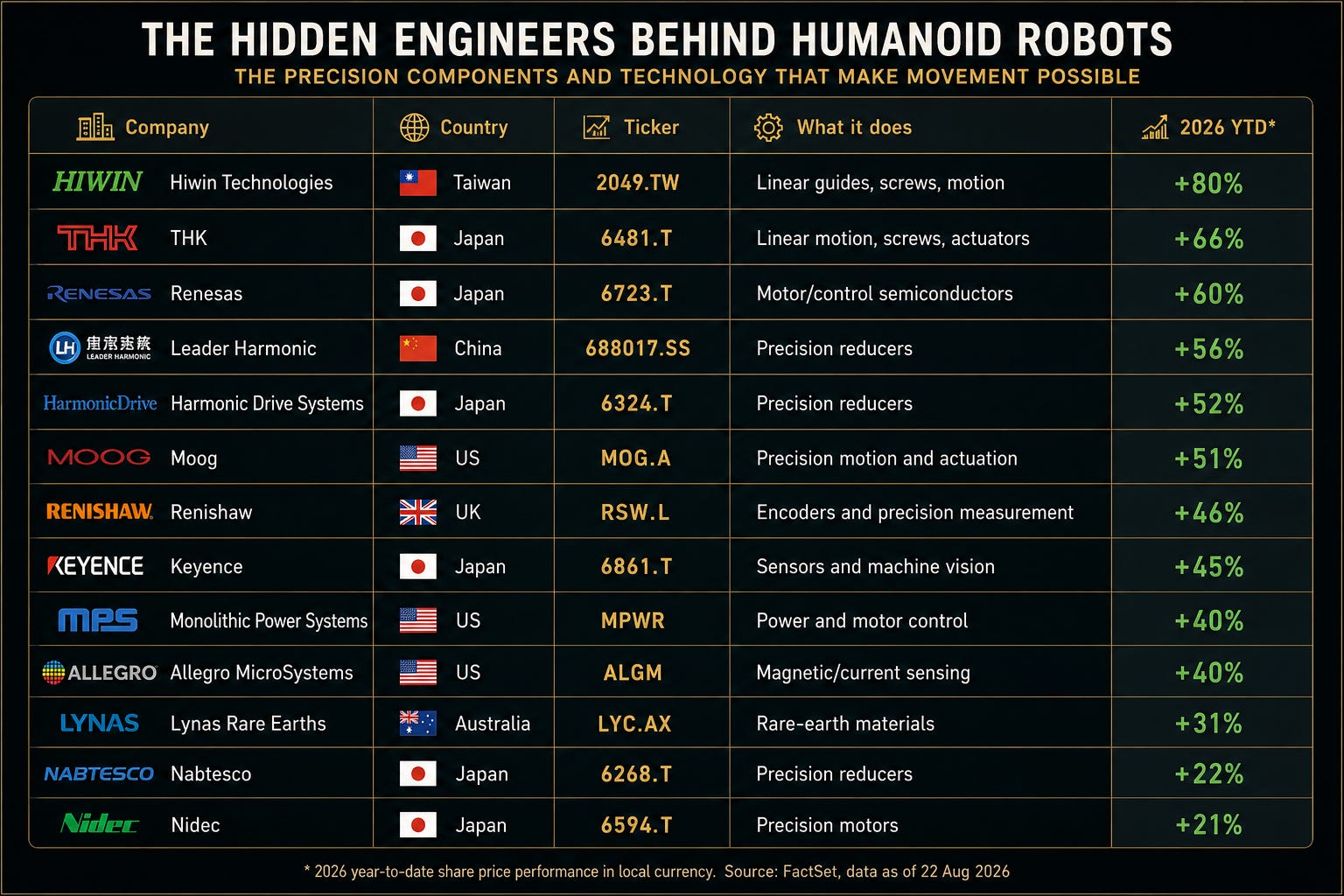
These aren’t pure robotics companies, so I wouldn’t pretend humanoids explain all of those moves. But it’s hard not to notice how many companies making motion, sensing, gearing and precision components are having very good years.
Batteries probably aren’t the first problem
I assumed batteries would be near the top of the list. Millions of robots means millions of batteries.
But battery production is already enormous because of EVs and energy storage. Even a few million humanoids wouldn’t move global battery demand anything like another few million electric cars would.
The bigger issue is weight. A larger battery gives the robot more runtime, but it also makes it heavier. That means more powerful motors, which use more power. You quickly end up chasing your own tail.
So energy density matters. Solid-state batteries could make a real difference here, but I still don’t think batteries are the first place supply gets tight.
Magnets could be
Many high-performance motors use neodymium permanent magnets, and China dominates their supply chain.
That becomes a problem if America, Europe, Japan and South Korea start building millions of robots at home while still relying on China for a basic ingredient inside the motors.
It also explains why Australia’s Lynas Rare Earths belongs in this story despite never making a robot.
Ten thousand robots is one thing. Ten million is another.
You can build 10,000 expensive robots with specialist suppliers and plenty of manual production. At ten million, you need something completely different.
Parts have to become cheaper and more standardised. Suppliers need much bigger factories. Production yields matter. And no manufacturer spending billions on a robot factory will want its entire production line dependent on one small supplier in Bavaria.
That’s when the obscure stuff starts to matter.
A shortage of planetary roller screws could do it. So could precision reducers, miniature motors, encoders, force sensors or permanent magnets.
It might be something even more boring that I’ve never heard of.
That’s what I’m looking for.
Stop looking at the robot
We’ve seen this with AI already. ChatGPT got everyone’s attention, then Nvidia made the fortune supplying the compute. That created demand for data centres, memory and networking, which needed transformers, copper, gas turbines and a frankly ridiculous amount of electricity.
Robotics is going to put the same sort of pressure on manufacturing.
We can build extraordinary robots today. Building ten million of them every year is a completely different problem. That means hundreds of millions of motors, bearings, gears, screws, encoders and sensors, all made accurately enough, cheaply enough and quickly enough.
Something won’t keep up.
It might be roller screws, precision reducers, magnets, motors or tactile sensors. It could just as easily be some obscure component made by a 70-year-old engineering company that nobody outside its industry has ever heard of.
Everyone is trying to work out who will win the race to build the robot.
I’m more interested in who already makes the thing they all discover they can’t get enough of.
Go take a and look, For the ❤️ of startups
Scout - who just got funded
Newly funded startups, pre-seed to Series B, as the rounds happen.
Raise - who’s deploying
New funds with fresh capital and cheques to write.Wire - what changed, what matters
The intelligence feed that filters the noise, with the “so what” attached.
If you have not joined the Fusion42 Community on Telegram —
it is probably time to do so.
For the ❤️ of Startups
✌🏼 & 💙
Derek
Thank you for reading. If you liked it, share it with your friends, colleagues and everyone interested in the startup Investor ecosystem.
If you've got suggestions, an article, research, your tech stack, or a job listing you want featured, just let me know! I'm keen to include it in the upcoming edition.
Please let me know what you think of it, love a feedback loop 🙏🏼
🛑 Get a different job.
Subscribe below and follow me on LinkedIn or Twitter to never miss an update.
This tracks with what we've seen for years in industrial robotics: Nabtesco and Harmonic Drive have been the real bottleneck suppliers for six-axis arms long before anyone called it Physical AI, and lead times on precision reducers were already stretching past 20 weeks during the last automation boom. The actuation point is the right one to watch, since most industrial robot OEMs still single-source their harmonic gearing, which is a fragile position if humanoid demand starts competing for the same production lines. Would be curious how much of that Japanese and German capacity is already locked into industrial robotics versus free to absorb humanoid volume.