



Index
Why people are protesting
We are trying to build the industry again
Inside an AI data centre
The supply chain underneath it
Everyone is building, and everyone is paying everyone
The global compute race
The real problem is power
The bill runs into trillions
Heat, cooling and water
Why locals are getting pissed off
Governments are changing the rules
Compute starts following energy
Elon wants to take it into space
Why people are protesting
My view on data centres is pretty simple. AI is going to need a lot more compute. That means a lot more data centres. Fine. Build them.
What I hadn’t done was add it all up.
Then the protests started catching my eye. In July there were 142 demonstrations across 42 US states, and a Reuters/Ipsos poll found only 14% of Americans would welcome a data centre in their own community.
Texas was the one that really got me. Cheap energy, cheap land, light regulation. Exactly the sort of place you would expect to want these things. Yet Republican politicians there are now talking about restricting them, removing tax breaks and making developers pick up more of the costs. Only 30% of Texans in one recent poll supported having one nearby.
I knew why data centres were needed. I just hadn’t worked through the physical scale of a 1GW campus: the power connection, substations, transmission, cooling, water, construction, grid upgrades, permanent jobs once the builders leave and who pays for all of it.
So I did the sums.
At roughly the same time Elon Musk was talking about putting some of the compute in space. SpaceX eventually wants to launch 100GW of AI compute capacity on solar-powered satellites every year. At full scale that means thousands of launches and roughly one million tonnes of hardware going into orbit annually.
I’ll come back to that.
I still want the data centres built. I just don’t think “build them” is the end of the argument once you see the numbers.
We are trying to build the industry again
The first number that really changed the way I looked at this was 103GW. That is roughly how much data-centre capacity exists globally today. JLL expects it to be around 200GW by 2030.
So in the next few years we are trying to build almost as much data-centre capacity as the world has built in total up to now.
McKinsey gets to a slightly bigger number using a different methodology: around 219GW by 2030, with 156GW coming from AI. The exact forecast will move as chips get better, models become more efficient and projects get cancelled or delayed. But whether the eventual number is 200GW or 219GW does not change what is happening. We are adding an enormous industrial load in a very short period of time.
The electricity numbers make the scale easier to understand. Gartner has worldwide data-centre power demand rising from roughly 104GW in 2025 to 132GW in 2026 and 290GW by 2030. Electricity consumption goes from 447TWh in 2025 to 565TWh in 2026, 702TWh in 2027 and more than 1,200TWh by 2030. From 2027, AI-optimised servers are expected to use more electricity than conventional servers.
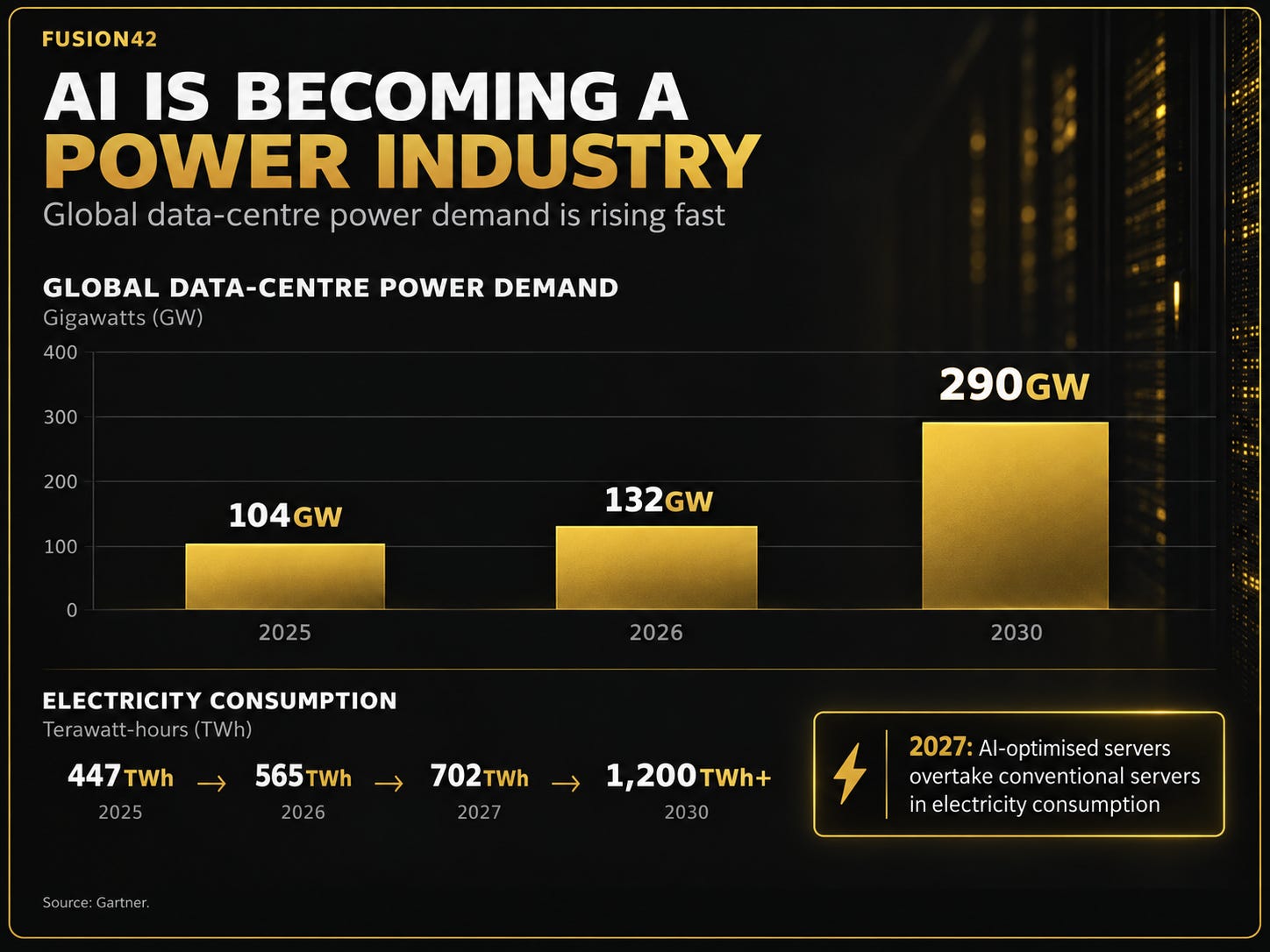
One thing worth clearing up because these GW numbers get thrown around rather casually. A 1GW data-centre campus is basically a site designed around access to roughly one gigawatt of electrical power. So when you see forecasts approaching 300GW, think hundreds of very large industrial campuses all drawing power at the same time.
And this is already showing up in the real economy. US data-centre construction spending hit an annualised $75bn in July, up 57% in a year and roughly 717% since the start of 2021. Since the end of 2023 alone, the annualised run-rate has risen by about $51bn.
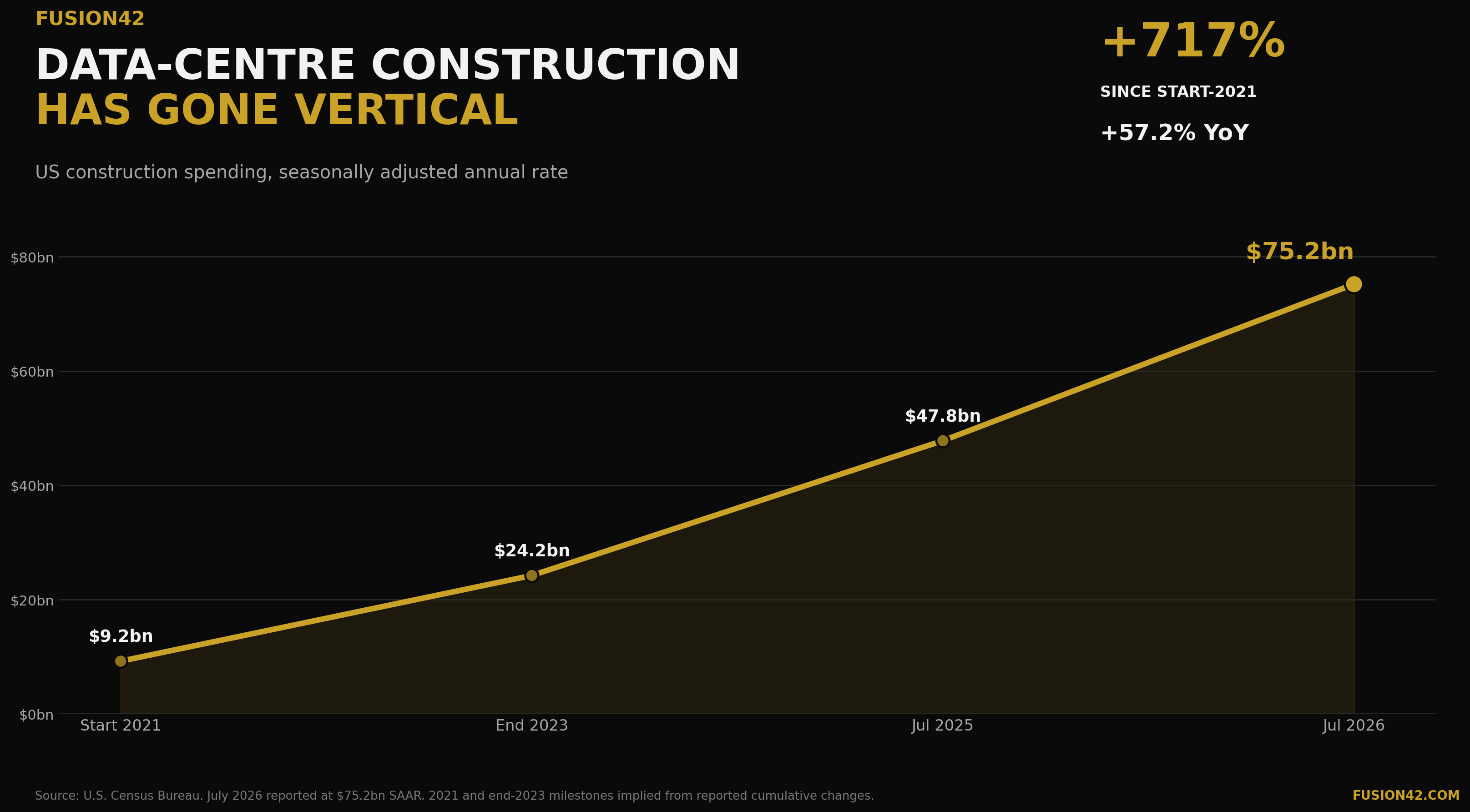
That $75bn does not include the GPUs and servers. It is the buildings, site work and equipment going into them.
Housing and commercial construction have their own problems, so I would not pretend data centres caused the weakness elsewhere. But construction workers, transformers, electrical equipment, land and capital are finite.
A lot more of all of them is now being pulled towards AI.
Inside an AI data centre
I’m leaving the chips mostly out of this because Nvidia, TSMC, HBM and advanced packaging deserve their own piece. Assume the GPUs have arrived.
The rest of the building exists to keep them running.
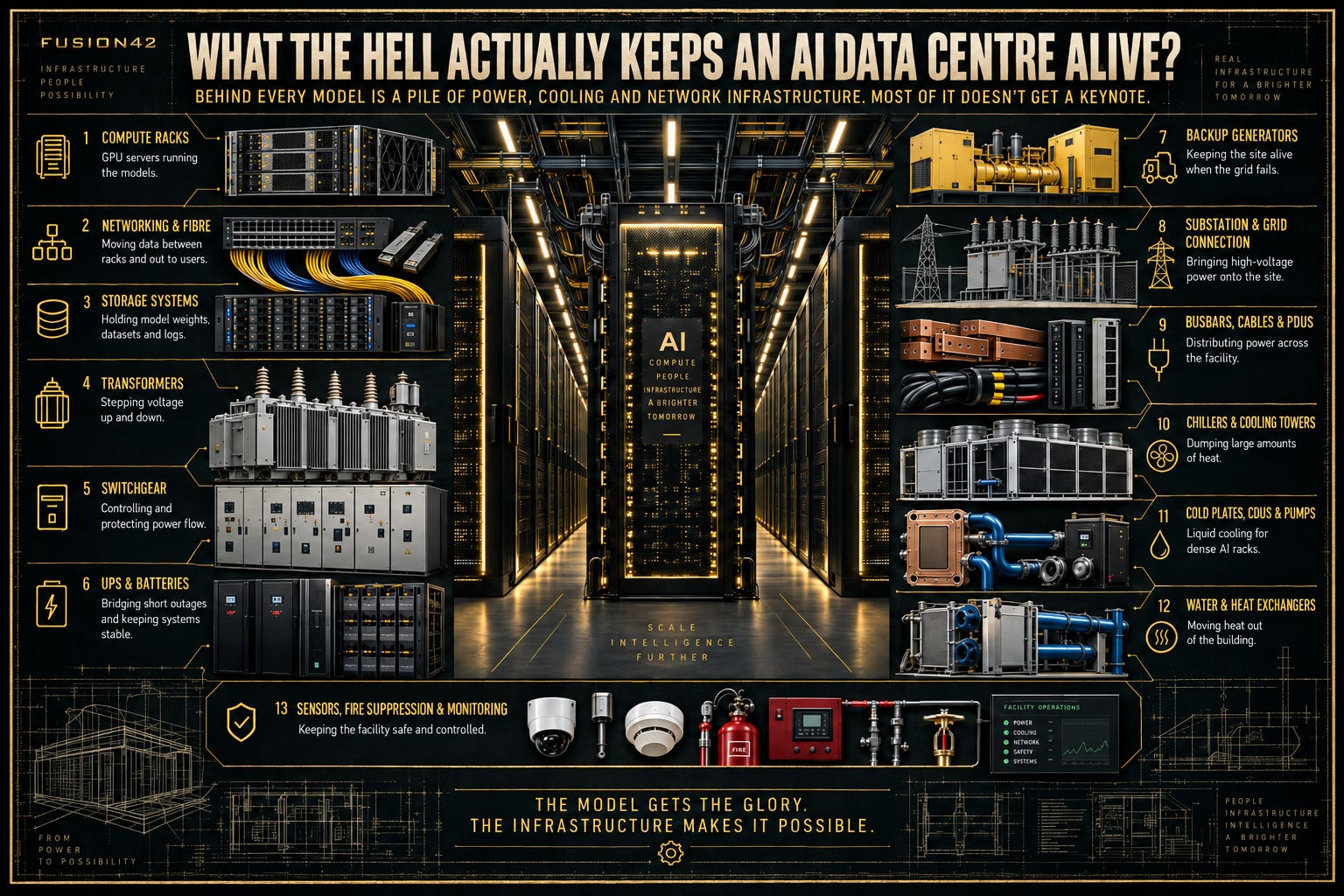
You need racks, servers, storage, networking and fibre. Then comes the electrical side: substations bringing power onto the site, transformers changing voltage, switchgear controlling and protecting the system, UPS equipment and batteries dealing with short interruptions, backup generators for longer ones, plus busbars and a lot of heavy cabling moving electricity around the building.
Cooling is becoming a much bigger part of the design as AI racks get denser. Air cooling only gets you so far. Higher-density systems increasingly use cold plates sitting directly against the processors, with pumps, coolant distribution units, heat exchangers and chillers moving the heat out of the building. Depending on the system and location, cooling towers and water may come into it as well.
Then there is everything outside the server room: land, roads, transmission connections, concrete, steel, copper, construction crews, electricians, engineers and all the other fairly unglamorous bits needed before anyone can run a model.
This is how Schneider Electric, Eaton, ABB, Siemens Energy, GE Vernova, Mitsubishi Heavy Industries, Vertiv, Delta Electronics, Caterpillar and Cummins end up sitting underneath the AI boom.
A surprising amount of artificial intelligence depends on some very old-fashioned engineering.
The supply chain underneath it
Once you look at everything inside an AI data centre, another problem appears. Somebody has to make all of it, and the supply chain stretches far beyond Silicon Valley.
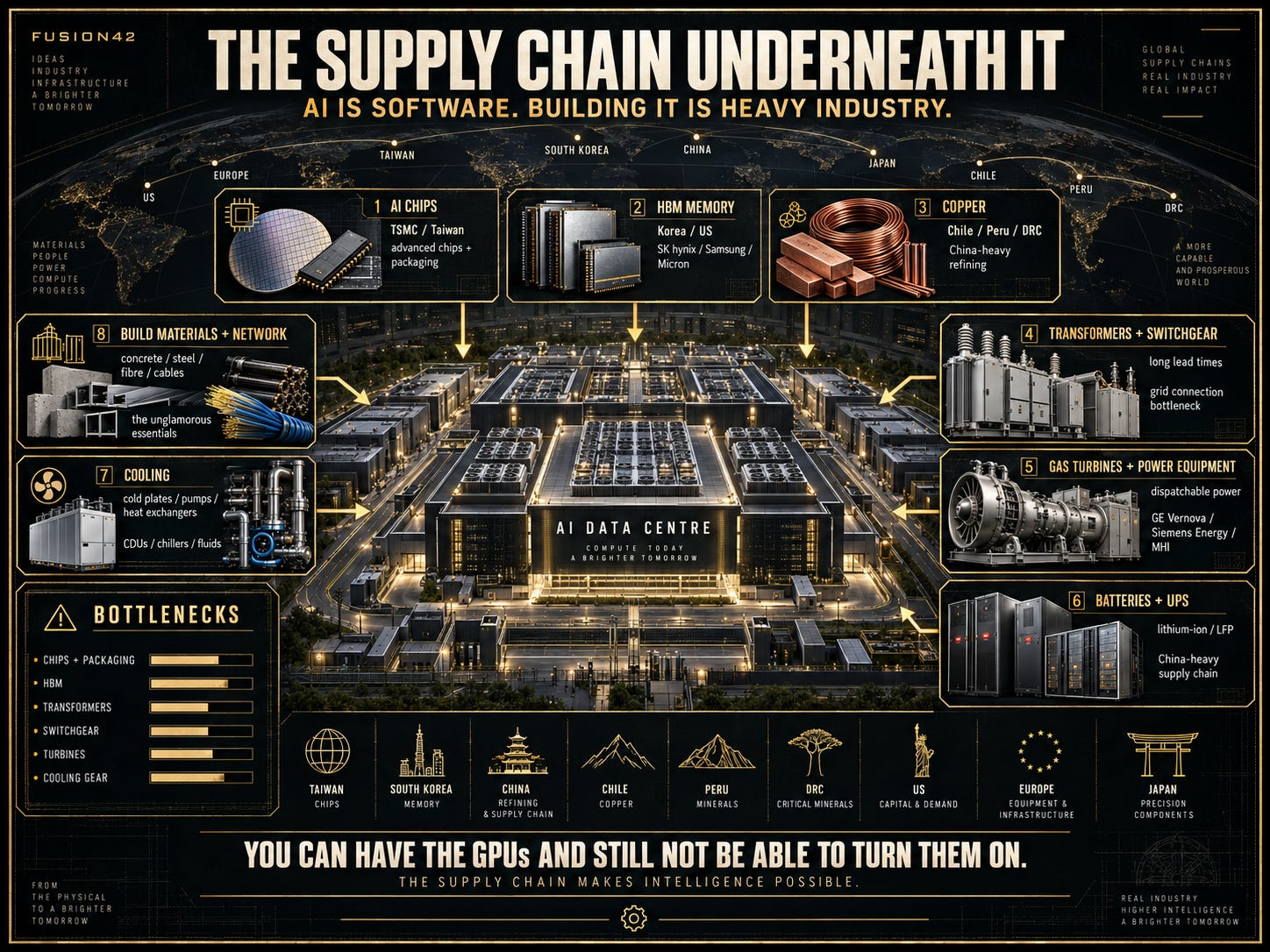
Start with the chips. The most advanced AI processors still depend heavily on TSMC in Taiwan, while the high-bandwidth memory beside them comes mainly from SK Hynix, Samsung and Micron. Then there is advanced packaging such as CoWoS, substrates, PCBs and the networking hardware needed to connect thousands of accelerators. A shortage in any one of those can slow the whole system down.
Move outside the rack and it gets much more industrial. A large data centre needs a lot of copper in transformers, cables, busbars, switchgear, cooling systems and the grid connection itself. Much of that copper is mined in places such as Chile, Peru and the Democratic Republic of Congo, while China plays a huge role in refining it.
Transformers are an even more immediate bottleneck. They are large, often built to order and can have lead times well beyond a year. Switchgear, circuit breakers and other high-voltage equipment are tight too. You can have the land, the building and billions of dollars of GPUs sitting inside it and still be waiting for the electrical kit needed to turn the bloody thing on.
Power generation has the same problem. AI companies want electricity faster than grids can add it, which has pushed gas turbines back into demand. GE Vernova, Siemens Energy and Mitsubishi Heavy Industries cannot simply double production overnight. These are huge machines built in specialised factories with their own supply chains for steel, castings, blades, generators and control systems.
Then add batteries. Modern data centres increasingly use large lithium-ion UPS systems to bridge interruptions before generators or other backup systems take over. Much of the LFP battery supply chain sits in China, from cathode materials through to finished cells.
Cooling adds another layer. Higher-density racks need cold plates, pumps, valves, coolant distribution units, heat exchangers, chillers, specialist fluids and kilometres of pipework. None of this looks particularly exciting next to an Nvidia GPU, but a failed pump or delayed heat exchanger can leave the GPU doing absolutely nothing.
And underneath all of that sit concrete, structural steel, electrical steel, fibre, optical equipment, connectors, generators, cables and a lot of skilled labour.
We talk about AI as software. Building the infrastructure behind it looks increasingly like heavy industry, with dependencies on mines, smelters, semiconductor fabs, transformer factories, turbine plants and electrical equipment manufacturers spread across the world.
The bottleneck will not always be the cleverest component. Quite often it will be the boring thing everyone suddenly needs at the same time.
You can have the GPUs and still not be able to turn them on.
Everyone is building, and everyone is paying everyone
This was the point where I started losing track.
The hyperscalers are already spending at extraordinary levels. AWS, Microsoft, Google, Meta and Oracle are all building huge amounts of data-centre infrastructure, while the AI companies themselves have increasingly started securing dedicated capacity rather than simply renting it.
OpenAI’s Stargate programme is a good example. It originally targeted 10GW of US AI infrastructure by 2029, and OpenAI said in April that it had already passed that figure. It is not pouring all the concrete itself. The capacity is being assembled through a network of infrastructure and cloud partners.
Anthropic is doing the same from both directions. It announced $50bn of custom-built US computing infrastructure with Fluidstack, with sites in Texas and New York, while also signing very large compute agreements with AWS, Google and others. Tesla has built its own dedicated training infrastructure at Giga Texas, where Cortex 1 has more than 90MW and Cortex 2 more than 115MW supporting autonomy and Optimus. SpaceXAI has Colossus in Memphis and is separately building a 1.2GW permanent power plant to support its terrestrial compute expansion. That is power generation for compute on Earth, not part of the orbital system.
Then you have the new infrastructure layer sitting underneath all of this. CoreWeave, Fluidstack, Lambda, IREN, Nscale and others are raising billions to secure land, power and hardware, then selling the resulting capacity back to AI companies. Nvidia sits in the middle selling the GPUs while also investing across much of the same ecosystem.
The financing has started to get equally strange. Oracle ended FY2026 with $638bn of remaining performance obligations, and some customers are now prepaying for GPUs or even supplying hardware themselves so Oracle does not have to finance all of it. Meanwhile the hyperscalers’ own capex numbers have become absurd: Amazon expects around $200bn in 2026, Meta $130bn–$145bn, with Alphabet and Microsoft spending at similarly enormous levels.
At that point the headline numbers start to lose meaning, because the same underlying capacity can show up again and again in different announcements. The AI company announces a compute contract. The cloud provider reports the backlog. Nvidia reports the hardware demand. The infrastructure company raises money against the contract. A government may then present the same project as inward investment.
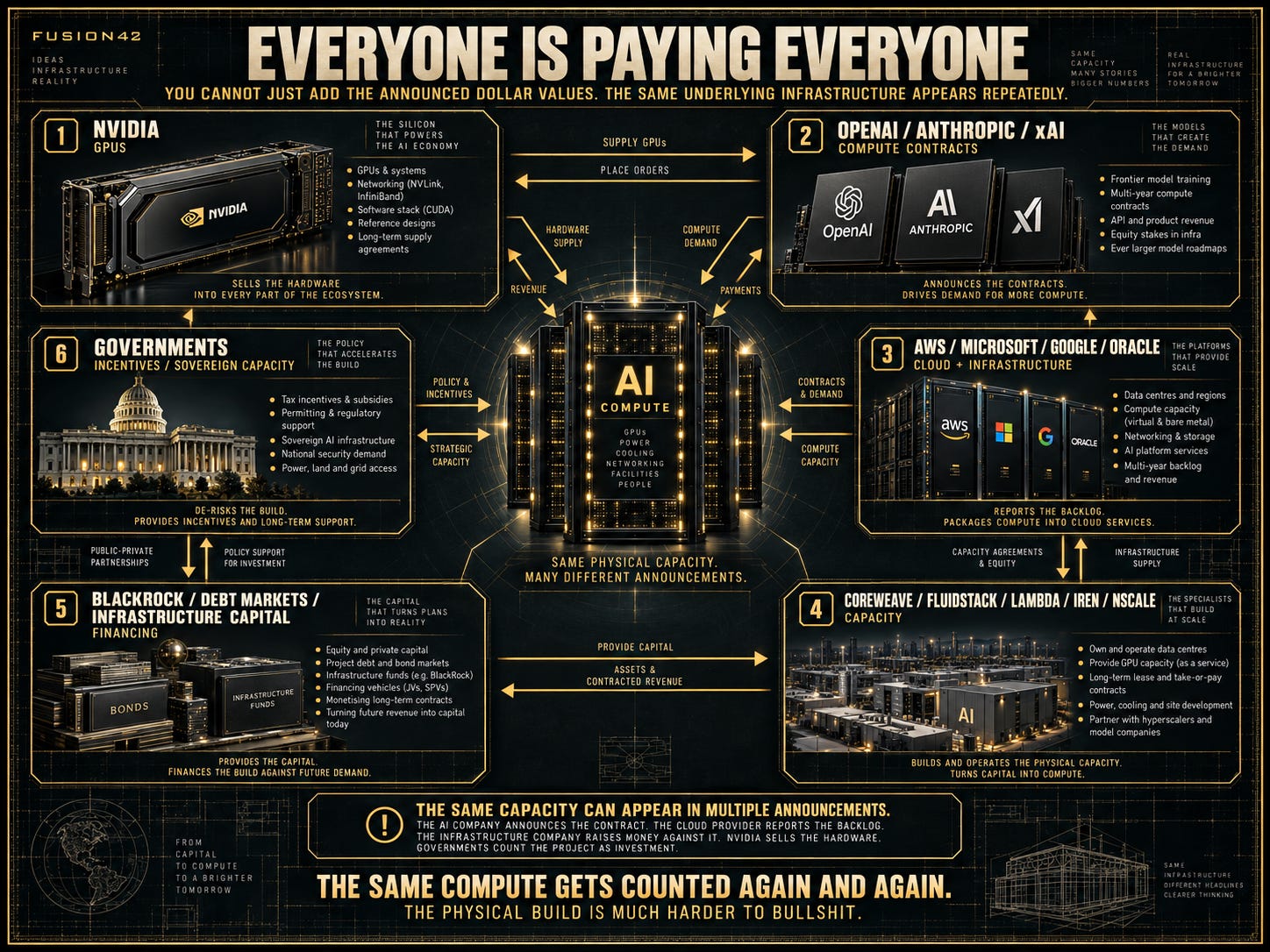
Everyone is paying everyone.
That is why I stopped trying to add the press releases together.
The physical build is much harder to bullshit. JLL’s model implies roughly another 100GW of data-centre capacity by 2030, with required investment of up to $3tn. McKinsey, using a broader definition that includes more of the infrastructure and hardware stack, gets to roughly $6.7tn, including about $5.2tn for AI.
And the spending does not stop once the buildings are finished. The concrete may last decades. The GPUs, servers and networking equipment do not. We will be replacing the expensive kit inside these buildings while still constructing the next generation of them.
There is also clearly a wall of corporate FOMO in the background. Nobody running a major technology company wants to wake up in three years and discover that a rival locked up the land, power, chips and grid connections while they were waiting for the economics to become obvious.
That creates a very powerful incentive to build first and work some of the details out later.
The global compute race
Individual projects are now enormous. Meta’s Hyperion campus in Louisiana is being expanded towards 5GW of compute capacity, with more than $50bn being invested. Meta expects around 7,500 jobs at peak construction and roughly 1,000 permanent roles once the site is operating.
Five gigawatts in one place gives you some idea how far this has moved from the old idea of a data centre.
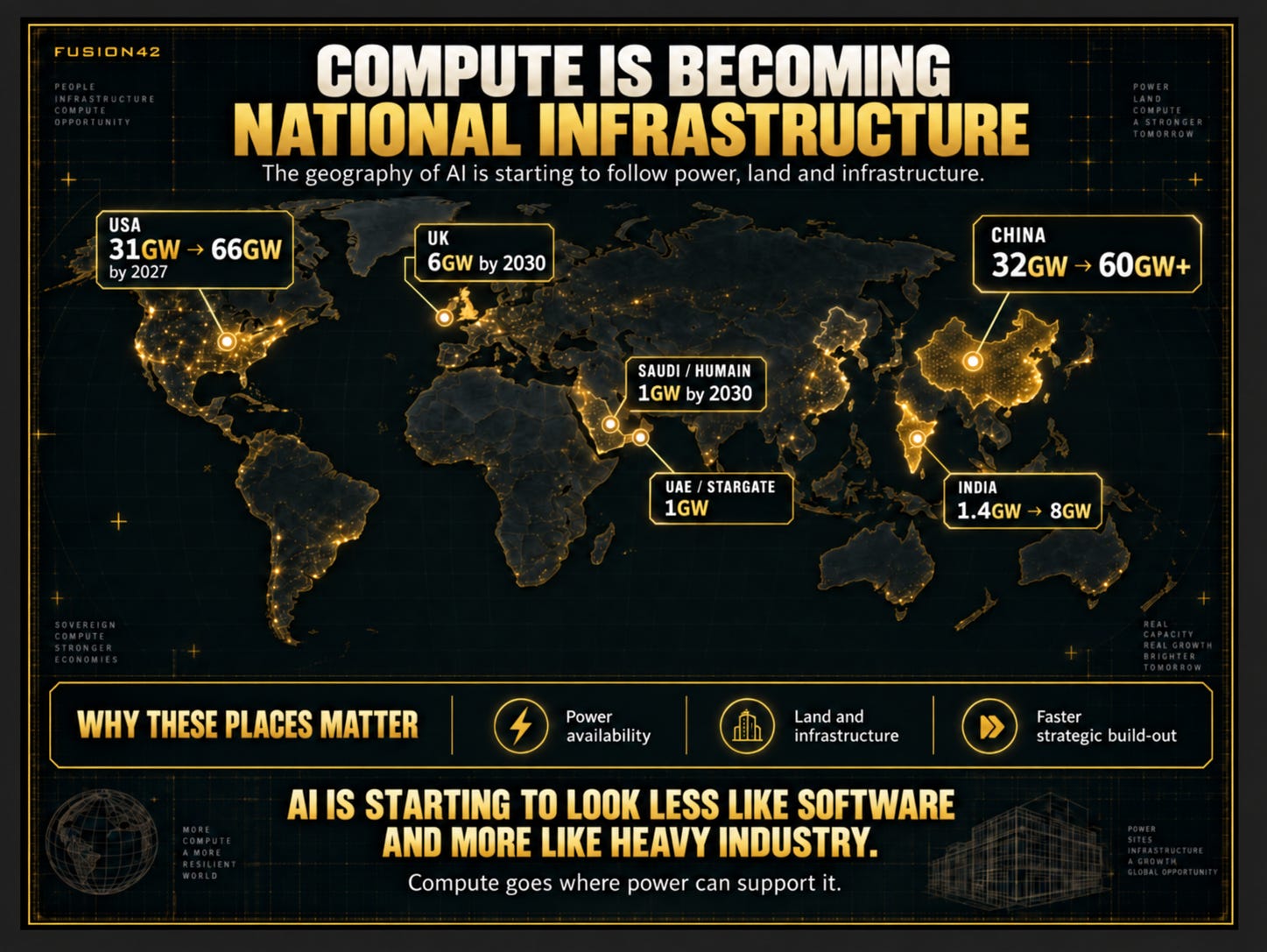
Governments are now entering the same race. Britain says it needs at least 6GW of AI-capable data-centre capacity by 2030, roughly three times what it has today, with several large AI Growth Zones planned and at least one site capable of exceeding 1GW. Saudi Arabia’s HUMAIN programme already has production AI compute running, with its AMD-Cisco venture beginning another 250MW of deployment from 2027 and targeting 1GW by 2030. Stargate UAE is planned as a 1GW AI cluster in Abu Dhabi, with the first 200MW expected online in 2026.
China is operating at a much larger scale. It had roughly 32GW of installed data-centre capacity at the end of 2025, with current projects potentially taking that above 60GW by 2030. India is starting from a smaller base but moving quickly, with its Economic Survey citing an estimate of around 1.4GW in 2025 rising towards 8GW by 2030. Europe is building sovereign AI capacity through its own programmes, while Japan is expanding too, although I still haven’t found a clean national GW target I trust enough to use.
What started as a hyperscaler capex boom is turning into strategic national infrastructure.
That makes sense. If AI becomes as important to economies as governments now expect, countries are hardly going to be comfortable relying entirely on somebody else’s compute capacity.
But every one of these national ambitions runs into the same physical constraint: electricity.
The real problem is power
Once an individual campus wants 500MW, 1GW or even 5GW, electricity stops being a utility bill and starts determining whether the project can exist at all.
That is becoming a serious problem because many grids simply cannot provide another gigawatt on the timetable AI companies want. US utilities have already received more than 700GW of large-load requests, more than ten times estimated current US data-centre demand. Texas has started auditing applications because regulators believe a substantial share is duplicated, speculative or attached to projects that may never be financed. The industry has started calling this ghost demand.
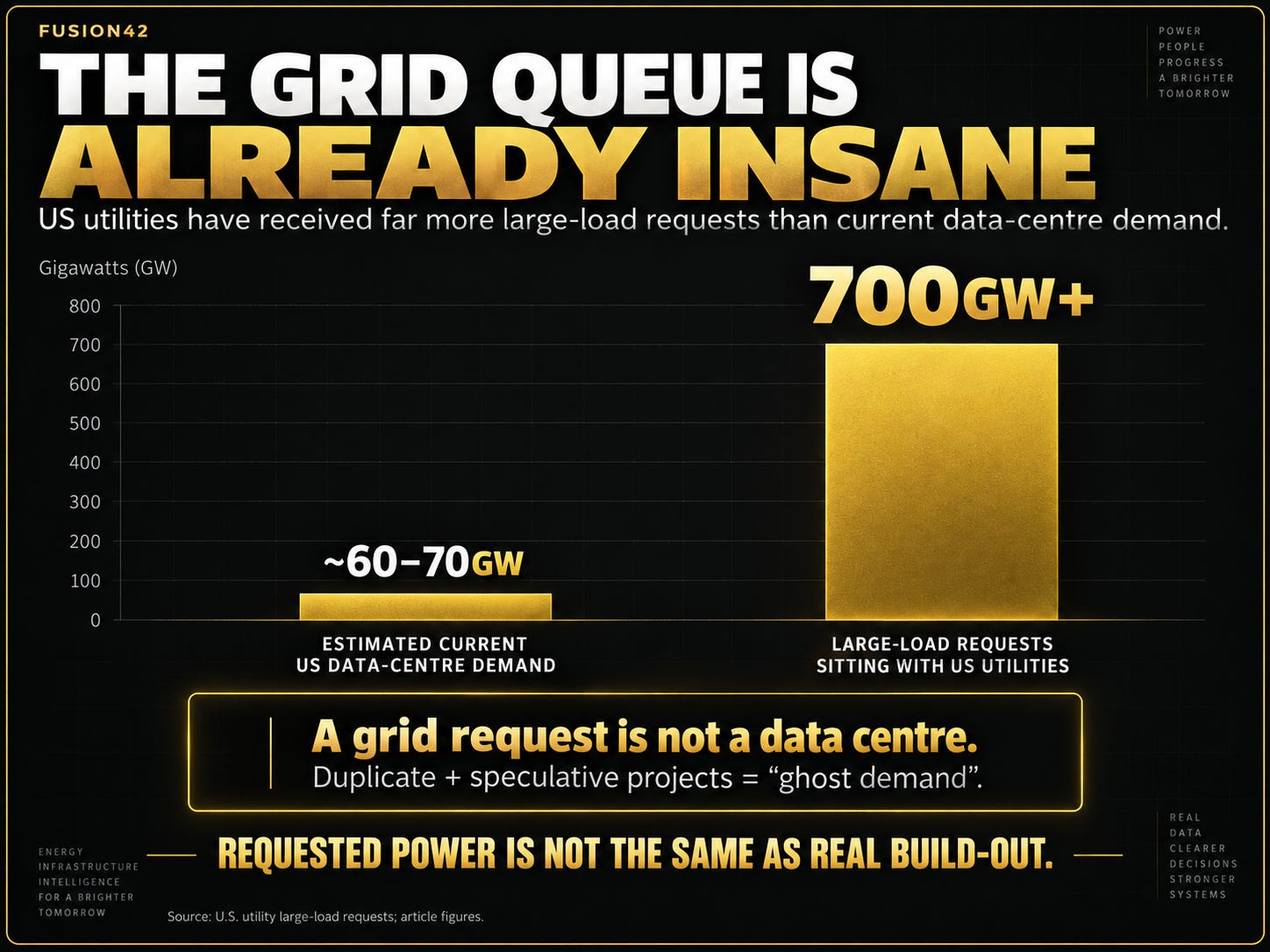
That matters whenever somebody announces another 2GW campus. Asking the grid for 2GW is easy. Financing the project, building it and actually energising 2GW are very different things. Even after stripping out the speculative requests, however, the underlying problem remains: AI companies need enormous amounts of reliable power, and they need it quickly.
The timing is awkward. New nuclear plants and SMRs feature heavily in AI infrastructure plans, but a reactor that arrives well into the 2030s does very little for a data centre that needs 500MW in 2028. In the near term, the options are more practical: gas generation, existing nuclear plants staying open longer or being restarted, whatever grid capacity is available, and behind-the-meter generation where it is not.
That is why companies such as GE Vernova, Siemens Energy and Mitsubishi Heavy Industries have suddenly become part of the AI story. They manufacture the gas turbines and other equipment capable of delivering hundreds of megawatts of dispatchable power. Developers are increasingly looking at building generation alongside the data centre rather than spending years waiting for the grid. Google has moved upstream as well, buying energy-infrastructure developer Intersect and signing large geothermal agreements, while other hyperscalers are pursuing nuclear and dedicated generation deals of their own.
The power station is only half the problem. Electricity still has to get from the generator to the GPUs, and that means substations, switchgear, circuit breakers and transformers. Large transformers in particular have long manufacturing cycles, so a finished data centre can have billions of dollars of computing hardware sitting inside it and still be waiting for the equipment needed to switch it on.
There is something rather wonderful about that.
Some of the most advanced technology humans have ever built can still be held up by a giant lump of copper and steel based on engineering that has existed for more than a century.
The bill runs into trillions
Putting a clean price on all of this is harder than it looks because people count different things. Land, buildings, grid connections, dedicated generation, cooling, GPUs, networking and financing can all end up under the heading of AI infrastructure.
JLL estimates that adding roughly another 100GW of global data-centre capacity by 2030 could require up to $3tn, including around $1.2tn of data-centre real estate. McKinsey counts more of the technology sitting inside and around the buildings and gets to roughly $6.7tn, with about $5.2tn linked to AI infrastructure.
Either way, we are talking about trillions of dollars being spent in a few years.
And unlike a railway, a lot of the expensive kit does not last very long. The building may still be standing in thirty years, but the GPUs, servers and networking equipment inside it will have been replaced several times by then.
That changes the economics quite a bit. The industry will still be building the first wave of new capacity while already replacing some of the most expensive equipment installed at the start of it.
So the capex does not simply peak when the buildings are finished.
A large part of this infrastructure has to be built, upgraded and rebuilt at the same time.
Heat, cooling and water
All that electricity eventually becomes heat, and getting rid of it is becoming a much bigger engineering problem as AI racks get denser.
Traditional data centres could rely heavily on air cooling. At higher rack densities, simply pushing more cold air through the room stops being enough, which is why liquid cooling has become such an important part of the build-out. Cold plates sit against the processors, pumps move coolant around the rack, heat exchangers pull the heat away and chillers or cooling towers deal with it further downstream.
That is how I ended up reading about pumps and pipework while supposedly researching artificial intelligence.
Water is more complicated because there is no honest universal number. Some cooling systems consume a lot, others use very little, and climate makes a big difference. But the issue is clearly becoming material enough for governments to regulate it. Minnesota, for example, has introduced special permitting requirements for projects proposing more than 100 million gallons of additional consumptive water use per year, with regulators required to consider conservation, recycling, reclaimed water and closed-loop systems.
There is also water used upstream by some forms of electricity generation, so the total impact can extend well beyond the cooling system itself. For a town already worried about water availability, a new 500MW or 1GW industrial customer is obviously going to attract scrutiny.
And water is only part of what neighbours actually experience. Cooling equipment runs continuously, and fans, chillers and other machinery can produce a persistent low-frequency hum. Hyperscale sites can also have large numbers of diesel backup generators behind the fence. They do not run continuously, but they still need testing and create noise and emissions when they do.
These sound like minor issues next to trillion-dollar AI forecasts.
They feel rather less minor when you live next door.
Why locals are getting pissed off
A data-centre announcement sounds fantastic when it first arrives. Billions of dollars of investment, thousands of construction jobs, new tax revenue and a place in the AI economy. Those benefits are real. We need the infrastructure, domestic compute capacity has strategic value, and the economic activity eventually built on top of AI could be worth far more than the facilities themselves.
The argument changes when residents start looking at what the project requires from the place hosting it. A large campus can consume hundreds of megawatts around the clock, require new substations and transmission lines, draw significant amounts of water and run cooling equipment continuously. Backup generation has to sit onsite as well, bringing its own noise and emissions.
Then there is the jobs question. Meta’s Louisiana campus is a useful example. More than $50bn of investment and around 7,500 jobs at peak construction eventually becomes roughly 1,000 permanent roles. A thousand jobs can still matter enormously to a local economy, but the calculation looks different when they sit alongside a 5GW industrial load and tens of billions of dollars of infrastructure.
That is why communities start asking harder questions about tax incentives, electricity prices, water, noise and who pays for the grid upgrades. The political fight starts when people begin to wonder whether the deal works as well for the place hosting the data centre as it does for the company using it.
Governments are changing the rules
Governments are starting to respond because data centres are becoming too large to treat like ordinary commercial developments.
South Dakota has gone as far as passing something literally called the Data Center Bill of Rights for Citizens. It applies to facilities with peak demand above 10MW and follows a fairly sensible principle: if a data centre creates extra costs for the electricity system, those costs should sit with the data centre rather than being spread across everyone else. Developers also have to disclose expected water use, while local authorities retain the right to restrict or prohibit projects.
Ireland has a different problem because data centres already consumed 22% of the country’s electricity in 2024, with that share potentially reaching 31% by 2034. New projects seeking grid connections now have to provide enough generation or storage to match their maximum requested demand. Germany has focused on efficiency, requiring new data centres from July 2026 to achieve a PUE of 1.2 or better and reuse an increasing share of the heat they produce.
The US is heading in the same direction. Virginia, already home to one of the world’s largest concentrations of data centres, decided in July that some transmission costs should be charged directly to the customers responsible for creating them. PJM, which runs much of the eastern US electricity market, is also developing rules that favour large new loads which bring generation with them. Projects without enough power behind them can face restrictions when the grid gets tight.
That is broadly where I think the rules should go.
Build the data centres, but make the economics honest. If a project needs a new substation, transmission line or power plant, the people building it should pay the costs created by it. If it needs huge amounts of water, tell the community how much and where it is coming from. If the local grid cannot support another gigawatt, build more generation or put the facility somewhere that can.
That is what serious infrastructure planning looks like.
Power availability is starting to redraw the geography of AI.
Software companies traditionally clustered around engineers, universities, customers and capital. Large AI training clusters have different priorities. Give them enough fibre and reliable electricity and much of the workload can move. Training is especially mobile because the GPUs do not care whether they are five miles or five hundred miles from the people building the model.
Inference is a bit different. Batch workloads can also move towards cheap power, while applications where latency matters benefit from being closer to the people or machines using them. So we are likely to end up with very large training clusters in places with abundant electricity, alongside more distributed inference capacity closer to users.
That suddenly makes some countries much more interesting. France has nuclear. The Nordics and Canada have hydro. China has deliberately pushed heavy compute towards western regions where land and electricity are easier to find. Saudi Arabia and the UAE have energy, capital and governments capable of making large infrastructure decisions quickly.
The Gulf comes with its own engineering problems. Saudi Arabia is bloody hot, so cooling is harder and water matters. Transmission and fibre still matter as well. But once compute starts behaving like heavy industry, the strategy makes sense. Saudi’s HUMAIN programme is targeting 1GW by 2030 through its AMD-Cisco venture, while Stargate UAE is planned as another 1GW cluster in Abu Dhabi.
China is doing the same thing at a much larger scale. Its data-centre capacity could move from roughly 32GW in 2025 to more than 60GW by 2030, with more of the heavy compute going to regions where the power and land already exist.
AI is beginning to follow the geography of heavy industry.
When a training campus needs 500MW or a gigawatt, access to electricity matters rather more than having the software engineers nearby.
Elon wants to take it into space
This brings me back to Elon, because after looking at all the constraints on Earth, SpaceX’s Starmind project starts to look a lot less mad.
AI needs enormous amounts of electricity, and finding hundreds of megawatts of reliable new power on Earth is getting harder. Grid connections can take years. New transmission can take longer. Land and water become political very quickly. SpaceX’s idea is to move some of the compute closer to an energy source that is already there: the Sun.
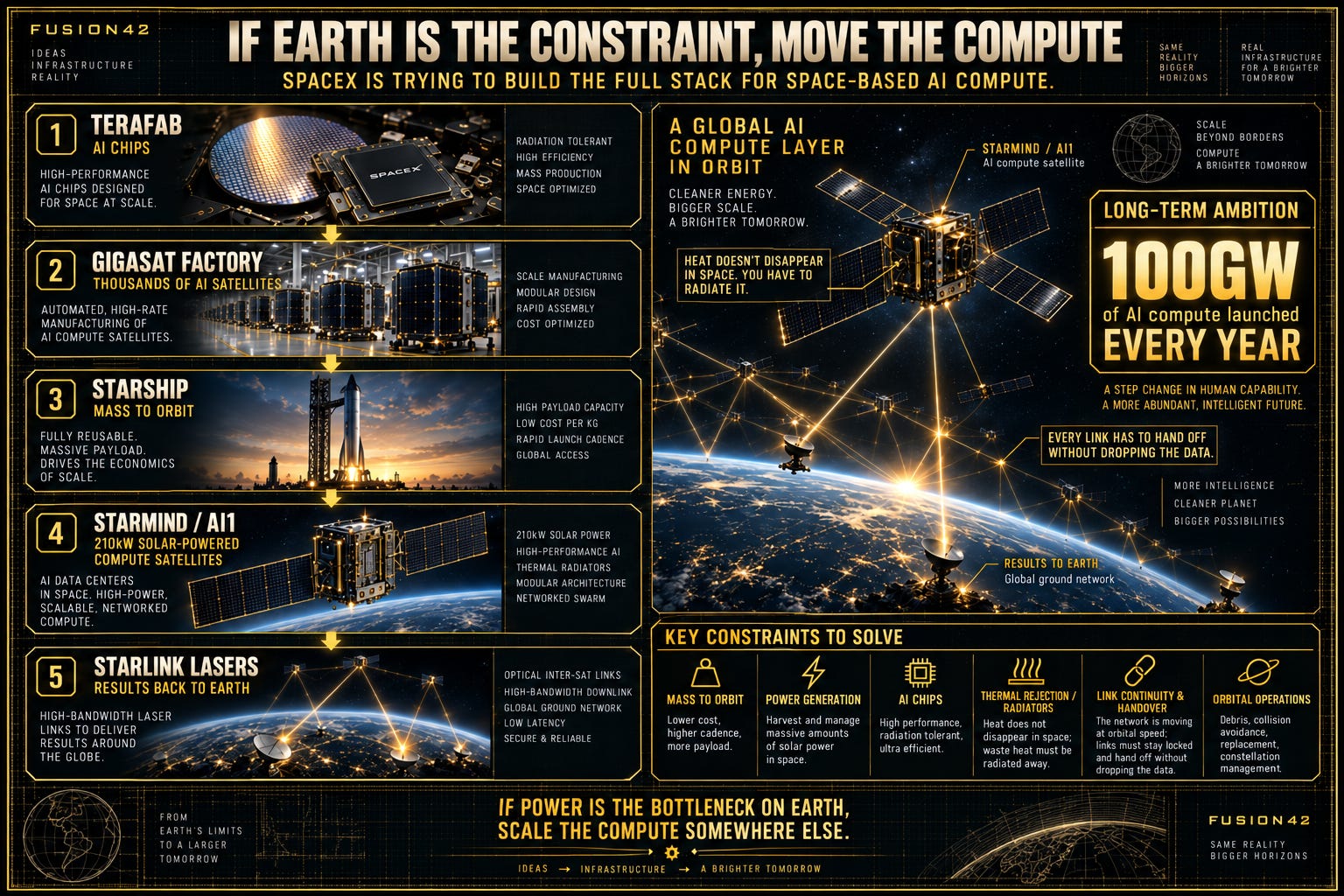
Its first design, AI1, is a modular AI-compute satellite using solar technology derived from Starlink. SpaceX says each satellite would carry a 210kW solar array and operate in sun-synchronous orbit, giving it long periods of solar exposure without weather or atmospheric losses. The compute modules are chip-vendor agnostic, while high-speed optical links would connect the satellites to one another and feed results back through Starlink.
This has moved beyond a slide deck. SpaceX is building a Gigasat Factory in Bastrop that it says could start producing and deploying thousands of AI satellites from late 2027. Terafab, being developed with Tesla, is intended to supply the advanced AI chips needed further up the stack.
SpaceX identifies three big constraints of its own: getting enough mass into orbit, generating enough power and producing enough AI chips. Starship is supposed to deal with the first, orbital solar with the second and Terafab with the third.
Then the numbers get properly ridiculous.
SpaceX’s June 2026 prospectus says the long-term ambition is to launch 100GW of AI compute capacity every year. At that scale it expects thousands of launches and roughly one million tonnes of hardware delivered into orbit annually.
The idea becomes easier to understand once you compare it with what is happening on Earth. A large terrestrial data centre can spend years waiting for grid capacity, substations, transmission lines and planning approval before anyone switches on the GPUs. SpaceX is effectively asking whether it eventually becomes easier to take some of the compute to the energy rather than keep dragging ever larger amounts of energy towards the compute.
Cooling is part of the case as well. Terrestrial data centres spend a lot of energy running pumps, chillers, fans and cooling towers. SpaceX says orbital compute can remove much of that overhead because heat can be radiated directly into space.
The heat still has to go somewhere. In a vacuum that means rejecting it through radiators, and at hundreds of kilowatts per satellite thermal management becomes a serious engineering problem of its own.
The network is another one. These satellites are moving at orbital speed, so laser links have to stay locked while traffic is continually handed from one satellite to another. Link continuity and handover matter enormously. A distributed orbital AI cluster cannot afford links dropping whenever one satellite disappears over the horizon.
Then add radiation, collision avoidance, replacement cycles, servicing, orbital debris and the economics of launching enough hardware to make the whole thing worthwhile.
SpaceX has spent the last twenty years turning problems like these into industrial systems, which is why I find Starmind interesting. It is trying to control most of the stack itself: Terafab makes the chips, the Gigasat Factory builds the satellites, Starship gets them into orbit, Starmind runs the compute and Starlink connects it back to Earth.
Whether that works economically at anything approaching 100GW a year is still a huge question. The industrial logic, though, is easy enough to see.
If power becomes one of the main constraints on AI, putting some compute next to a near-continuous source of solar energy starts to make sense.
That brings me back to where I started.
I believe in what this technology can do, and I think we are going to need vastly more compute than we have today. Some of the rush is rational. Some of it is corporate FOMO, with trillion-dollar companies racing to secure land, power, chips and grid capacity before their competitors do.
We need to build the bloody thing properly.
Put data centres where the power and infrastructure can support them. Build generation alongside them where necessary. Be honest about water, noise and emissions. And when a project creates the need for a new substation or transmission line, the company building it should pay rather than quietly handing the bill to everyone living nearby.
I’m all for building the compute.
We just shouldn’t fuck over the people living next door to do it.
And if Earth really does become the constraint, perhaps some of that compute ends up somewhere else entirely.
Go take a and look, For the ❤️ of startups
Scout - who just got funded
Newly funded startups, pre-seed to Series B, as the rounds happen.
Raise - who’s deploying
New funds with fresh capital and cheques to write.Wire - what changed, what matters
The intelligence feed that filters the noise, with the “so what” attached.
If you have not joined the Fusion42 Community on Telegram —
it is probably time to do so.
For the ❤️ of Startups
✌🏼 & 💙
Derek
Thank you for reading. If you liked it, share it with your friends, colleagues and everyone interested in the startup Investor ecosystem.
If you've got suggestions, an article, research, your tech stack, or a job listing you want featured, just let me know! I'm keen to include it in the upcoming edition.
Please let me know what you think of it, love a feedback loop 🙏🏼
🛑 Get a different job.
Subscribe below and follow me on LinkedIn or Twitter to never miss an update.