


This isn’t a news roundup. It’s a read on what just shifted and what that breaks.
The goal isn’t coverage. It’s consequence.
If you’re building, read this with decisions in mind.

This is what’s inside:
⚡ THE BREAK
What crossed a line this week and why it matters now.
🧠 WHAT QUIETLY CHANGED
The follow-on effects most people will miss until it’s obvious.
🧪 THE EDGE CASE
The example everyone is debating and what it actually reveals.
🎯 THIS WEEK’S BET
Where to lean in and what to avoid based on the shift above.
💡 FOUNDER SPOTLIGHT
Someone already building for this reality, not the last one.
🛠️ THE UNFAIR STACK
Five tools that give leverage if used properly right now.
❓ THE QUESTION
The question this week leaves hanging.
This week’s developments aren’t about flashy product demos — they’re about trust, access, and where AI actually sits in decision-critical workflows.
From how models are packaged to how outputs are received in the wild, the narrative is shifting from “what AI can do” to “what the world will actually accept and govern.”
⚡ THE BREAK
OpenAI releases GPT-5.2 with nuanced reasoning tiers
OpenAI’s launch of GPT-5.2 — with instant, thinking, and Pro modes — isn’t just another iteration. It signals a segmentation of AI capability into tiers that map directly to professional work outcomes. The “thinking” and “Pro” variants emphasise reasoning, long-form execution, and project workflows rather than simple prompt output. This matters because commoditised generation no longer differentiates products — reasoning and task completion do.
Founder move: every time you use AI for a real decision this week, force it to add three lines at the bottom:
Assumptions: what it assumed to be true
Uncertainty: what it’s not confident about
Decision trigger: what new info would change the answer
If it can’t do that cleanly, treat the output as brainstorming, not truth.
Optional (one step further): keep a simple running note for one workflow with input → output → your edits. You’ll quickly see where AI is saving time and where it’s making confident messes.
Source:
🧠 WHAT QUIETLY CHANGED
• Meta’s reported move toward charging for Avocado underscores a broader shift: open-source ideation is receding where control and monetisation intersect.
• Publishers and brands facing backlash for poorly integrated AI content are prompting precautionary regulation and transparency debates.
• Regulatory moves in the UK and US are pushing disclosure and safety requirements for AI outputs, meaning products will soon compete on trust, not just capability.
We are building Arthur, your agentic Startup OS that gets **it done for you.


CLICK HERE TO GET EARLY ACCESS AND YOUR FREE FUEL UNITS
🧪 THE EDGE CASE
McDonald’s pulls its AI-generated Christmas ad after backlash
Last week McDonald’s Netherlands withdrew an AI-generated ad that was widely mocked for emotional incoherence and tone deafness. The controversy highlights how output quality and audience perception matter in ways that go beyond technical capability.
People argue it’s just poor creative execution, but the real issue is that AI outputs are increasingly judged as products in the cultural economy, not generative toys.
Founder takeaway: design for audience sentiment and human context before launching anything that interacts with your user base.
🎯 THIS WEEK’S BET
Build:
Integrate reasoning-centred model tiers as a native part of key workflows (e.g., proposal generation with critique loops, automated contract summarisation with anomaly detection). Reasoning is now where users notice real difference.
Bail:
Avoid launching “AI features” that don’t move the needle on decision quality or trust signals (such as unguided creative generation without user validation steps), because users and regulators are tightening expectations.
💡 FOUNDER SPOTLIGHT
Demis Hassabis (Google DeepMind) — why systems beat features.
Who he is:
British, Cambridge-educated co-founder and CEO of DeepMind. Trained in neuroscience and computer science, with a background spanning academic research, game design, and applied AI.
Why his authority matters:
Hassabis isn’t a commentator. He’s led teams behind AlphaGo, AlphaZero, and AlphaFold — systems that didn’t just outperform humans, but changed entire fields. AlphaFold alone solved a 50-year protein-folding problem and produced peer-reviewed results published in Nature, reshaping biology and drug discovery. His work consistently moves AI from benchmarks into real-world consequence.
What’s unique in this video:
He’s explicit that the next real jump isn’t better prompting or bigger models. It’s world models — systems that can reason about reality, plan actions, test outcomes, and revise based on feedback. That’s a shift from AI that sounds right to AI that can be wrong, notice it, and correct itself. For founders, that’s the line between demos and deployable systems.
Pinch-this lesson:
Stop shipping answers. Start shipping systems that can explain, test, and revise their decisions.
Worth watching in full.
“Nobody’s found anything in the universe that’s non-computable.”
That doesn’t mean AI can do anything tomorrow. It means most of what we call “too complex” is usually just “not instrumented yet”. The ceiling isn’t compute. It’s whether you can turn your domain into signals, and whether you can verify the answer.
If you can measure it and check it, you can automate part of it.
AI for Startups Live
The Shifts Founders Need to Act On
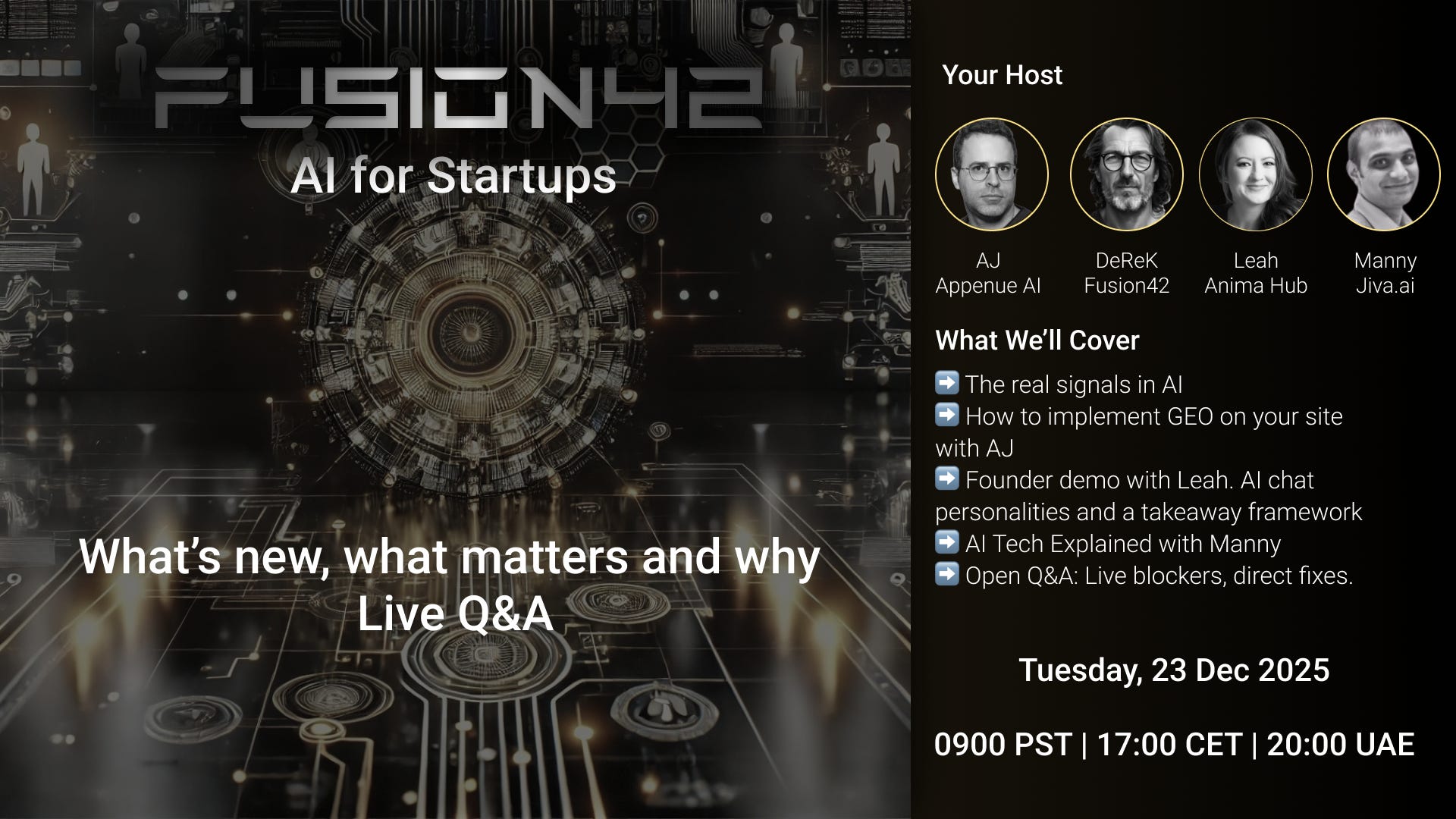
Watch yesterdays session here
AI For Startups | Supercharge Your Startup's Growth with Google | Ahmed AbdelKhalek

This masterclass explores where AI is actually heading as we move into an agent-driven future and what that means for startups building today.
🛠️ THE UNFAIR STACK
Perplexity — sourced answers with citations you can actually sanity-check
Start here: Run every “important” claim through it and keep the sources.
OpenAI Responses API — one API for agents, tools, and structured outputs
Start here: Turn one workflow into input → output → explanation.
Langfuse — traces, prompt versions, and run logs for AI workflows
Start here: Log inputs and outputs so you can see what changed.
promptfoo — automated evals for prompts and model swaps
Start here: Write 20 real test cases and score outputs weekly.
Guardrails AI — enforce format, checks, and refusal rules
Start here: Add “assumptions / uncertainty / decision trigger” as a required footer.
❓ THE QUESTION
Where in your business are you using AI outputs without being able to explain how they were reached?
Answers in the comments👇
FOR THE ❤️ OF STARTUPS
Thank you for reading. If you liked it, share it with your friends, colleagues and everyone interested in the startup Investor ecosystem.
If you've got suggestions, an article, research, your tech stack, or a job listing you want featured, just let me know! I'm keen to include it in the upcoming edition.
Please let me know what you think of it, love a feedback loop 🙏🏼
🛑 Get a different job.
Subscribe below and follow me on LinkedIn or Twitter to never miss an update.
For the ❤️ of startups
✌🏼 & 💙
Derek