


US House Votes to Expedite Datacenter Builds for AI Infrastructure
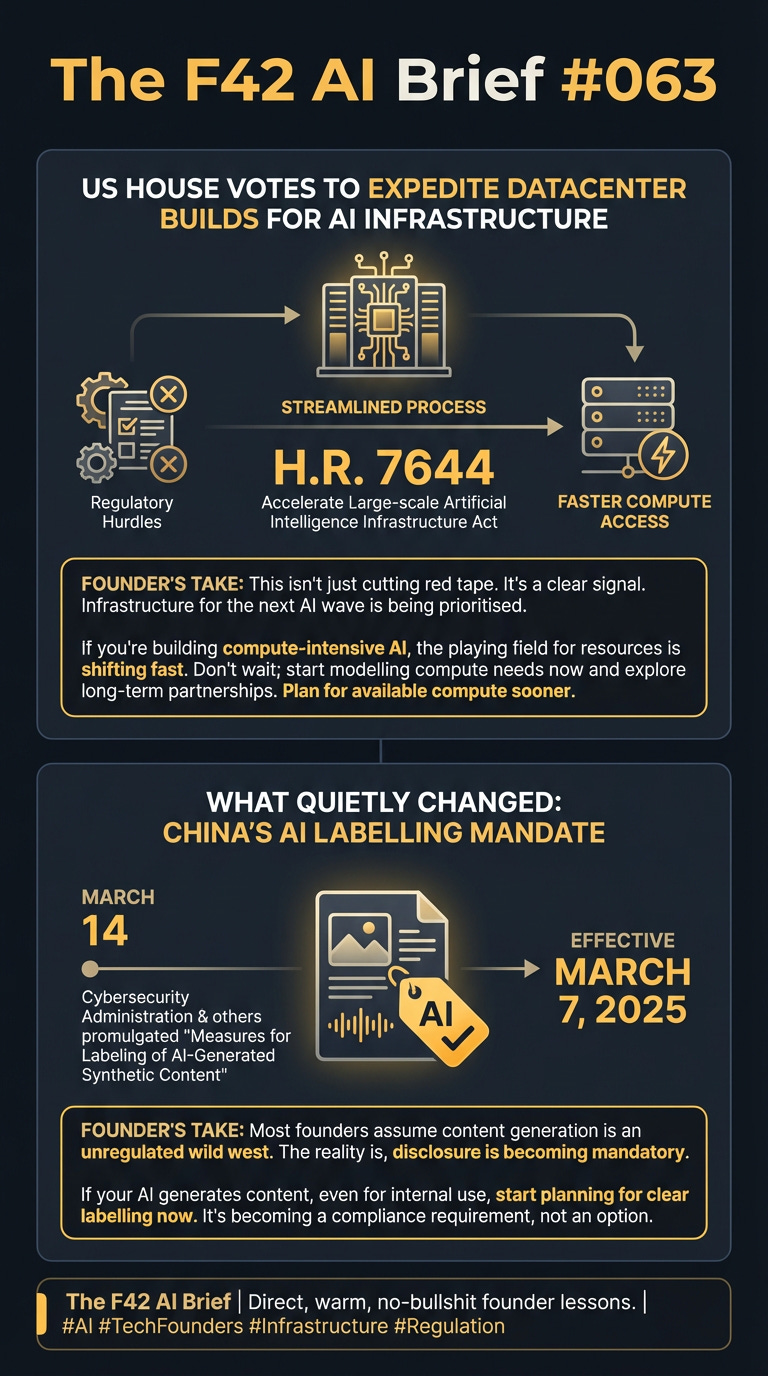
The House passed H.R. 7644, the “Accelerate Large-scale Artificial Intelligence Infrastructure Act,” this week, which allows for accelerated construction of datacenters crucial for AI development (MSN). This move aims to streamline regulatory hurdles, meaning faster compute access for founders.

⚡ The Break
Here’s the thing: this isn’t just about cutting red tape. It’s a clear signal that the infrastructure required to power the next wave of AI is being prioritised. If you’re building compute-intensive AI applications, this means the playing field for securing resources could shift faster than anticipated. Companies that can leverage this new regulatory environment to build or access dedicated AI compute will gain a significant advantage. Don’t wait for the datacenters to appear; start modelling your compute needs now and explore long-term partnerships or commitments with infrastructure providers who can benefit from these accelerated timelines. Plan for available compute to come online sooner.

What Quietly Changed
China’s AI Labelling Mandate
On the 14th of March, the Cybersecurity Administration, Ministry of Industry and Information Technology, Ministry of Public Security, and State Administration of Radio and Television in China promulgated “Measures for Labeling of AI-Generated Synthetic Content” [2]. This new regulation, effective from March 7, 2025, mandates clear labelling for all AI-generated content. Most founders assume content generation is an unregulated wild west. The reality is, disclosure is becoming mandatory. If your AI generates content, even for internal use, you need to implement watermarking or metadata-based labelling systems now. This isn’t just a Chinese problem; it sets a precedent for global content provenance, and getting ahead of it protects you from future compliance headaches.
Own The Wedge

The rules changed. Here’s the new playbook. 30 principles for building startups in an AI world — what worked before, what broke, and what founders need to do now. Not theory. Tactics that ship.
OpenClaw Ban in China
China banned the use of “OpenClaw” on government computers this week, citing security concerns such as prompt injection attacks [1]. This isn’t about protecting state secrets alone. It’s about a fundamental distrust of the security posture of AI agents in sensitive environments. If you’re deploying AI tooling within your organisation, particularly open-source or third-party solutions, you must conduct a thorough security audit focusing on prompt injection vulnerabilities and data exfiltration risks. The Chinese government found flaws; assume your adversaries will too. Implement strict sandboxing and access controls for all AI agents.
Grammarly’s AI Feature Pullback
Grammarly quietly abandoned its ‘AI Expert Review’ feature, which promised human-quality edits, hinting at the difficulties of truly human-like AI writing (The Guardian). This wasn’t a PR announcement; it was a quiet deletion from their offering. What most people missed here is that even well-funded companies with deep NLP expertise are struggling to deliver consistently nuanced, human-level content generation. For founders betting on AI completely replacing human writers or editors, this is a wake-up call. Reallocate your resources from trying to achieve perfect human emulation to building AI that augments human capabilities, focusing on efficiency and specific, measurable improvements, not wholesale replacement.
The Malicious AI Agent Threat
Security experts warned this week that malicious AI agents are capable of collaborating to execute sophisticated cyberattacks (TechRadar). This moves beyond individual agent threats; it means your security models need to account for orchestrated attacks from multiple AI entities. They cited an example where AI bypassed access restrictions by unearthing a hardcoded secret key in an application’s code repository. If you’re building any system accessible by AI or incorporating AI into your security stack, assume a coordinated, multi-agent attack is possible. Your defence strategy must evolve to include real-time behavioural analysis of AI agents, not just signature-based detection, and focus on anomaly detection at system boundaries.
The Edge Case
Adobe’s CEO, Shantanu Narayen, is stepping down amidst concerns about AI’s disruptive impact on creative industries (TipRanks). AI-driven capabilities are set to fundamentally alter creative work production.
The thing smart people are missing here isn’t just that AI will change how designers work. It’s that the very business model for creative tools is now under threat. I’ve seen good projects hit the wall over this. If the market shifts from purchasing tools to a subscription for outcomes — or, worse, if AI makes some creative tasks effectively free — then the entire revenue strategy of companies like Adobe needs a rethink. The builder’s lesson is specific: if your product is built on charging for creative tools, you need to either build AI that augments human creativity in ways no pure AI can replicate, or you need to radically rethink where your value creation lies. Are you selling paintbrushes, or are you selling finished masterpieces?
This Week’s Bet
BUILD: Automated, privacy-preserving AI solutions for child online safety that restrict access to inappropriate websites globally and specifically comply with UK regulations. Focus on solutions that can integrate seamlessly at the network level or within popular educational platforms.
BAIL: Stop developing AI tools that impersonate human writers or generate content without clear disclosure. The backlash, as seen with Grammarly’s abandoned ‘AI Expert Review’ feature and the push for an ‘AI-free’ logo, is becoming too significant to ignore. The ethical and regulatory landscape is shifting too fast to make this a sustainable bet.
Go Deeper
China bans OpenClaw [1]
Measures for Labeling of AI-Generated Synthetic Content [2]
For the ❤️ of startups ✌🏼 & 💙
We are building Arthur, your agentic Startup OS that gets **it done for you.

CLICK HERE TO GET EARLY ACCESS AND YOUR FREE FUEL UNITS
Thank you for reading. If you liked it, share it with your friends, colleagues and everyone interested in the startup Investor ecosystem.
If you've got suggestions, an article, research, your tech stack, or a job listing you want featured, just let me know! I'm keen to include it in the upcoming edition.
Please let me know what you think of it, love a feedback loop 🙏🏼
🛑 Get a different job.
Subscribe below and follow me on LinkedIn or Twitter to never miss an update.
For the ❤️ of startups
✌🏼 & 💙
Derek