



Back in August, I wrote A New Financial Cycle Has Begun, looking at how government borrowing, AI investment, energy costs, commodities and global capital markets were heading towards a fairly uncomfortable collision. My concern was that governments were accumulating debt faster than their economies could comfortably support it, while the AI industry was adding an extraordinary new demand for capital and physical resources.

Three months later, I believe we’re already inside the adjustment I was describing. The interesting thing is where the pressure is starting to appear, because we’re now seeing some of the financial assumptions behind the AI boom being challenged by the people actually lending the money.
I’ve spent over 30 years building companies, managing investment capital, operating in private markets and navigating multiple economic and financial cycles. I’ve seen firsthand how businesses are financed, how capital gets allocated and what happens when the assumptions supporting an investment fall apart. Financial engineering can disguise poor economics for a surprisingly long time, but it cannot fix them. Eventually businesses must generate cash, investments must deliver returns and debts must be serviced. Governments have more options for postponing that reckoning, but the underlying economics don’t disappear.
And that, as far as I’m concerned, is where the real problem lies.
💣 AI: The Money Is Starting to Ask Questions
I’ve been arguing for some time that AI will be an enormous technological revolution. I genuinely believe that. I also think we’re heading towards a serious correction in the financing behind the current investment boom, and I suspect plenty of investors are going to discover the difference between backing a revolutionary technology and making a sensible investment.
Look at what’s happening in credit.
CoreWeave’s unsecured bonds have been trading at spreads exceeding 1,000 basis points above US Treasuries. Oracle’s credit-default swap spreads have risen substantially, while SoftBank’s five-year CDS recently reached 466 basis points, a four-year high.
These aren’t small adjustments in the cost of capital. Lenders are demanding significantly more compensation for financing businesses whose valuations and growth expectations were built around extraordinary future demand.
The more interesting development, however, is what we’re seeing in actual transactions.
Blackstone-backed QTS reportedly reduced a proposed $800 million debt sale to around $300 million after investors pushed back on the terms. Yet another Blackstone vehicle agreed to acquire a majority interest in $5 billion of established data centres leased to Amazon.
Think about what that tells us. Investors are still prepared to finance data centres with credible tenants, contractual income and sensible economics. They’re becoming considerably less enthusiastic about funding projects where the returns depend on aggressive forecasts and continued access to cheap capital.
And then there’s Nvidia.
The company has become far more than the dominant supplier of AI processors. Its investments, guarantees, capacity agreements and commercial relationships connect it to a substantial part of the ecosystem purchasing its products. Its disclosures identify up to $108.5 billion of gross guarantee exposure, alongside enormous supply and infrastructure commitments.
These aren’t all debts or guaranteed future losses, and treating them as such would be nonsense. But the financial interdependence is extraordinary. Suppliers are helping finance customers, those customers are using the capital to purchase infrastructure, and the resulting demand supports further investment and borrowing.
It works while utilisation grows, customers pay their bills and lenders remain confident in the returns.
The problem comes when one of those assumptions stops working.
If computing demand develops more slowly than expected, or prices fall faster than forecast, infrastructure developers can find themselves servicing enormous obligations against revenues that no longer justify the investment. Some will reduce spending, others will restructure, and a few will probably fail.
I wouldn’t be surprised to see significant amounts of AI infrastructure eventually changing hands at a fraction of what it cost to build. That could be very good news for the companies acquiring it and bloody expensive for the people who financed it.
We’ve seen this before. The internet changed the world, but it didn’t save the shareholders and creditors of every company that helped build it.
I think AI could follow a similar path, only with considerably larger amounts of capital involved.
🇺🇸 America Has Its Own Financing Problem
This is where the AI story becomes much more interesting from a macro perspective.
America has more than $40 trillion in federal debt, enormous annual deficits and a Treasury that must continually refinance existing obligations while raising substantial amounts of additional money. Its latest projections call for around $1.4 trillion in net marketable borrowing across the final quarter of 2026 and the first quarter of 2027.
And the cost of that borrowing is considerably higher than it was during the years of near-zero interest rates.
We’ve recently seen the US 10-year yield above 5%, with the 30-year around 5.5%. Those levels matter when you’re dealing with trillions of dollars of refinancing requirements.
The Treasury market is still functioning, and there are plenty of willing buyers. I’m not suggesting America is suddenly unable to finance itself. But those buyers increasingly have alternatives, and the US government has to compete with corporations, infrastructure developers and other sovereign borrowers for capital.
The economic consequences are already visible in housing. Mortgage rates around 7% have made buying increasingly unaffordable, while homeowners with much cheaper existing mortgages have little incentive to move. Builders face expensive financing, transactions slow and investment suffers.
You don’t need another 2008-style banking collapse for housing to become a serious drag on the economy.
And here’s the contradiction. Washington needs stronger growth to support its debt burden, but the cost of financing that debt is making growth more difficult. At the same time, the AI industry is asking investors to commit enormous sums today against productivity gains and financial returns that may take years to arrive.
I find the assumption that AI-driven growth will simply rescue America’s fiscal position rather optimistic, particularly when we haven’t established how much of the current investment will actually earn an acceptable return.
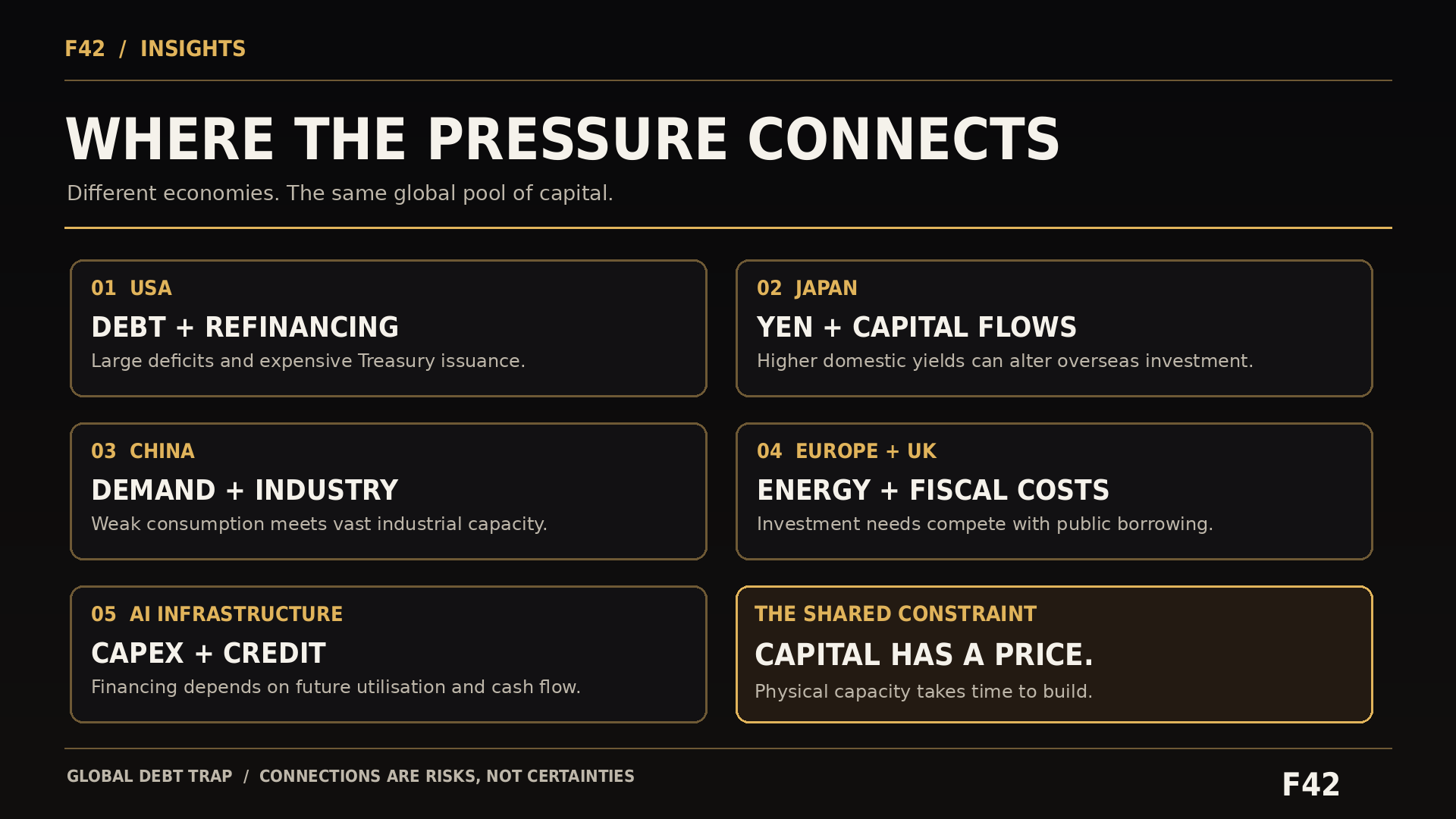
🇯🇵 Japan Could Make Everything More Uncomfortable
Japan is the part of this story I think deserves far more attention.
For decades, Japan operated with exceptionally low interest rates and an enormous government debt burden. That encouraged Japanese institutions to invest overseas, while international investors borrowed cheaply in yen to finance positions in higher-yielding assets.
Now the yen is trading around 160 to the dollar, imported inflation has surged and Japanese government bond yields have risen to levels that would have seemed extraordinary only a few years ago.
Japan’s 10-year yield has approached 2.9%, while its 30-year is around 4%.
The Bank of Japan faces a difficult problem. Higher rates could help support the currency and contain inflation, but they also raise domestic borrowing costs and change the economics of investments built around almost-free money.
Japan is also one of America’s largest overseas creditors.
If Japanese institutions increasingly decide that domestic bonds offer attractive returns, less capital may flow abroad. And if the yen reverses sharply, leveraged carry trades could unwind, forcing investors to sell overseas assets and repay yen borrowing.
I’m not claiming Japan is about to dump its entire Treasury portfolio. But a sustained shift in Japanese capital flows could put additional pressure on international funding markets at precisely the wrong moment.
Now imagine that happening while AI lenders are reducing exposure and the US Treasury is still issuing enormous amounts of debt.
That’s the sort of combination that worries me far more than another 5% decline in the Nasdaq.
🇨🇳 China, Europe and the Physical Economy
China presents an entirely different problem. Its property market remains deeply troubled, local-government debt is substantial and domestic consumers aren’t spending enough to support the country’s enormous industrial capacity.
October retail sales grew just 0.4%, while property investment was down more than 20% over the first ten months of the year.
China is increasingly relying on manufacturing and exports to compensate for weak domestic demand, which puts further pressure on producers in Europe and America. It could also export disinflation, making the monetary picture rather more complicated than simply assuming every indebted economy will experience runaway inflation.
But China also controls important parts of the physical supply chain needed for AI, electrification and industrial production, particularly rare-earth processing and magnets.
That was a central part of my August argument, and it remains important.
America leads much of the AI technology industry, but building that technology requires electricity, transformers, copper, cooling equipment, manufacturing capacity and strategic materials. A substantial part of the processing and manufacturing infrastructure sits in China.
Governments are responding with subsidies, trade restrictions and efforts to move production closer to home. I understand the strategic reasoning, but rebuilding industrial capacity is expensive and takes time.
Europe has its own problems financing defence, energy security and industrial competitiveness, while France and Italy carry substantial debt burdens. Britain is struggling with weak productivity, expensive housing and limited fiscal flexibility. Germany needs to spend heavily to improve infrastructure and competitiveness.
Meanwhile, Brazil, Canada, Australia and the Gulf remain essential suppliers of the energy and commodities on which much of this investment depends.
We can create credit almost overnight. Developing a copper mine, building electricity infrastructure or expanding energy production takes years. That difference between the speed of financial expansion and the speed of physical investment is becoming increasingly important.
💵 The Debasement Trade Is Already Underway
This brings me back to the bigger monetary argument.
I believe we have already entered a fundamental restructuring of the global monetary system, driven by excessive debt, changing international capital flows and increasing pressure on the purchasing power of currencies.
I expect governments to favour inflation tolerance and financial repression over the political pain of genuinely reducing their debt burdens. That may involve keeping real interest rates below inflation for prolonged periods, changing the maturity of government borrowing or using monetary policy to support financial markets when conditions become difficult.
It’s a relatively convenient way of reducing the real burden of debt. Creditors get repaid, but the money they receive buys less.
America has the additional advantage of issuing the world’s dominant reserve currency, something that has allowed Washington to borrow on terms most other countries can only dream of.
I believe that advantage is gradually eroding.
Central banks have been accumulating gold, China is expanding trade settlement in renminbi and countries are developing alternatives to dollar-based financial arrangements. The dollar’s share of official foreign-exchange reserves has declined over the longer term, although it remains by far the most important currency in global finance.
There’s no obvious replacement, and I don’t expect one to appear overnight. But America doesn’t have to lose reserve-currency dominance completely for its borrowing costs to be affected. A gradual reduction in the willingness of foreign investors to increase their exposure to dollar assets could matter enormously when Treasury issuance remains so large.
Of course, the immediate market reaction to a serious credit squeeze could be a stronger dollar rather than a weaker one. Borrowers scramble for liquidity, investors sell assets and demand for dollars increases. Gold might fall at precisely the moment people expect it to rally.
We’ve already seen how sensitive gold remains to real interest rates and dollar strength.
What interests me is what comes afterwards.
If credit deterioration begins affecting investment, employment, asset prices and government revenues, the pressure for monetary intervention will increase. I struggle to see politicians willingly accepting prolonged austerity, widespread defaults and falling asset values when they have other options available.
That is where I believe the debasement trade becomes considerably more powerful, and where the gradual move away from dollar-denominated assets could accelerate.
🔎 Where I Think This Goes Next
My expectation over the next six to twelve months is that financing becomes increasingly difficult for the weaker parts of the AI infrastructure market. Some projects will be delayed, borrowing terms will become more demanding and companies dependent on repeated capital raising will face uncomfortable decisions.
I suspect we’ll see asset sales and restructurings before we see the full consequences in the wider economy.
Japan could accelerate the process if its domestic yields continue rising or the yen moves sharply enough to trigger broader deleveraging. Persistent US borrowing costs above 5% would add further pressure, particularly across housing, private credit and businesses that relied on cheap refinancing.
I don’t know exactly when the next major credit event arrives. Markets can support questionable economics for surprisingly long periods, and the strongest AI companies may continue growing rapidly throughout the correction.
But I believe a meaningful adjustment in the financing of AI infrastructure is coming, and the broader debt environment makes that adjustment more dangerous than it would have been a decade ago.
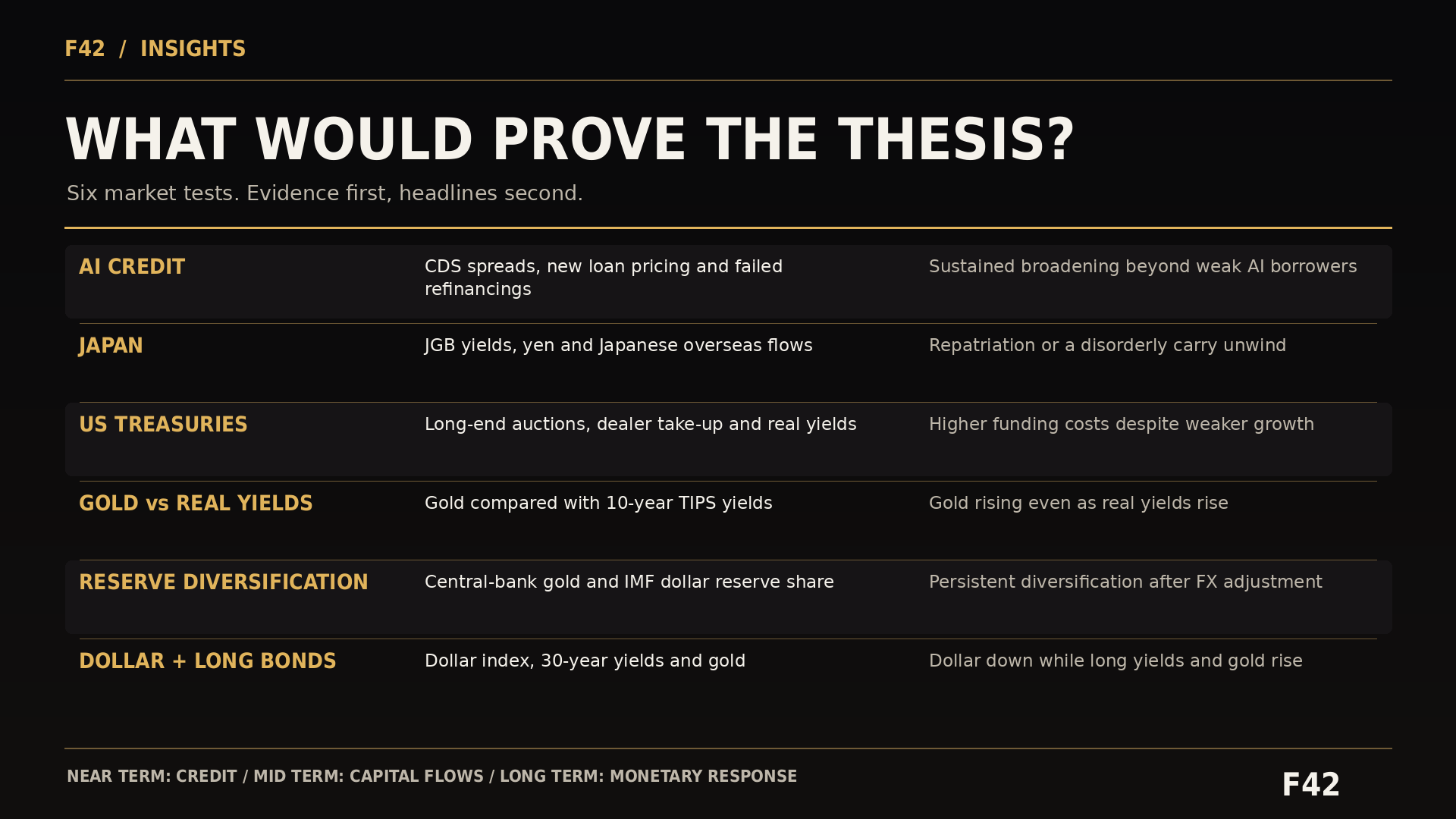
I’ll be watching what lenders actually do, rather than treating every fall in technology shares as proof that the bubble has burst. Credit spreads, new debt issuance, refinancing terms and asset sales will tell us far more.
I’ll also be watching Japan’s capital flows and Treasury demand, particularly whether long-dated US yields keep rising even when economic growth weakens.
For the debasement thesis, I want to see whether gold can rise alongside higher real yields, whether central banks continue diversifying away from dollar reserves, and whether gold and long-dated Treasury yields begin rising together while the dollar weakens. That would tell us something considerably more serious about confidence in sovereign debt.
If those developments don’t materialise, I’ll say so. There’s no point having a thesis if you’re unwilling to test it.
Back in August, I argued that governments, technology companies and the physical economy were heading towards a collision over capital, energy and productive capacity.
Three months later, the credit market is providing some of the first meaningful evidence that the financing assumptions behind the AI boom are being challenged.
I think that pressure has further to run, and I believe the monetary consequences will eventually matter much more than the current correction in technology shares.
That’s what I’ll be following in my macro commentary from here.
Go take a and look
Scout - who just got funded
Newly funded startups, pre-seed to Series B, as the rounds happen.
Raise - who’s deploying
New funds with fresh capital and cheques to write.Wire - what changed, what matters
The intelligence feed that filters the noise, with the “so what” attached.
If you have not joined the Fusion42 Community on Telegram —
it is probably time to do so.
For the ❤️ of Startups
For the ❤️ of startups
✌🏼 & 💙
Derek
Thank you for reading. If you liked it, share it with your friends, colleagues and everyone interested in the startup Investor ecosystem.
If you've got suggestions, an article, research, your tech stack, or a job listing you want featured, just let me know! I'm keen to include it in the upcoming edition.
Please let me know what you think of it, love a feedback loop 🙏🏼
🛑 Get a different job.
Subscribe below and follow me on LinkedIn or Twitter to never miss an update.