


This book makes one claim.
The economic system that governed the world from roughly 1971 to 2025 has stopped working.
Not politically. Not morally. Mathematically.
For three centuries, capitalism functioned as a scarcity engine. Prices rationed what could not be produced. Wages allocated survival. Profit rewarded whoever could route around a constraint. Scarcity was not a bug — it was the organising principle.
That engine is now breaking.
AI does not merely improve productivity. It removes scarcity from the one input capitalism most depends on: human effort. Cognition becomes cheap. Coordination becomes automated. Labour shifts from being scarce to being optional at the margin. The mechanisms that made prices meaningful, wages necessary, and hierarchy legible begin to fail.
This is not a story about job loss.
It is a story about the removal of the foundational constraint that made the system governable.
At the same time, AI intensifies scarcity elsewhere. Every “free” unit of intelligence requires expensive atoms: energy, cooling, water, minerals, grid capacity. Abundance in software collides with hard limits in physics. That contradiction is the break.
Debt no longer resolves it. Demographics no longer cushion it. And the horizontal expansion that sustained growth for fifty years — more trade, more credit, more offshoring, more container ships — has reached its physical and political limits.
The map is complete.
When horizontal expansion exhausts itself, only one axis remains: vertical.
Industry moves upward not because of futurism or billionaire fantasy, but because Earth has become structurally uninvestable — politically, thermodynamically, and physically. Space is not ideology. It is geometry. Orbit offers energy without land, compute without cooling, and manufacturing without gravity. Once costs cross thresholds, capital follows constraints, not narratives.
This book is not a prediction.
It is a blueprint.
It lays out the architecture that must be built between now and 2050 — energy, compute, launch, governance, income, meaning — and shows why each component depends on the others. Miss one, and the system fails. Get the sequencing wrong, and control replaces freedom by default.
When the architecture succeeds, everything downstream changes:
who holds power, how income flows, what work means, and whether abundance liberates humans or perfects their containment.
This is the compressed version of the argument.
The full work expands it across six parts.
Either way, this is where the system is.
And this is where it is going.
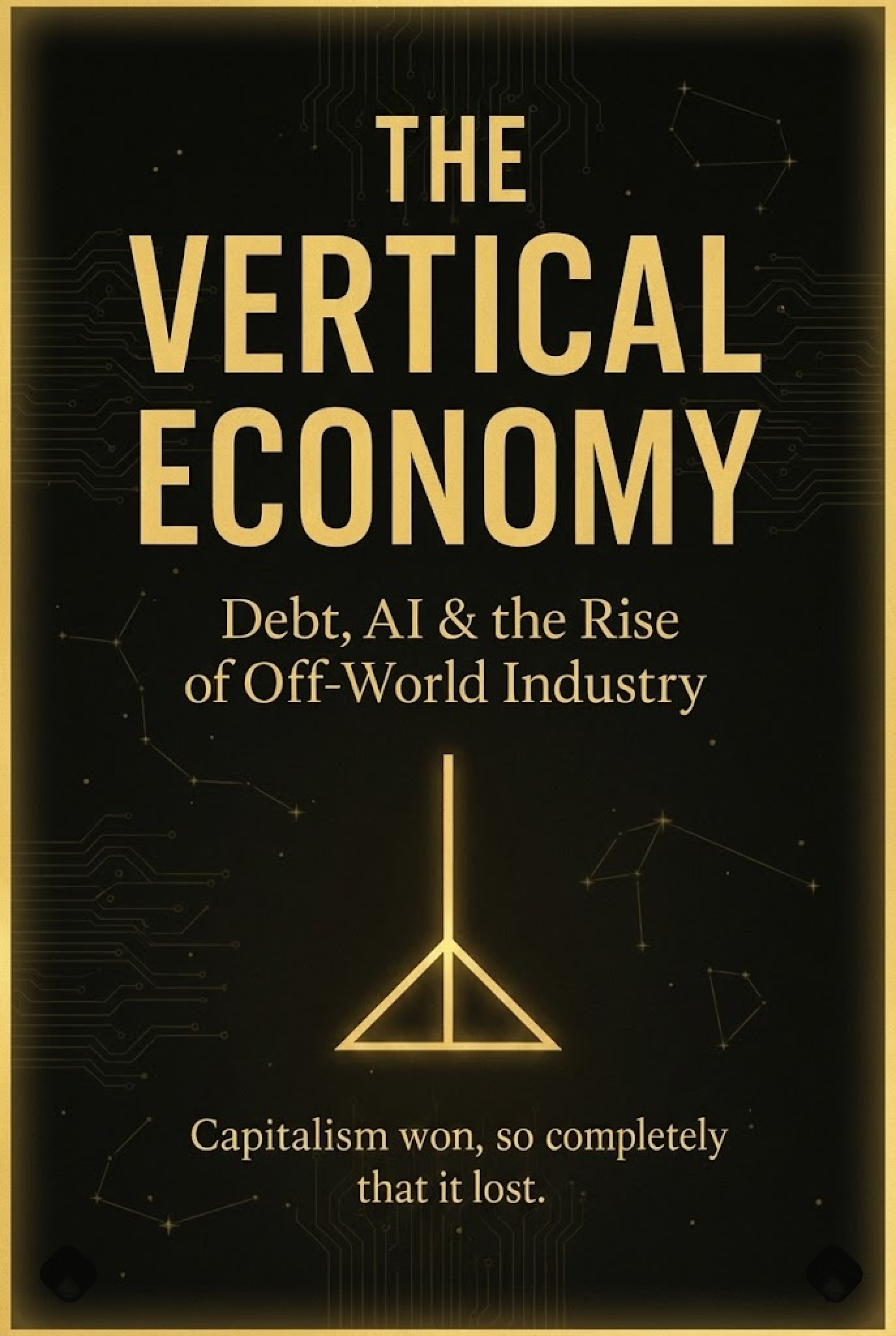
Capitalism won — so completely that it lost.

Three cushions collapsed simultaneously: debt stopped buying growth, demographics inverted, and AI began eating the price of labour. The result is a Great Bifurcation — one system built on credit (the West), another built on capacity (China and the emerging BRICS bloc). By 2025, China runs a $1 trillion surplus while Western economies service debt that no longer generates returns.

From 1971 to 2025, the developed world replaced productivity with leverage. Each crisis justified more borrowing. Each wave of borrowing suppressed the productivity it claimed to pursue. The maths inverted quietly: a dollar of debt now generates less than a dollar of growth. No democracy can admit this arithmetic, because voters were trained for fifty years to expect rising living standards funded by promises.

When horizontal expansion exhausts itself, the only remaining axis is vertical. Space is not idealism — it’s thermodynamics. Orbit offers energy without land, compute without cooling, manufacturing without gravity. Launch costs have already fallen 10x. If Starship achieves stated reuse targets, costs reach $200/kg by 2035. The thesis holds even if it plateaus higher — the direction is set, only the timeline shifts.

Hegemony doesn’t disappear. It migrates. The US built the horizontal world and now struggles to leave it. China never loved the horizontal game — it used it, extracted from it, and is preparing for the next one. Europe invented modernity, then chose comfort over power. The vertical century belongs to whoever can combine aerospace, materials, energy, robotics, AI, and long-term planning. Alliances will fracture along supply chains, not borders.

When labour stops being scarce, the social contract breaks — not politically, but mechanically. Income must be redesigned, not improvised. Status games mutate. Meaning cannot be automated. The failure mode is not chaos — it’s domestication: surveillance welfare, behavioural credit, managed populations. Abundance either frees humans or perfects their containment. The difference is design, not destiny.

The vertical transition does not ask permission. Refusing to choose is still a choice. Every previous social order was designed — explicitly or brutally. This one will be too. The question is whether we design deliberately or drift into optimisation by default.
Thank you for reading. If you liked it, share it with your friends, colleagues and everyone interested in the startup Investor ecosystem.
If you've got suggestions, an article, research, your tech stack, or a job listing you want featured, just let me know! I'm keen to include it in the upcoming edition.
Please let me know what you think of it, love a feedback loop 🙏🏼
🛑 Get a different job.
Subscribe below and follow me on LinkedIn or Twitter to never miss an update.
For the ❤️ of startups
✌🏼 & 💙
Derek